Description
Product Overview
The ABB INIET800 Infi-Net-to-Ethernet Transfer Module is a communication component used to connect ABB Bailey INFI 90 control systems with Ethernet-based supervisory and engineering environments. Its role is to make process information available beyond the INFI-NET control network, supporting data exchange with compatible operator stations, servers, and engineering tools. ABB’s Symphony Plus architecture documentation identifies the INIET800 alongside the INNIS21 network interface and shows Ethernet and serial connectivity within the overall communication arrangement.
In an operating plant, this module is relevant to control-system integration, operator data access, and migration projects that retain existing Bailey control infrastructure while connecting it to newer supervisory systems. ABB’s published architecture material lists support involving Composer 5.1, S+ Operations, System 800xA SV5.1 revision A, and the Harmony OPC Server. The same document lists a capacity of 30,000 Ethernet tags, 5,000 serial tags, and 10 Composer connections. These are documented platform figures, not a guarantee that every installed configuration will support the same capacity without software, licensing, and configuration checks.
When purchasing a replacement ABB INIET800, the primary task is to confirm that the existing system uses the same communication architecture and compatible hardware. Check the module label and revision, associated termination units, cable types, Ethernet configuration, and host software versions. Do not assume that any generic Ethernet interface—or a similarly named module intended for another ABB platform—can replace it. Also verify the site’s security requirements: legacy documentation references TLS 1.0 and SSL 3.0, which should not be treated as evidence of suitability for a modern network without a security review.
Product Introduction
The INIET800 is intended for industrial communication between legacy Bailey control infrastructure and compatible Ethernet-connected systems. It is most relevant when maintaining an established INFI-NET installation, restoring a failed communication path, or supporting a staged control-system integration. Because it participates in the data path between control and supervisory layers, an incorrect replacement or configuration can interrupt process data availability even when the module powers up normally.
For procurement, request clear photographs of the nameplate, connectors, and circuit-board identification where available. Confirm whether the unit is new surplus, refurbished, or repaired, and ask for the scope of any functional testing. Before installation, preserve the existing network settings and verify termination-unit and cable compatibility. A successful hardware inspection alone does not establish that the module will communicate correctly with the plant’s software and network configuration.
Key Technical Specifications
| Parameter | Specification |
|---|---|
| Product Model | INIET800 |
| Manufacturer | ABB |
| Product Type | Infi-Net-to-Ethernet Transfer Module |
| Control Network | INFI-NET |
| Ethernet Interface | 10/100 Mbps, as documented in ABB architecture material |
| Serial Communication | Supported through compatible termination hardware |
| Ethernet Tag Capacity | Up to 30,000, per ABB published architecture material |
| Serial Tag Capacity | Up to 5,000, per ABB published architecture material |
| Composer Connections | Up to 10, per ABB published architecture material |
| Supported Software | Composer 5.1, S+ Operations, System 800xA SV5.1 rev. A, Harmony OPC Server, as listed in the cited document |
| Operating Voltage | Verify against the module label and applicable hardware manual |
| Communication Protocol Details | Confirm against the installed system configuration |
| Operating Temperature | Not verified from the cited ABB architecture document |
| Installation Method | Confirm the applicable module mounting and termination arrangement |
| Protection Rating | Not verified |
| Security | Legacy document references Twofish and TLS 1.0/SSL 3.0; conduct a current security review |
Specifications above are limited to information supported by the cited architecture material. Confirm applicability to the exact module revision and installed system before using these figures as acceptance criteria.
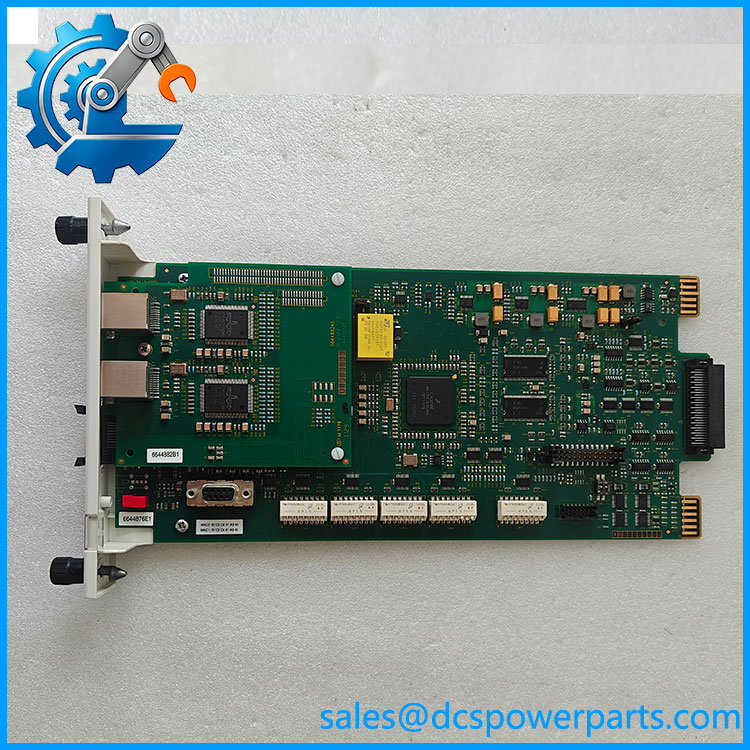
INIET800
Related Products
These components appear in the same communication architecture or related product family; they are not automatic substitutes.
- INNIS21 — Network interface module shown in ABB’s Symphony Plus communication architecture.
- SPIET800 / IET800 — Related Symphony Plus naming for the INFI-NET-to-Ethernet transfer function; verify the specific ordering code and revision.
- NTCL01 — Termination unit shown for INFI-NET cabling in the documented arrangement.
- NTMP01 — Termination unit shown for serial communication connections.
- NKPL-series cables / NKCL-series cables — Twinaxial or coaxial cable families shown in the architecture documentation; confirm the installed cable type and required length.
Frequently Asked Questions
Q1: What is the ABB INIET800 used for?
It transfers information between an ABB Bailey INFI-NET control network and compatible Ethernet-based supervisory or engineering systems.
Q2: Is the compatible with every ABB DCS?
No. Compatibility depends on the control-system family, communication architecture, module revision, associated hardware, and software version. Confirm the installed system before ordering.
Q3: Which software environments are documented for the architecture?
ABB’s published material lists Composer 5.1, S+ Operations, System 800xA SV5.1 revision A, and Harmony OPC Server. Confirm the exact version requirements for the plant in question.
Q4: Can I replace an with an SPIET800?
The SPIET800 is described by a specialist product catalog as a Symphony Plus version of the Bailey INFI 90 . Still, confirm the full part number, revision, and system compatibility before treating it as an approved replacement.
Q5: What should I check if Ethernet communication fails after replacement?
Check the module and termination-unit seating, cabling, Ethernet link status, network settings, host-side configuration, and communication diagnostics. Compare the replacement against the original configuration before changing network parameters.
Q6: Does the support modern network security requirements?
Do not assume that it does. The cited legacy architecture document mentions TLS 1.0 and SSL 3.0. Review the actual firmware and configuration against the plant’s current cybersecurity requirements before connecting it to a production network.
Q7: What should I request when buying a used or refurbished module?
Ask for the complete nameplate, revision details, connector photographs, condition disclosure, and documented functional-test results. Confirm return terms and whether testing covers only basic power-up or actual communication with compatible hardware.
Procurement Recommendation
For the ABB , prioritize compatibility with the installed Bailey INFI-NET architecture over general Ethernet specifications. Verify the module revision, termination units, cable arrangement, host software, and current cybersecurity constraints before purchase. For a critical process-control network, request traceable inspection and functional-test evidence rather than relying solely on a supplier’s “tested” or “working” description.