Description
Product Overview
The ABB Bailey IMSED01 is a Sequence of Events (SOE) digital input module designed for the INFI 90 and Harmony control-system family. It collects changes in discrete field signals and makes those events available to the controller for sequence-of-events processing. In a process plant, this capability helps engineers reconstruct the order of equipment status changes during trips, interlocks, shutdowns, and other abnormal operating conditions. Unlike a general-purpose digital input module used only for current status monitoring, the IMSED01 is intended for applications where the chronological order of input transitions is important. ABB documentation specifies support for up to 16 digital field inputs.
The IMSED01 communicates with its Harmony controller over the I/O expander bus and uses function code 242 for configuring and accessing SOE digital input channels. It does not provide the time-synchronization-link processing found in the related IMSET01 module. ABB documentation states that up to 63 IMSED01 modules can operate on an I/O expander bus segment alongside one IMSET01, subject to the applicable system configuration. Field wiring uses the NTDI01 termination unit. These dependencies matter when replacing a module in an established installation: the controller configuration, bus arrangement, termination hardware, and SOE application logic must all match the installed design.
For maintenance and procurement teams, the ABB Bailey IMSED01 is most relevant when preserving an existing INFI 90/Harmony SOE system. Before ordering, compare the full module designation and faceplate label with the installed unit, then confirm the required input voltage, termination arrangement, and system documentation. Do not treat IMSED01 and IMSET01 as interchangeable simply because both belong to the SOE family. The handles digital events; the IMSET01 also handles time-synchronization-link information. Confirm the condition and test history of the specific supplied unit separately from its catalog identity.
Product Introduction
When an equipment trip occurs, the order of digital status changes can be as important as the final alarm state. The ABB Bailey captures up to 16 digital field inputs for SOE processing within compatible INFI 90/Harmony systems, supporting event analysis and fault investigation.
For replacement projects, verify input voltage, termination hardware, controller function-code configuration, and bus capacity before installation. These checks help preserve the existing event-recording design rather than introducing a mismatch during maintenance.
Key Technical Specifications
| Parameter | Specification |
|---|---|
| Manufacturer | ABB Bailey |
| Model | |
| Product Description | Sequence of Events Digital Input Module |
| System Family | INFI 90 / Harmony |
| Maximum Digital Inputs | 16 |
| Supported Input Voltages | 24 VDC, 48 VDC, 125 VDC, 120 VAC under documented conditions |
| Operating Power | +5 VDC, ±5% |
| Typical Power Consumption | 350 mA |
| Maximum Power Consumption | 500 mA |
| Minimum Turn-On Voltage | 21.6 V at 24 VDC; 43.2 V at 48 VDC; 112.5 V at 125 VDC; 108 V at 120 VAC |
| Maximum Turn-Off Voltage | 10 V at 24 VDC; 20 V at 48 VDC; 50 V at 125 VDC; 50 V at 120 VAC |
| Typical Input Current | 5 mA at 24 VDC; 4 mA at 48 VDC; 4 mA at 125 VDC; 5 mA at 120 VAC |
| Typical Response Time | DC fast: 1.1 ms; DC slow: 18 ms; AC: 5 ms after the first positive half-cycle |
| Input Isolation | 350 V channel-to-channel; 1,000 V channel-to-system, as documented |
| Controller Interface | I/O expander bus |
| SOE Configuration | Function code 242 |
| Mounting | One standard module mounting-unit slot |
| Ambient Temperature | 0°C to 70°C |
| Humidity | Noncondensing; limits vary with ambient temperature |
| Field Termination | NTDI01 termination unit |
Specifications are drawn from the available documentation. The 120 VAC input option is described in the manual as applicable only for system control logic; confirm the intended use and wiring details against the original system manual before applying AC signals.
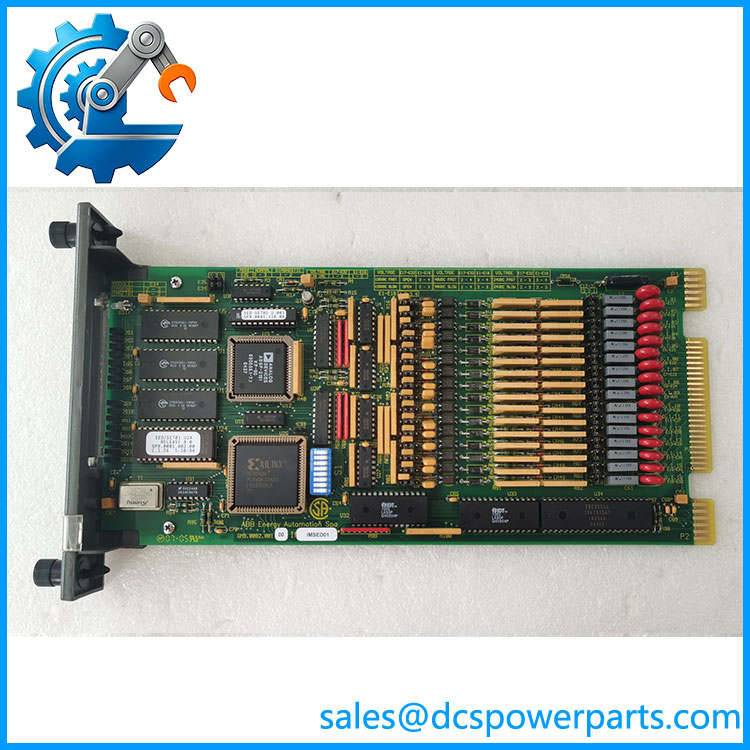
IMSED01
Related Products
- IMSET01 — Sequence of Events Timing module; handles digital inputs and time-synchronization-link information.
- INSEM01 — SOE master module; collects, sorts, and processes event data for presentation to the operator interface.
- INTKM01 — Time Keeper module; manages system event time and can receive external IRIG-B time information.
- NTDI01 — Termination unit for field wiring.
- NTST01 — Time-synchronization-link termination unit used with the SOE timing architecture.
- SPSED01 — Associated newer Symphony Plus designation listed for the family; verify system-specific replacement compatibility before ordering.
- INNIS01 — Network interface module used in the broader Harmony SOE architecture.
- INFI 90 I/O Expander Bus components — Relevant when reviewing bus capacity, module placement, and controller compatibility.
These products serve different roles in the event-recording architecture. They should be selected according to the original system configuration, not merely because their model names are associated with SOE.
Frequently Asked Questions
Q1. What does the ABB Bailey module do?
It collects up to 16 digital field-input transitions for sequence-of-events processing in compatible INFI 90/Harmony systems. This allows the control system to evaluate event order during equipment trips, alarms, and other process disturbances.
Q2. What is the difference between and IMSET01?
Both support SOE applications, but their functions differ. The processes digital field inputs without handling time-synchronization-link information. The supports digital inputs and also processes time-synchronization information. The correct choice depends on the original system architecture.
Q3. Can I use the with 24 VDC, 48 VDC, or 125 VDC field signals?
The documentation lists all three DC input options, as well as a 120 VAC option under specified conditions. Confirm the actual input configuration, signal thresholds, and wiring requirements before connecting field circuits.
Q4. Can I hot-swap the while the control system is operating?
Do not assume live replacement is permitted. The procedure depends on the installed INFI 90/Harmony configuration and plant maintenance rules. Follow the approved isolation and replacement procedure, especially where SOE records support trip analysis or safety investigations.
Q5. Does replacing the require function-code or application changes?
It may not require changes if the replacement is equivalent and the existing configuration remains valid. However, verify function code 242, channel assignments, input voltage settings, controller recognition, and event processing after replacement. A hardware match alone does not confirm that the application will record events correctly.
Q6. How do I verify that a supplied is genuine and functional?
Check the model label, board condition, connector condition, and traceability information. Request any available inspection or functional-test report, including the scope of testing. A visual inspection cannot confirm that all input channels or SOE functions work correctly.
Q7. Is a new-surplus guaranteed to be factory-sealed?
No. New-surplus status does not automatically mean the module remains in its original sealed packaging. Confirm the actual condition, whether the unit has been previously installed, available test records, warranty terms, and return conditions before purchase.