Description
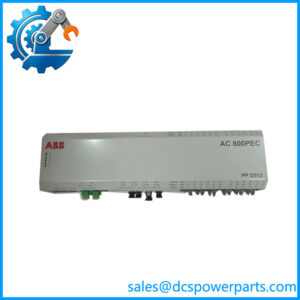
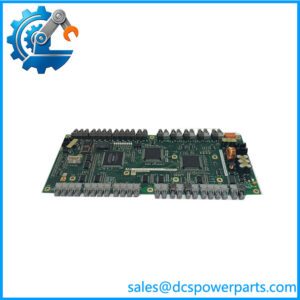
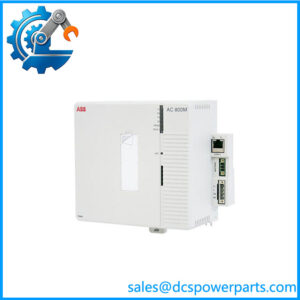
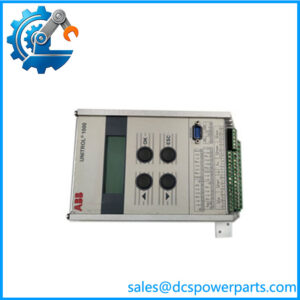
ABB CPM810 Common Processor Module
Product Introduction
When an 800 Series turbine controller needs a processor replacement, the critical issue is not simply finding a board marked CPM810. The module is the computing and communication element shared by ABB’s AS800 Auto Synchronizer, TP800 Turbine Protection, and VP800 Valve Positioner architectures. It executes the application software and communicates with the plant control system through Profibus DP.
The CPM810 plugs into the TBU810 Termination Base Unit together with the application-specific module. In TP800, that companion is TPM810; in VP800 it is VPM810; in AS800 it is ASM810. ABB documentation identifies the CPM810, TBU810, and ROM810 as common components across these turbine products, which is useful when managing spares across multiple turbine-control functions.
Key Technical Specifications
| Parameter | Specification |
|---|---|
| Product Model | CPM810 |
| Manufacturer | ABB |
| Product Family | 800 Series Turbine Modules |
| Product Type | Common Processor Module |
| Primary Function | Application processing and Profibus DP communication |
| Processor | MCF5272, 25 MHz |
| Flash Memory | 16 MB |
| DRAM | 16 MB |
| System Communication | Profibus DP |
| Operating Voltage | +24 VDC ±5% |
| Typical Current | Approximately 0.21 A for the module without field I/O |
| Maximum Current | Approximately 0.30 A |
| Typical Consumption | Approximately 5.0 W |
| Maximum Consumption | Approximately 7.2 W |
| Module Mounting | Plug-in slot on TBU810 |
| Associated Base | TBU810 Termination Base Unit |
| Typical System Applications | AS800, TP800, VP800 |
The processor, memory, communications, and electrical figures above come from ABB’s Symphony Plus 800 Series turbine-control documentation. The catalog specifies the MCF5272 at 25 MHz with 16 MB Flash and 16 MB DRAM, Profibus DP system communication, and +24 VDC ±5% supply architecture.
Major Features / Advantages
Common processor architecture across three turbine functions
The biggest practical advantage of the CPM810 is architectural commonality. ABB designed the 800 Series turbine products around a shared processor platform. The same is used with the application-specific TPM810, VPM810, or ASM810, while the TBU810 provides the physical termination and module interface. This reduces the number of processor types that have to be maintained as turbine-control spares.
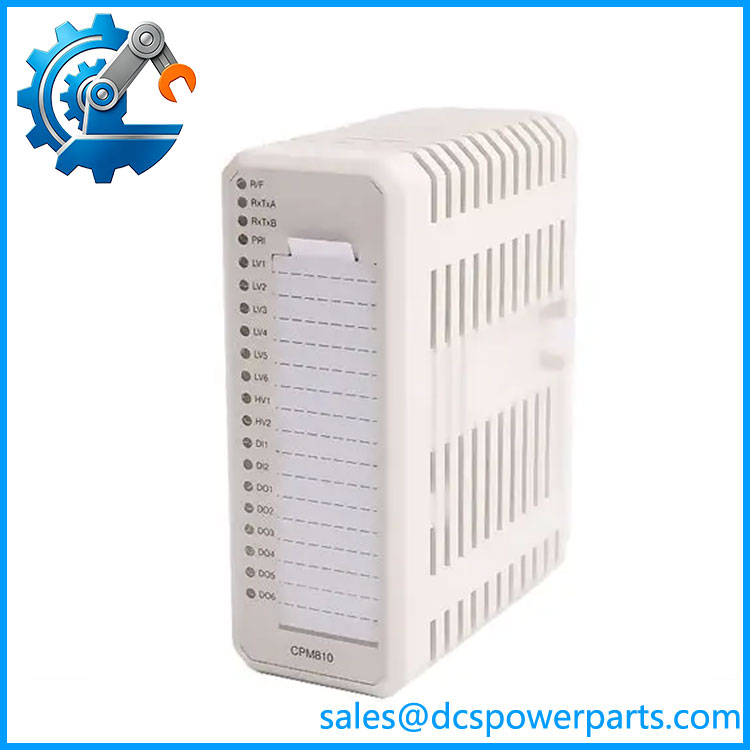
CPM810
Dedicated application processing
The is responsible for executing the software algorithms associated with the installed turbine application. It should therefore be viewed as the computational core rather than as a generic I/O card. The application module handles the function-specific field signal work. For example, TPM810 establishes the TP800 protection function, while VPM810 is used for valve positioning and ASM810 for automatic synchronization.
Profibus DP communication
Profibus DP is the documented system communication interface for the 800 Series turbine architecture. The provides the communication function between the turbine module assembly and the master control system. This matters during replacement because the processor module is not just exchanging internal signals with its application module; its configured communication identity is part of the operating system architecture.
TBU810-based modular construction
The is designed to plug into the . ABB’s catalog specifies that each module occupies one slot in the termination base, while the provides the termination interface for power, field wiring, and communications. This construction makes the processor physically replaceable without replacing the entire turbine-control assembly.
Suitable for redundant turbine-control architectures
The participates in larger architectures where multiple turbine modules can be installed for redundancy. For TP800, ABB documentation describes configurations using multiple TP800 modules according to the required protection architecture, including 2oo3 arrangements. The SIL claim applies to the certified system configuration—not to an isolated sitting on a workbench.
Firmware is a procurement issue
Revision control deserves more attention than the generic part number suggests. ABB documentation records different hardware revisions and firmware releases, including hardware Rev. 2.0 in the 800 Series firmware history. ABB material also identifies a later Rev. 2.1 / firmware 4.2 combination. A replacement should therefore be checked against the installed hardware revision and firmware requirements rather than ordered solely from the label “.”
Application Scenarios & Field Pain Points
Turbine Protection —
In , the works with TPM810 and to form the turbine-protection assembly. The architecture supports functions such as overspeed trip, overspeed protection, trip anticipation, load-drop anticipation, and power-load-unbalance functions. ABB documentation identifies the platform as safety-certified, but the certification applies to the defined system configuration and engineering conditions.
Valve Positioning — VP800
For valve-positioning applications, works with VPM810 and . The VP800 controls turbine inlet-valve positioning, with the processor handling application algorithms and Profibus DP communication while the application module handles the relevant field interfaces.
Automatic Synchronization — AS800
The AS800 combines , ASM810, and . The processor executes the automatic-synchronization software while ASM810 receives and digitizes the relevant field inputs. The architecture can interface with ROM810 relay output modules for application-specific outputs.
Legacy turbine-control maintenance
For maintenance teams supporting older Symphony Plus turbine installations, can be a strategic spare because the same processor platform appears in several 800 Series turbine products. The practical issue is configuration matching: processor revision, firmware, Profibus address/configuration, application module, and interface all need to be considered before installation.
Related Products
- — Termination Base Unit that houses and the application module and provides system termination.
- TPM810 — Turbine Protection Module used with to form .
- VPM810 — Valve Position Module used with to form VP800.
- ASM810 — Auto Synchronization Module used with to form AS800.
- ROM810 / ROM810v2 — Relay output modules used for additional digital relay outputs.
- ROM830 — Used with ROM810v2 in 2oo3 voting arrangements.
- EIM810 — Additional input/output expansion module for applicable 800 Series configurations.
- PCM810 — Phase Current Module used where generator-current measurements are required for power-load-unbalance calculations.
- SIM810 — Firmware upgrade module for and certain standalone configurations.
Engineer’s Guide — Field Pitfalls to Avoid
1. Do not treat every as firmware-equivalent.
The part number alone is not enough for a safety-related turbine application. ABB’s historical firmware documentation shows multiple hardware revisions. Record the installed processor revision and firmware before ordering a spare.
2. Verify the application module.
A does not define whether the assembly is , , or . The companion TPM810, VPM810, or determines that application. Installing the correct processor into the wrong application architecture does not create a valid replacement system.
3. Check the Profibus configuration.
The processor communicates with the control system through Profibus DP. Configuration and addressing therefore need to be preserved or correctly restored during replacement. Do not assume a processor pulled from another turbine has the same communication identity.
4. Inspect the before blaming the processor.
The provides the physical interface for the and application module. Oxidized contacts, damaged locking hardware, loose termination wiring, or a mechanically compromised base can produce symptoms that look like processor failure.
5. Do not transfer a SIL rating to the spare module itself.
ABB documents SIL3 certification for the turbine-protection system/configuration. That should not be interpreted as ” alone is a SIL3 device.” The complete certified architecture, application, configuration, and engineering controls matter.
6. Confirm the physical revision from the nameplate.
If procurement documentation lists only “,” request photographs of the actual label and board revision when possible. This is especially important for legacy spares where visually similar modules may represent different hardware or firmware generations.
FAQ
Is ABB a PLC CPU?
Not in the conventional standalone PLC sense. is the Common Processor Module for ABB’s 800 Series turbine-control architecture. It executes the application software and provides Profibus DP communication, but it operates as part of a modular turbine-control assembly with and an application-specific module.
What systems use the ?
The is used as a common processor in Auto Synchronizer, Turbine Protection, and Valve Positioner configurations. ABB documentation specifically identifies as common hardware across these three turbine products.
Can be installed without ?
The intended architecture uses as a plug-in module on the Termination Base Unit. The provides the physical and electrical termination interface for the processor and application module, so a loose should not be treated as a complete functioning turbine-control assembly.
Does communicate through Ethernet?
The documented 800 Series turbine architecture identifies Profibus DP as the system communication method. I would not specify Ethernet as a standard interface unless the exact hardware revision and documentation for the installed system confirm it.
What processor and memory does use?
ABB’s Symphony Plus catalog identifies the processor as an MCF5272 at 25 MHz, with 16 MB Flash and 16 MB DRAM for the 800 Series turbine-control architecture.
Can I use a from a different turbine application?
The shared architecture makes common across , , and , but that does not mean every physical spare is automatically interchangeable without configuration checks. Verify hardware revision, firmware, application-module compatibility, Profibus configuration, and the target before installation.
What should I verify before purchasing a replacement ?
At minimum, request the complete model marking, hardware revision, firmware information if available, physical connector/board condition, and photographs of the actual module. For a running turbine application, also compare the existing application module and configuration. “” alone is not sufficient information for a controlled replacement.
Procurement Note
For legacy turbine-control spares, the expensive mistake is usually not buying the wrong brand—it is buying the right family with the wrong revision or firmware state. For , match the processor revision to the installed 800 Series configuration and treat the /application module combination as part of the compatibility check. Actual inventory condition should be verified before purchase, particularly for older removed-from-service modules.