Description
Key Technical Specifications
| Parameter | Specification |
|---|---|
| Manufacturer | ABB |
| Model | AX722F |
| Order Number | 3BDH000377R0001 |
| Hardware Designation | AX 722F Rev. A |
| Product Type | Analog input/output module |
| I/O Family | S700 |
| Total Channels | 16 |
| Analog Inputs | 8 channels |
| Analog Outputs | 8 channels |
| Input Signal Types | ±10 V, 0/4–20 mA, supported RTD measurements |
| Output Signal Types | Voltage and current, depending on channel and configuration |
| Voltage Output Range | −10 to +10 V |
| Current Output Range | 0–20 mA or 4–20 mA on supported channels |
| Resolution | 12 bits plus sign |
| Supply | 24 VDC |
| Power Consumption | 5 W in the original catalog specification |
| Terminal Unit | TU 715F or TU 716F |
| System Integration | PROFIBUS remote I/O or direct I/O for AC 700F / AC 900F |
| Software Requirement | Freelance 2013 SP1 RU04 or later, per the cited catalog |
| Protection Rating | IP20 |
| Operating Temperature | 0°C to +60°C |
| Dimensions | Approximately 67.5 × 76 × 54 mm (W × D × H) |
Configuration note: The AX722F does not provide eight freely interchangeable analog outputs. Its output arrangement includes four channels configurable for voltage or current and four additional voltage-output channels. Confirm the terminal assignment and signal ranges against the installed hardware documentation before wiring.
Application Scenarios & Pain Points
A failed analog channel can be more disruptive than its physical size suggests. A missing transmitter reading may invalidate a control sequence, while an incorrect output signal can leave a valve or drive command outside its intended operating range. The AX722F consolidates measurement and output functions, but correct channel configuration remains essential.
- Petrochemical processing: Acquire pressure, flow, and temperature signals while sending analog commands to compatible control equipment. Verify the input type and engineering-unit scaling for each instrument.
- Water and wastewater treatment: Monitor supported process transmitters and RTD sensors while generating control signals for compatible valves and other modulating equipment.
- Power generation and utilities: Integrate analog measurements and control references into an existing Freelance or supported PROFIBUS-based architecture.
- Legacy control cabinet maintenance: Replace a failed module without redesigning the whole I/O arrangement, provided the existing terminal unit, controller, software, and channel configuration are compatible.
Field note — replacement under time pressure: If a process signal disappears after an AX722F failure, installing another module is only the first step. Compare the old and replacement part numbers, inspect the terminal connections, verify the channel configuration, and check live readings against a known field signal before returning the loop to automatic control. This is a recommended commissioning procedure, not a claim about a specific customer installation.
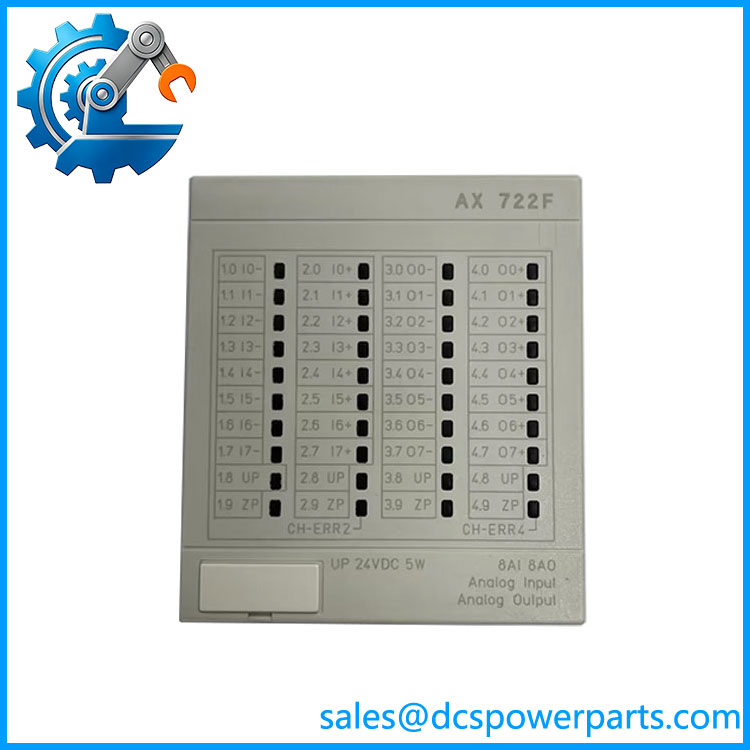
AX722F 3BDH000377R0001
Related Products
The following ABB S700 modules and accessories are relevant when maintaining or expanding an AX722F installation. They are not all direct substitutes; confirm the required signal types and hardware configuration before selecting an alternative.
- ABB AX722F — 3BDH000377R0001: The combined analog I/O module itself. Appropriate when the application requires both analog inputs and analog outputs in one module.
- ABB AI723F — 3BDH000376R0001: A dedicated analog input module with 16 input channels. Consider it when the application is measurement-heavy and does not require analog outputs on that module.
- ABB AO723F — 3BDH000384R0001: A dedicated 16-channel analog output module. Suitable for applications with a higher output-channel requirement; its output configuration differs from the .
- ABB DC732F — 3BDH000375R0001: A digital input/output module for discrete signals. Use it for on/off status and control rather than continuous analog measurements.
- ABB DX722F — 3BDH000383R0001: Combines eight digital inputs with eight relay outputs. It serves discrete switching applications, not analog signal conditioning.
- ABB DA701F — 3BDH000371R0005: A mixed digital and analog I/O module combining several signal types. It may suit compact mixed-signal applications, but its channel layout is different from the .
- ABB TU715F: A terminal unit specified for use with the . Confirm the exact installed version and terminal arrangement before reusing it.
- ABB TU716F: An alternative terminal unit specified for the . Verify the cabinet wiring and applicable hardware documentation before treating it as interchangeable with TU715F.
The Engineer’s Guide: Field Pitfalls to Avoid
Warning 1 — Firmware and software revision mismatch
The documentation identifies Freelance software version 2013 SP1 RU04 or later as a requirement for the documented configuration. A replacement that fits physically may still be unsuitable if the engineering environment cannot configure or recognize it correctly.
How to avoid it:
- Record the controller model and installed Freelance software revision.
- Verify the replacement’s complete order number and hardware revision.
- Confirm that the project configuration supports the replacement before removing the operating module.
Warning 2 — Incorrect terminal unit or wiring
The is specified for TU715F or TU716F terminal units. The two should not be assumed interchangeable in every cabinet without checking the hardware documentation. Incorrect terminal assignments can misroute signals or prevent commissioning.
How to avoid it:
- Read the terminal-unit label before disconnecting any wiring.
- Photograph and label the conductors before removal.
- Check the terminal diagram and channel assignments against the replacement documentation.
- Never assume a matching connector guarantees matching electrical assignments.
Warning 3 — Incorrect channel configuration or signal range
The has eight analog inputs and eight analog outputs, but the output channels do not all support the same signal types. A current-output instrument connected to a voltage-only channel, for example, will not operate as intended. The module also does not provide channel-to-channel potential separation.
How to avoid it:
- Record each channel’s configured signal type and range.
- Check the field device’s wiring requirements and load before energizing outputs.
- Use appropriate isolation where differences in ground potential or circuit design require it.
- Apply ESD precautions when handling the module; avoid touching exposed contacts and store removed electronics in suitable antistatic packaging.
Frequently Asked Questions (FAQ)
1. Can I replace an ABB 3BDH000377R0001 with another directly?
Often, yes, provided the replacement matches the required hardware specification and is supported by the installed controller and software. Check the full order number, hardware revision, terminal unit, and channel configuration first. A physically compatible replacement is not automatically a verified drop-in replacement.
2. Does the support both 4–20 mA inputs and outputs?
Yes, on supported channels. The module accepts 0/4–20 mA input signals and provides current outputs in the documented ranges. However, the output channel arrangement matters: four channels support configurable voltage or current output, while four additional channels provide voltage outputs. Confirm the individual channel assignments before connecting field wiring.
3. Can I use the with a PROFIBUS remote I/O system?
Yes. The is documented for PROFIBUS remote I/O and direct I/O applications with ABB AC 700F and AC 900F controllers. The complete installation must still meet the relevant controller, bus configuration, terminal-unit, and software requirements. Do not infer compatibility with every PROFIBUS master from protocol support alone.
4. Can I hot-swap the while the system is running?
Do not assume that live removal or insertion is supported. The permissibility of hot swapping depends on the system architecture, hardware configuration, and approved maintenance procedure.
Before replacement:
- Determine whether the affected process can tolerate loss of the module’s I/O.
- Follow the site’s isolation and process-safety procedures.
- Confirm whether the specific installation permits live replacement.
- Verify signal recovery and interlocks before returning the process to automatic operation.
5. How can I verify whether an is new, surplus, or refurbished?
Request evidence tied to the actual unit rather than relying on the listing description alone. Useful checks include:
- Clear photographs of the model and serial-number labels.
- Inspection for damaged connectors, corrosion, contamination, or repaired components.
- A written condition declaration and test report, where applicable.
- Confirmation of which functions were tested and whether the test included analog input and output channels.
A clean exterior does not establish operational condition, and a test report should not be interpreted as proof of factory-new status.
6. What warranty should I expect when buying a replacement ?
Warranty coverage depends on the seller’s written terms and the condition of the specific unit. Confirm the warranty duration, start date, return authorization procedure, exclusions, and whether a failed module will be repaired, replaced, or refunded. For a refurbished unit, ask whether the warranty covers functional failure under the intended operating conditions.
Do not assume that all units carry the same warranty or that a seller’s warranty is equivalent to an OEM warranty.
7. How quickly can I obtain ABB 3BDH000377R0001?
Lead time depends on actual inventory, condition, inspection requirements, and shipping arrangements. A quoted availability date is not the same as a confirmed dispatch date.
For a time-critical plant outage, request written confirmation of:
- Physical stock and the exact part number available.
- The unit’s condition and completed test status.
- Dispatch timing and estimated transit time.
- Warranty terms and the procedure for handling a unit that fails incoming inspection.
For procurement planning, keep the existing module’s terminal unit and configuration records available so compatibility checks do not delay installation after delivery.