Description
ABB AI910N 3KDE175513L9100
Key Technical Specifications
| Parameter | Specification |
|---|---|
| Manufacturer | ABB |
| Model | AI910N |
| ABB Article Number | 3KDE175513L9100 |
| Product Family | S900 I/O |
| Module Designation | AI4 |
| Product Type | Analog Input |
| Number of Channels | 4 |
| Input Signal | 4–20 mA |
| Field Device Type | 2-wire loop-powered transmitters |
| Transmitter Power | Integrated transmitter power supply |
| HART | No |
| Intrinsic Safety | No |
| Channel Redundancy | No |
| Input Isolation | Electrical isolation between input/bus and input/power |
| Input Return | Common return for all inputs |
| Diagnostics | Short-circuit and line-break detection |
| S900 Communication | PROFIBUS DP system architecture |
| Mechanics | S900 |
| Operating Temperature | -20 to +60 °C |
| Relative Humidity | Up to 93% ±3% at 40 °C |
| Corrosive Atmosphere | ISA-S71.04 G3 |
| Width | 20 mm |
| Depth | 104 mm |
| Height | 104 mm |
| Weight | Approx. 0.13 kg |
| Installation Area | Safe/non-hazardous area |
ABB specifies AI910N as a four-channel S900 analog input module with 4–20 mA inputs and transmitter power for loop-powered 2-wire transmitters. ABB also identifies the module as non-HART, non-intrinsically safe, and non-redundant.
The environmental rating is important when selecting between S900 variants. AI910N is the Type N safe-area version; it should not be confused with AI910B or AI910S, which have different hazardous-area characteristics. ABB lists AI910N at -20 to +60 °C, with G3 corrosive-atmosphere capability and dimensions of 20 × 104 × 104 mm.
Product Introduction
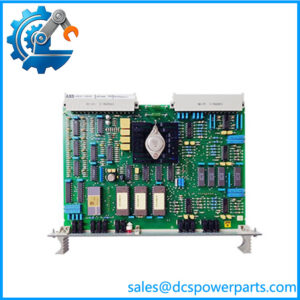
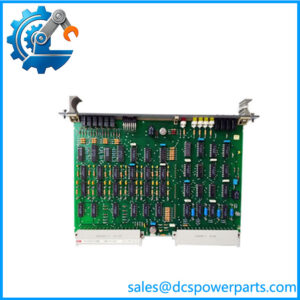
The ABB AI910N 3KDE175513L9100 is a four-channel analog input module in the ABB S900 remote I/O family. Its intended field signals are 4–20 mA from loop-powered 2-wire transmitters, making it suitable for collecting process measurements such as pressure, flow, level, and other transmitter-based variables. The module also supplies the field transmitter loop, reducing the need for a separate transmitter power arrangement.
belongs to the Type N safe-area product group. It is not the intrinsically safe AI910S and does not provide HART communication. This distinction matters during replacement because the three modules can look similar at the system level while serving different field-instrument architectures. ABB also specifies short- and line-break detection and electrical isolation between the input/bus and input/power portions of the module.
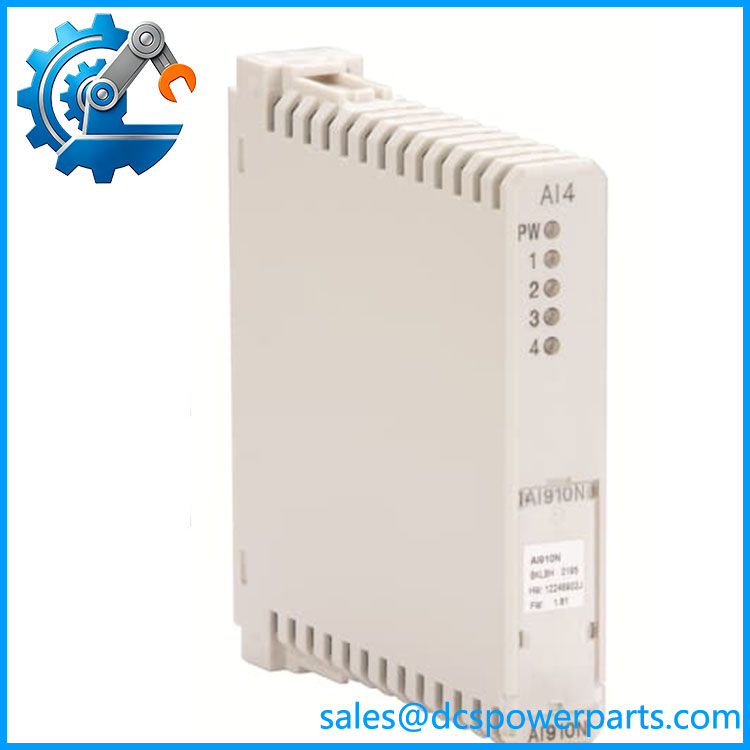
AI910N
Engineering Pain Point
The most common replacement mistake with is selecting the module by signal type alone. A specification such as “4-channel 4–20 mA AI” is not enough. , AI910B, and AI910S all belong to the same analog-input family but have different hazardous-area characteristics. is the non-intrinsically-safe Type N version, while ABB identifies AI910B and AI910S as intrinsically safe variants. If the field loop crosses a hazardous-area boundary, the installed system design must be checked before substituting an .
Typical Applications
- Pressure measurement — Receives 4–20 mA signals from conventional 2-wire pressure transmitters.
- Flow measurement — Interfaces process flow transmitters with the remote I/O station.
- Level measurement — Suitable for 4–20 mA level transmitters where HART communication is not required.
- General process analog acquisition — Used for standard 4–20 mA instrumentation in safe-area installations.
Technical Pitfalls to Avoid
- Do not confuse with AI910S. AI910S is the intrinsically safe version, while is not. Hazardous-area instrumentation requires verification of the complete loop design, not just the I/O signal range.
- Do not substitute AI930N when HART is required. is documented without HART functionality. ABB identifies AI930N as the 4-channel analog input with HART and transmitter power.
- Check the transmitter wiring. is intended for loop-powered 2-wire transmitters. A passive 4–20 mA source belongs to a different input architecture, such as AI931N.
- Verify the station configuration. The module is part of the remote I/O architecture rather than a standalone PLC analog card. The station’s communication interface, mounting arrangement, power architecture, and controller configuration must be compatible.
- Check the complete ABB article number. For procurement, specify 3KDE175513L9100 together with . Do not rely only on the short model designation because the family contains similarly named AI modules.
- Check environmental conditions. ABB lists a maximum ambient temperature of +60 °C and G3 corrosive-atmosphere classification for . Cabinet temperature and chemical exposure should be considered before installation.
Related Products
- ABB AI910B — Four-channel 4–20 mA analog input with intrinsically safe characteristics; not equivalent to the non-IS .
- — Four-channel 4–20 mA analog input for Ex applications; intended for a different hazardous-area architecture.
- ABB AI930N — Four-channel HART analog input with transmitter power; relevant where intelligent transmitter communication is required.
- ABB AI931N — Four-channel HART-capable passive analog input for 0/4–20 mA signals; differs from in transmitter power architecture.
- ABB AI950N — temperature input module supporting RTD and thermocouple signals rather than standard 4–20 mA transmitter inputs.
- ABB AO910N — four-channel analog output module for 0/4–20 mA outputs; it is an output device, not a substitute for .
Procurement Note
For a replacement order, use the complete identification ABB , 3KDE175513L9100. Confirm that the existing station is an Type N safe-area installation, that the field instruments are 4–20 mA loop-powered 2-wire transmitters, and that HART or intrinsic-safety functionality is not required.
For an operating plant, compare the installed module label, station configuration, field termination wiring, transmitter type, and controller configuration before approving the replacement. The short designation identifies the module family, but the ABB article number is the safer procurement reference.