Description
Key Technical Specifications
| Parameter | Specification |
|---|---|
| Manufacturer | ABB |
| Model | AI03 |
| Product Family | Symphony Plus SD Series I/O |
| Product Type | RTD Analog Input Module |
| Number of Channels | 8 |
| Input Signal | RTD |
| Wiring | 2-wire, 3-wire, or 4-wire |
| Supported RTDs | 100 Ω Platinum US Lab/Industry Standard, 100 Ω Platinum European Standard, 120 Ω Nickel, Chinese 53 Ω Copper |
| A/D Resolution | 16-bit with polarity |
| A/D Converters | 4 converters, 2 channels per converter |
| Update Rate | 450 ms for all 8 channels |
| Accuracy | ±0.1% of full-scale range; FSR = 500 Ω |
| HART | No |
| SOE | No |
| Redundancy | No |
| Power Supply | 24 VDC ±10% |
| Typical Current | 68 mA |
| Maximum Current | 76 mA |
| Field-to-Logic Isolation | Galvanic, 1500 V for up to 1 minute |
| Channel Isolation | 1 × 8 group isolated |
| Maximum Field Cable Length | 600 m / 1968 ft |
| Open-Circuit Detection | <5 seconds |
| Normal-Mode Noise Rejection | ≥70 dB |
| Common-Mode Noise Rejection | ≥90 dB |
| Operating Temperature | -40°C to +70°C |
| Storage Temperature | -40°C to +85°C |
| Protection Rating | IP20 |
| Form Factor | Standard, 190 mm |
| Mounting | Horizontal row or vertical column |
| Compatible MTUs | HBS01-CJC, VBS01-CJC |
ABB’s current hardware selector lists AI03 as an active 8-channel RTD analog input module with 2/3/4-wire capability, 16-bit conversion, 450 ms eight-channel update time, and ±0.1% full-scale accuracy.
The module’s supported RTDs are specifically documented by ABB; this is not a general-purpose 4–20 mA analog input card. The HBS01-CJC and VBS01-CJC mounting bases are the relevant MTUs for AI03.
Application Scenarios & Pain Points
RTD measurement looks simple on a wiring diagram. In the field, three-wire compensation, sensor type, cable resistance, and terminal quality can all affect the final temperature value. A replacement card therefore needs to match the sensor architecture, not merely the number of channels.
- Process temperature monitoring: Used for temperature measurement in process equipment, vessels, heat exchangers, and related plant assets.
- Power generation: Suitable for RTD-based monitoring of bearings, auxiliary equipment, and process temperatures where the Symphony Plus architecture is used.
- Industrial process control: Eight independently configurable channels allow different supported RTD types to coexist within the same module.
- Remote instrumentation: The module supports field cable runs up to 600 m, subject to the actual installation and signal-quality requirements.
Field note: If one RTD channel is unstable while the remaining seven are normal, check the sensor and three-wire/ four-wire termination before replacing the AI03. A damaged lead can mimic an input-channel fault.
Brief Field Case
A plant technician replacing an AI03 may find that the replacement module passes a bench test but gives an incorrect temperature after installation. The root cause can be a sensor configured as a 3-wire RTD while the field wiring was terminated incorrectly. Recording the original wiring and sensor type before removal is cheap insurance.
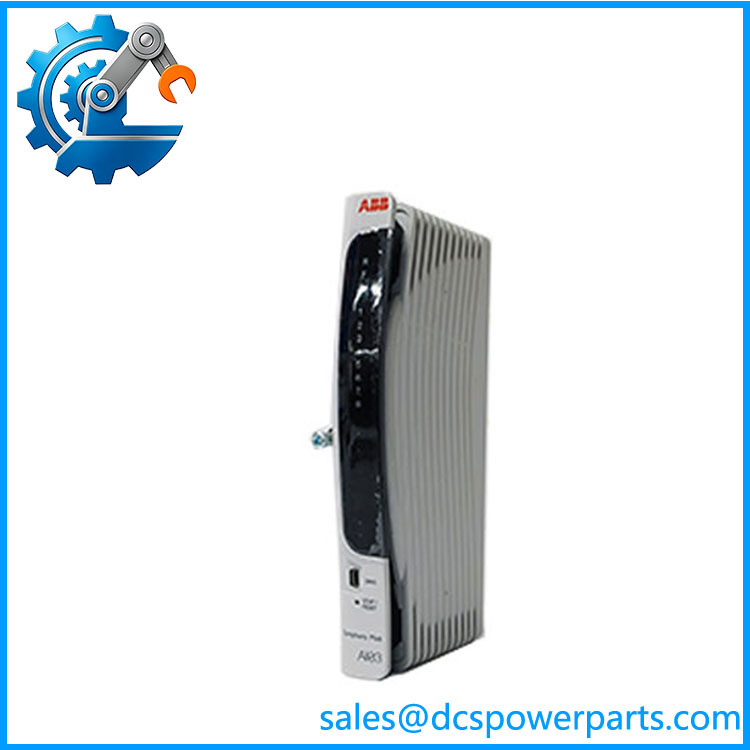
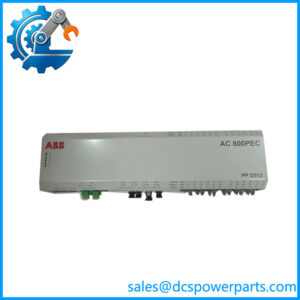
AI03
Related Products
- ABB AI03 — The subject 8-channel RTD input module. Designed specifically for supported RTD temperature sensors in the Symphony Plus SD Series.
- ABB AI04 — 16-channel thermocouple/millivolt analog input module. It handles TC and mV signals rather than RTDs, so it is complementary rather than a direct substitute. ABB specifies the same HBS01-CJC/VBS01-CJC base family.
- ABB AI01 — 8-channel analog input module for voltage/current-type signals. It is intended for conventional analog process signals rather than direct RTD measurement.
- ABB AI02 — 8-channel HART analog input module. It provides 4–20 mA/HART capability and should be selected when intelligent field transmitters are required rather than passive RTD sensors.
- ABB AI05 — 8-channel HART analog input module with additional channel-level isolation and dedicated HART/A/D resources. It belongs to the same SD Series but serves a different signal type.
- ABB HBS01-CJC — Horizontal mounting/termination unit compatible with and AI04. ABB identifies it as a full-size 190 mm MTU.
- ABB VBS01-CJC — Vertical mounting base for singular and AI04 modules. It provides the corresponding RTD/TC field connections for the vertical arrangement.
- ABB VBS01-EPD — Vertical SD Series MTU for several conventional analog, digital, and pulse I/O modules, but . This distinction matters when replacing the base.
The Engineer’s Guide: Field Pitfalls to Avoid
WARNING 1 — Do not use for 4–20 mA transmitter signals.
is an RTD input module. AI01/AI02/AI05 are the more relevant SD Series choices for conventional analog current/voltage or HART signals.
How to avoid it: Identify the actual field sensor first. If the instrument is a 4–20 mA temperature transmitter, is not the appropriate input card.
WARNING 2 — Three-wire RTD wiring errors can look like module failure.
RTD accuracy depends heavily on correct lead compensation and termination.
How to avoid it: Photograph the existing terminal arrangement before removing the module. Confirm the sensor type and 2/3/4-wire configuration in the Symphony Plus configuration, then verify resistance at the field terminals.
WARNING 3 — Check the MTU before ordering the replacement.
ABB specifies HBS01-CJC and VBS01-CJC for . The VBS01-CJC specifically supports singular and AI04 modules.
How to avoid it: Do not substitute an apparently similar SD Series MTU. ABB uses keyed mounting interfaces to ensure the correct module/base combination.
Frequently Asked Questions (FAQ)
What is ABB ?
ABB is an 8-channel RTD analog input module for the Symphony Plus SD Series I/O system. It accepts 2-, 3-, and 4-wire RTD signals and converts them into digital values for the control system.
Which RTD types does ABB support?
supports:
- 100 Ω platinum, U.S. laboratory/industry standards
- 100 Ω platinum, European standard
- 120 Ω nickel
- Chinese 53 Ω copper
Each input channel can be independently configured for the supported RTD type.
Is ABB a HART analog input?
No. ABB lists with HART = No. It is an RTD input module. If the application requires 4–20 mA HART communication, an SD Series module such as AI02 or AI05 is the more appropriate category.
What is the resolution and update time of ?
The module provides 16-bit A/D resolution with polarity. Four A/D converters serve the eight inputs, and ABB specifies an update time of approximately 450 ms for all eight channels.
This is an important distinction from the individual conversion time of a single channel; the 450 ms figure is for updating the complete eight-channel set.
Which terminal base is compatible with ABB ?
ABB specifies HBS01-CJC and mounting bases for . is the horizontal-row option, while is the vertical-column option.
Do not assume another SD Series MTU will accept simply because the physical dimensions look similar.
Can ABB be used in a redundant configuration?
The ABB hardware selector lists Redundancy: No for .
If the control application requires redundant temperature measurement, that requirement needs to be addressed at the system and instrumentation level rather than assuming two modules constitute an approved redundant architecture.
What should I check when purchasing a replacement ABB ?
For a production spare, request:
- Exact identification.
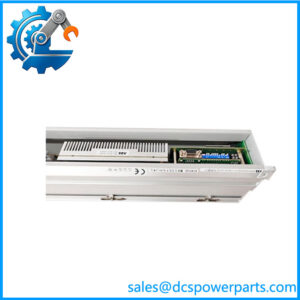
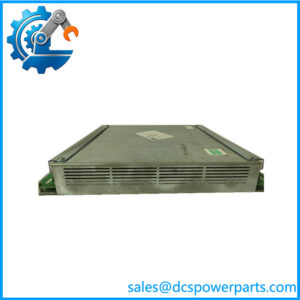
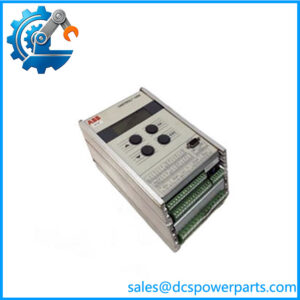
- Clear module photographs.
- Hardware/revision information, where applicable.
- Channel functional test across all eight inputs.
- RTD simulation test using the required sensor ranges.
- Diagnostic/LED verification.
- Connector and terminal inspection.
- MTU compatibility confirmation.
- Condition statement.
- Warranty documentation.
For a used , I would specifically request an 8-channel RTD simulation test. A power-on test alone tells you very little about whether the analog conversion path is actually healthy.