Description
Product Overview
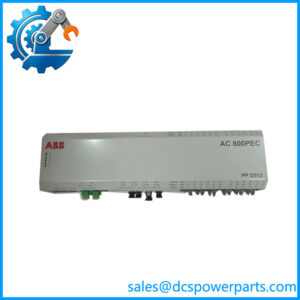
ABB LD 810HSE EX 3BSE091722R1 is a FOUNDATION Fieldbus communication gateway designed to connect H1 field devices with a High Speed Ethernet (HSE) backbone. Within an ABB System 800xA or Freelance automation architecture, the device provides the communication bridge between Ethernet-based supervisory systems and FOUNDATION Fieldbus H1 instruments installed in the process area.
The ABB LD 810HSE EX operates as a fieldbus linking device rather than a controller or traditional I/O module. It manages communication between up to four independent FF H1 segments and one HSE Ethernet interface, allowing field devices such as transmitters, positioners, and intelligent valves to exchange process data, alarms, and diagnostic information with the control system.
The ABB 3BSE091722R1 version is designed for DIN rail installation and supports hazardous-area-oriented fieldbus architectures. The module itself requires an external 24 VDC supply, while the connected H1 links require separate power arrangements. Its EX designation makes it important to verify the installed area classification, certification requirements, and system design before replacement.
For maintenance engineers, the LD 810HSE EX 3BSE091722R1 is a communication-path component. A fieldbus communication failure does not automatically indicate a failed linking device. Network configuration, H1 segment power, terminators, cable quality, device addressing, and host configuration should all be checked before replacement.
Technical Specifications
| Parameter | Specification |
|---|---|
| Manufacturer | ABB |
| Model | LD 810HSE EX |
| Article Number | 3BSE091722R1 |
| Product Type | FOUNDATION Fieldbus Linking Device |
| Communication Role | HSE-to-H1 Gateway |
| Fieldbus Protocol | FOUNDATION Fieldbus HSE / H1 |
| HSE Interface | 1 channel Ethernet HSE |
| HSE Speed | 10/100 Mbps autosensing |
| H1 Interfaces | 4 independent H1 links |
| H1 Speed | 31.25 kbit/s |
| Mounting Type | DIN rail mounting |
| Power Supply | External 24 VDC |
| Protection Class | IP20 |
| Operating Temperature | -40 °C to +70 °C |
| Storage Temperature | -40 °C to +85 °C |
| Humidity Range | 10% to 95% RH, non-condensing |
| Redundancy Support | Yes, with compatible configuration |
| System Compatibility | ABB System 800xA / Freelance environments |
Technical data from ABB describes LD 810HSE EX as supporting one HSE interface and four H1 links, with 24 VDC supply and DIN rail installation.
Main Features and Advantages
FOUNDATION Fieldbus HSE/H1 Conversion
The main purpose of ABB LD 810HSE EX 3BSE091722R1 is protocol conversion and communication management between:
Control System Ethernet Network → HSE → LD 810HSE EX → H1 Fieldbus Segment → Field Devices
This allows multiple FOUNDATION Fieldbus H1 devices to be integrated into modern process control environments.
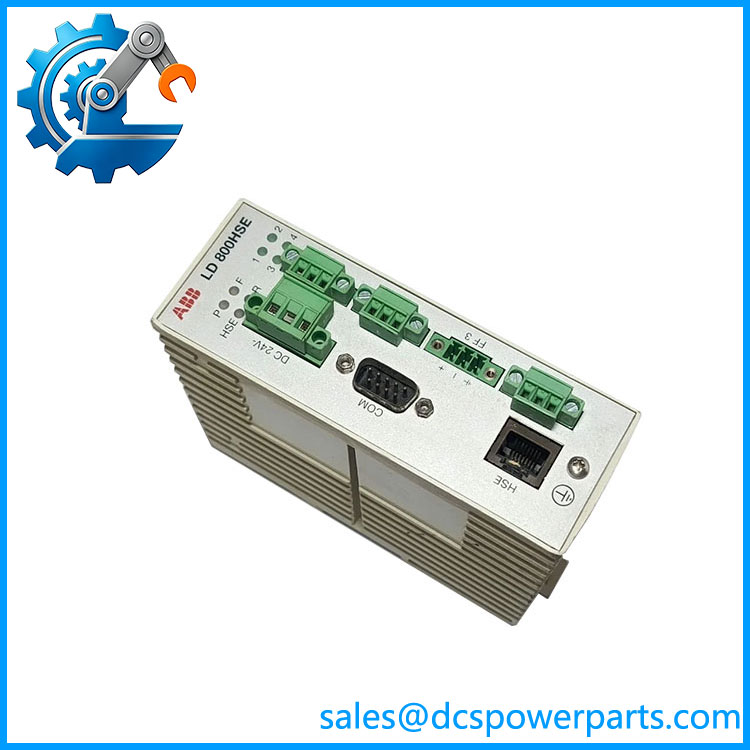
LD800HSE
Four Independent H1 Segments
The module supports up to four separate H1 links. Each H1 channel can operate as a fieldbus segment connection, reducing the need for multiple gateway devices in larger instrument networks.
Typical connected devices include:
- Pressure transmitters
- Flow transmitters
- Temperature transmitters
- Smart valve positioners
- Process analyzers
Link Master and LAS Functions
The LD 810HSE EX operates with FOUNDATION Fieldbus communication functions including Link Master capability and Link Active Scheduler (LAS) operation. This allows scheduled communication between H1 field devices according to FOUNDATION Fieldbus timing requirements.
System 800xA Integration
The module is commonly used as part of ABB process automation systems where FOUNDATION Fieldbus instruments need integration into supervisory control and asset management environments.
Redundancy Capability
The LD 810HSE EX supports redundant configurations when installed according to ABB system requirements. However, ABB specifies that it cannot simply replace one LD 800 linking device inside an existing redundant pair; both devices in that redundant pair must be replaced with LD 810HSE EX units.
Application Scenarios
Process Plant Instrumentation
Common applications include:
- Oil and gas processing
- Chemical plants
- Power generation
- Water treatment
- Pharmaceutical production
FOUNDATION Fieldbus Networks
The module provides connectivity between intelligent field instruments and the automation system.
ABB System 800xA Projects
Typical use includes fieldbus integration within ABB System 800xA architectures.
Remote Field Instrumentation
The LD 810HSE EX can connect distributed field devices located away from the main control system through HSE network infrastructure.
Related Components
- ABB LD 810HSE EX — 3BSE091722R1
FOUNDATION Fieldbus HSE/H1 Linking Device. - ABB LD 800HSE / LD 800HSE EX
Previous-generation HSE/H1 linking devices. - ABB System 800xA Controller and Communication Interfaces
Host-side integration components. - FOUNDATION Fieldbus H1 Instruments
Field transmitters and intelligent process devices connected through H1 segments.
Engineer’s Guide: Field Pitfalls
⚠️ Do Not Treat LD 810HSE EX as an I/O Module
The LD 810HSE EX does not directly read analog or digital field signals.
It is a communication gateway between FF HSE and FF H1 networks.
⚠️ Verify Redundancy Compatibility
A common replacement mistake is installing one LD 810HSE EX into a redundant LD 800 configuration.
ABB specifies that LD 810HSE EX is not suitable for replacing only one device in an LD 800 redundant pair. Both units must be replaced with LD 810HSE EX modules.
⚠️ Check H1 Segment Power
The module requires external 24 VDC power, and H1 links require separate power arrangements.
Before replacement, verify:
- H1 power conditioner status
- Segment voltage
- Terminator installation
- Device current consumption
- Segment wiring
⚠️ Verify Fieldbus Configuration
A replacement module may require verification of:
- HSE IP configuration
- Fieldbus segment mapping
- Device addresses
- Host engineering database
- System 800xA configuration
- Firmware compatibility
⚠️ Do Not Diagnose Only by Communication Alarm
A fieldbus communication fault can originate from:
- Damaged H1 cable
- Incorrect termination
- Excessive segment loading
- Device failure
- Network configuration error
- Power supply problems
The linking device should be tested as part of the complete communication chain.
Frequently Asked Questions
What is ABB LD 810HSE EX 3BSE091722R1?
It is a FOUNDATION Fieldbus HSE/H1 Linking Device used to connect H1 field devices to an HSE Ethernet network.
Is LD 810HSE EX a PLC module?
No. It is a fieldbus communication gateway.
How many H1 channels does it support?
It supports four H1 links and one HSE connector.
What power supply does it require?
The module requires an external 24 VDC power supply. H1 links require separate powering arrangements.
Can LD 810HSE EX replace LD 800HSE EX directly?
Compatibility depends on the system configuration. For redundant LD 800 installations, ABB specifies that both devices in the redundant pair must be replaced with LD 810HSE EX units.
What should be checked when purchasing a replacement?
Request:
- Exact model marking: LD 810HSE EX
- Article number: 3BSE091722R1
- Hardware revision
- Connector condition
- HSE Ethernet test
- H1 communication test
- Redundancy compatibility
- Power-up diagnostic results
- Firmware information
- Test report