Description
MOOG ANIMATICS SM2337D
Product Overview
The Moog Animatics SM2337D is an integrated SmartMotor from the Animatics 2300 Series. Unlike a conventional servo motor that needs a separate servo amplifier and motion controller, the SM2337D combines the motor, drive electronics, motion-control electronics, and encoder into one compact unit. This architecture was developed for machine builders that need coordinated motion without filling a control cabinet with individual servo drives. Animatics documentation identifies the SM2337D as an eight-pole SmartMotor with a nominal continuous power rating of approximately 0.13 kW and a no-load speed of 8,630 RPM.
The Moog Animatics SM2337D uses a NEMA 23 mechanical format and provides 35 oz-in of continuous torque and 110 oz-in of peak torque under the documented test conditions. An integrated 2,000 post-quadrature-counts-per-revolution encoder provides position feedback to the internal motion controller. The result is a self-contained motion axis that can execute motion commands locally rather than depending entirely on a centralized PLC motion module.
From a machine-integration standpoint, the Moog Animatics SM2337D is best understood as a complete motion-control node, not simply as a motor. Depending on the installed communication and firmware configuration, SmartMotors can operate with serial control, standalone SMI programs, or external motion commands. That distinction matters when replacing one in an older machine: matching the shaft and flange is not enough. Firmware, stored motion program, communication method, gearing, limits, and controller configuration can all affect whether the replacement actually behaves like the original axis.
Product Introduction
The usual servo architecture—motor, amplifier, encoder feedback, and motion controller—becomes physically inefficient on compact machines. The puts those functions into one NEMA 23 SmartMotor, with 35 oz-in continuous torque, 110 oz-in peak torque, and a documented 8,630 RPM no-load speed.
For a legacy machine replacement, the important question is not merely whether the replacement motor turns. Verify the SmartMotor firmware, stored SMI program, encoder configuration, communication interface, and mechanical coupling before commissioning.
Key Technical Specifications
| Parameter | Specification |
|---|---|
| Product Model | |
| Manufacturer / Brand | Moog Animatics |
| Product Family | SmartMotor 2300 Series |
| Product Type | Integrated Servo Motor / SmartMotor |
| Motor Configuration | Brushless servo motor with integrated controller and amplifier |
| Motor Frame | NEMA 23 |
| Nominal Supply Context | 48 VDC |
| Continuous Torque | 35 oz-in / 2.188 in-lb |
| Peak Torque | 110 oz-in / 6.875 in-lb |
| Nominal Continuous Power | 0.18 hp / approximately 0.13 kW |
| No-Load / Top Speed | 8,630 RPM |
| Torque Constant | 5.60 oz-in/A |
| Voltage Constant | 5.62 V/kRPM |
| Winding Resistance | 0.6 Ω |
| Encoder Resolution | 2,000 post-quadrature counts/rev |
| Number of Poles | 8 |
| Number of Slots | 12 |
| Rotor Inertia | Approximately 0.00190 oz-in-sec² |
| Face Size | 2.25 × 2.25 in / approximately 57.2 × 57.2 mm |
| Shaft Diameter | 0.250 in / approximately 6.35 mm |
| Bolt Circle | 2.625 in / approximately 66.7 mm |
| Motor Length | Approximately 4.54 in according to legacy dimensional documentation |
| Default Thermal Limit | 70°C |
| Certification | CE certification documented for the SmartMotor family |
The published torque and speed values are nominal engineering values and are subject to the test conditions stated by Animatics. In particular, the documented peak and continuous torque curves were measured at 48 VDC with a specified aluminum mounting plate.
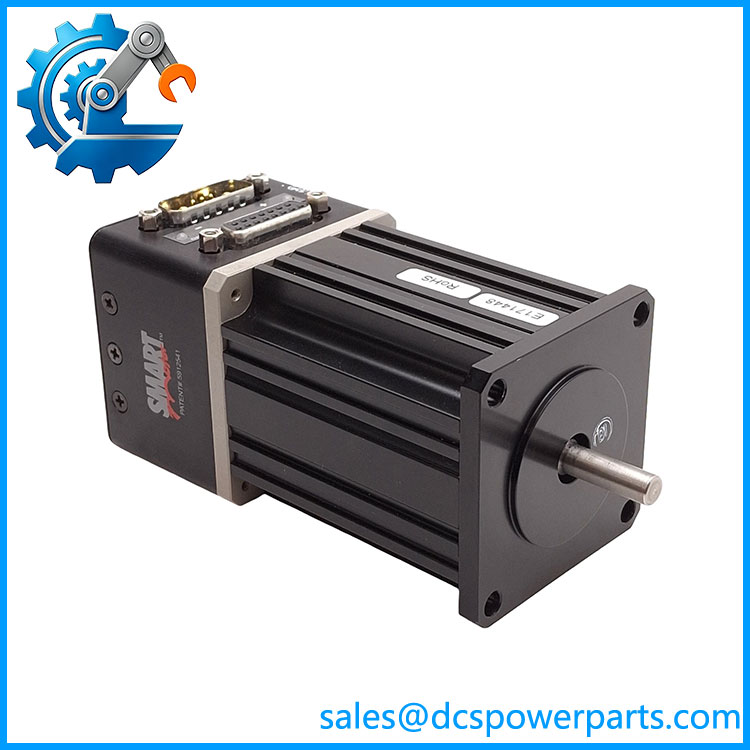
SM2337D
Major Features / Practical Advantages
1. Integrated Servo Architecture
The combines several functions normally separated in a servo system. The motor contains the drive electronics, motion controller, and encoder feedback, reducing the need for a separate cabinet-mounted amplifier.
That can materially simplify compact machine designs. There are fewer power-stage components to mount, fewer motor-to-drive cables, and less cabinet wiring.
The tradeoff is worth stating plainly: the integrated architecture makes the motor more application-specific. A generic replacement servo motor cannot simply be substituted because the contains electronics and firmware that are part of the machine’s control architecture.
2. 35 oz-in Continuous Torque
The documented continuous torque rating is 35 oz-in, equivalent to approximately 2.188 in-lb. Peak torque reaches 110 oz-in under the specified test conditions.
For sizing work, use the actual torque-speed curve rather than treating 110 oz-in as continuously available. The 110 oz-in figure is a peak-duty value, not a continuous operating point.
This distinction becomes important in indexing equipment, feeders, compact rotary stages, dispensing equipment, and other machines with repeated acceleration and deceleration.
3. High-Speed NEMA 23 Package
The has a documented 8,630 RPM no-load speed, considerably higher than many conventional low-speed NEMA 23 stepper applications.
The combination of a relatively compact NEMA 23 mechanical package and integrated servo electronics makes it useful where both physical space and response speed matter.
Actual operating speed under load will be lower than the no-load figure. The torque-speed curve should be used for real machine sizing.
4. Integrated Encoder Feedback
The uses a built-in encoder with 2,000 post-quadrature counts per revolution in the documented SmartMotor specifications.
That feedback is fundamental to the SmartMotor architecture. The internal controller can use encoder position to close the servo loop, detect motion errors, and execute programmed motion.
For replacement work, encoder behavior should therefore not be treated as an interchangeable accessory. The machine’s control software may depend on the SmartMotor’s established position scale and motion parameters.
5. Standalone Motion Capability
Animatics SmartMotors can execute motion programs locally using the SMI programming environment. This allows certain applications to operate without placing every motion calculation inside a PLC.
That architecture can be useful for compact automation systems, indexing mechanisms, laboratory equipment, packaging machinery, and multi-axis machines.
A practical warning for procurement: if the existing contains a customer motion program, do not assume that a replacement motor arrives with the same program. The physical motor and the machine-specific software are separate procurement concerns.
6. Serial Communication
SmartMotor systems support serial communication architectures, including RS-232 and RS-485 configurations depending on the specific product generation and interface arrangement. Animatics documentation also describes daisy-chain arrangements for multiple motors and isolated RS-485 options for applications with higher current spikes or demanding multi-axis environments.
The exact communication hardware and firmware should be verified from the motor’s nameplate and existing system documentation before specifying a replacement.
7. 48 VDC Operating Environment
The published torque data is based on 48 VDC operation. Animatics documentation specifically warns that free-wheeling vertical applications may require a shunt to protect the SmartMotor from overvoltage caused by regenerative back-drive, particularly when the supply is already close to the motor’s 48 VDC input limit.
This is a practical design issue rather than a footnote. Vertical axes, high-inertia loads, and aggressive deceleration can return energy to the DC bus. If the original machine used a braking or shunt arrangement, removing it during a retrofit can create repeat drive faults or damage.
8. Compact NEMA 23 Mechanical Interface
The legacy dimensional drawing shows a 2.25-inch square face, 0.250-inch shaft, four 0.205-inch mounting holes on a 2.625-inch bolt circle, and an overall length of approximately 4.54 inches for the .
These dimensions make the model mechanically recognizable, but dimensional compatibility should not be used as the sole replacement criterion. Shaft extension, coupling geometry, connector orientation, encoder behavior, and stored motion parameters also matter.
9. Thermal Management Matters
Animatics documentation lists a 70°C default thermal limit for the SmartMotor family configuration shown for .
The mounting surface is part of the thermal system. The published torque data was generated using a defined aluminum mounting plate, so an installation with substantially less heat dissipation should not automatically be expected to deliver the same continuous torque.
This is a common retrofit mistake: the motor fits mechanically, but the new mounting arrangement changes the thermal path.
10. Regeneration Must Be Considered
Back-driven loads can generate DC-bus voltage. Animatics explicitly notes the need for a shunt in many free-wheeling vertical applications.
For machines with vertical slides, counterbalanced mechanisms, high reflected inertia, or rapid deceleration, check the original braking strategy before commissioning a replacement. A servo fault that appears to be an electronics problem may actually be a regeneration problem.
Related Products
- SM2316D — Smaller SmartMotor from the same legacy 2300 family; different torque, speed, and mechanical characteristics.
- SM2320D — NEMA 23 SmartMotor with a different motor constant and torque-speed profile; useful for comparison during legacy motion-system replacement.
- SM2330D — Closely related 2300-series SmartMotor with different torque and speed characteristics.
- SM2337DT — Higher-torque variant of the SM2337 platform. Published data lists 59 oz-in continuous torque and 200 oz-in peak torque, but only about 3,800 RPM no-load speed. It should not be treated as a drop-in electrical substitute without checking the application.
- SM2340D — Related 2300-series SmartMotor with a different torque-speed curve and approximately 5,310 RPM no-load speed in the published data.
- — DeviceNet-oriented version of the platform. Communication architecture differs from the standard and must be verified before substitution.
- SM2337DT-DN — DeviceNet version of the higher-torque DT model.
- SM2377DT — Related Animatics SmartMotor model appearing in the manufacturer’s legacy CAD documentation; mechanical and electrical configuration must be checked against the .
FAQ
What is the Moog Animatics ?
The is an integrated SmartMotor servo motor from the Animatics 2300 family. It combines a brushless motor with integrated servo electronics, motion-control functionality, and encoder feedback.
It is therefore more than a conventional NEMA 23 motor.
What are the continuous and peak torque ratings?
The documented ratings are:
- Continuous: 35 oz-in / 2.188 in-lb
- Peak: 110 oz-in / 6.875 in-lb
These values are associated with the published 48 VDC test conditions and mounting arrangement.
Can I use a standard servo drive with the ?
Not in the normal sense. The is designed as an integrated SmartMotor, with the servo amplifier and controller inside the motor assembly.
Replacing the complete SmartMotor with a conventional motor plus external servo drive would therefore be an architectural change, not a simple component replacement.
Can I hot-swap the ?
No unrestricted hot-swap assumption should be made.
The contains powered motor-control electronics, encoder electronics, and control circuitry. Follow the machine manufacturer’s shutdown procedure, isolate the 48 VDC supply, allow the DC bus to discharge, and verify that the mechanical load cannot move unexpectedly before removal.
For vertical axes, mechanical restraint is particularly important.
Does support firmware v3.1?
The model number alone does not establish a particular firmware revision. Some commercial records identify individual units with specific firmware versions, but that information should not be generalized to every .
For a replacement, capture the firmware revision from the existing motor before removal if possible.
Does the replacement motor contain my original motion program?
Do not assume so.
The SmartMotor can execute locally stored SMI programs, but a replacement motor’s stored memory is a separate matter from its mechanical identity. If the machine relies on standalone SmartMotor programming, back up the existing program and configuration before removing the original unit.
Is the same as SM2337DT?
No. The DT version has substantially higher torque but lower maximum speed. Published data gives approximately 59 oz-in continuous / 200 oz-in peak for SM2337DT compared with 35 oz-in continuous / 110 oz-in peak for , while the no-load speed is approximately 3,800 RPM for the DT versus 8,630 RPM for the D version.
Those differences can materially change machine behavior.
Does require a shunt?
Not every application does, but Animatics specifically warns that many free-wheeling vertical applications require a shunt to protect the SmartMotor from regenerative overvoltage.
If the original installation used a shunt or braking arrangement, retain and verify it rather than assuming the replacement motor eliminates the requirement.
What should I verify before buying a replacement ?
For a production machine, verify:
- Complete part number
- Hardware and firmware revision
- Communication interface
- Stored SMI program, if used
- Encoder configuration
- Supply voltage
- Shaft and flange dimensions
- Connector arrangement
- Brake/shunt requirements
- Mechanical load and torque-speed requirements
A photograph of the actual motor nameplate is useful because older SmartMotor variants can have suffixes or application-specific options that are not obvious from the base model.
Procurement Note
The Moog Animatics is a legacy integrated servo system, not merely a NEMA 23 motor. Its published specification includes 35 oz-in continuous torque, 110 oz-in peak torque, 8,630 RPM no-load speed, 2,000 post-quadrature encoder counts/revolution, and approximately 0.13 kW nominal continuous power.
For replacement procurement, the most important check is the complete motor configuration and installed firmware/program, not simply the label. If the motor is used on a vertical or high-inertia axis, also verify the regenerative-energy and shunt arrangement before commissioning.
One more point worth making: older SmartMotor documentation and current reseller descriptions can differ on specifications and firmware. Use the actual nameplate and the applicable Animatics documentation for the specific revision rather than treating every as electrically identical.