Description
Product Overview
The Yokogawa AFV10D-S41201 is a duplexed Field Control Unit designed for Yokogawa CENTUM VP distributed control systems. It executes configured control functions and coordinates communication between the control system and connected field I/O equipment. The AFV10D model is intended for Vnet/IP and FIO architectures and supports 19-inch rack mounting. In process plants, an FCU of this type forms part of the control infrastructure responsible for executing control logic, processing field information, and exchanging data with other system components.
This model’s ordering code identifies a standard-type unit with dual-redundant Vnet/IP communication and dual-redundant power supplies. The 2 power-supply code corresponds to 220–240 V AC, while the final 1 identifies the LFS1500 control function for the Field Control Station. These distinctions are important when matching a replacement to an existing cabinet: similar AFV10D units may have different supply-voltage or control-function selections. Verify the full model code and installed module arrangement rather than selecting by the AFV10D family name alone.
For maintenance and procurement teams, the Yokogawa AFV10D-S41201 should be assessed as part of the installed CENTUM VP system, not as an independent plug-in controller. Processor modules, power-supply modules, field bus couplers, node-unit expansion, software licensing, and controller configuration all affect whether a replacement will operate correctly. Published product references report 32 MB of main memory and a VR5432 processor, but the applicable Yokogawa general specification should be used to confirm hardware details and installation limits. Before ordering, confirm the nameplate, hardware revision, software compatibility, and condition with supplier.
Product Introduction
The Yokogawa AFV10D-S41201 is a duplexed field controller for CENTUM VP process control installations. It supports Vnet/IP communication, FIO field interfaces, and redundant power configuration in a 19-inch rack-mounted assembly.
Its suffix code specifies the power-supply and control-function configuration. Confirm the complete order code and existing system architecture before replacement, particularly where redundant processors and field node units are involved.
Key Technical Specifications
| Parameter | Specification |
|---|---|
| Manufacturer | Yokogawa |
| Model | -S41201 |
| Product type | Duplexed Field Control Unit |
| System | CENTUM VP |
| Network | Vnet/IP |
| Field I/O architecture | FIO |
| Mounting | 19-inch rack |
| Redundancy | Dual-redundant Vnet/IP and power supply |
| Power supply | 220–240 V AC, according to suffix code |
| Control function | LFS1500 |
| Processor | VR5432, 133 MHz, reported in product references |
| Main memory | 32 MB |
| Maximum field node capacity | Depends on node type, control function, and licensing; verify Yokogawa documentation |
| Power consumption | Approximately 230 VA reported for the 220–240 V AC configuration |
| Operating temperature | Verify against the applicable Yokogawa general specification |
| Communication interfaces | Vnet/IP; other interfaces depend on installed configuration |
| Installation accessories | Confirm rack hardware and insulation bush requirements |
| Condition | Confirm actual condition with supplier |
Specifications are based on product references and should be checked against Yokogawa’s applicable AFV10S/ general specifications before installation.
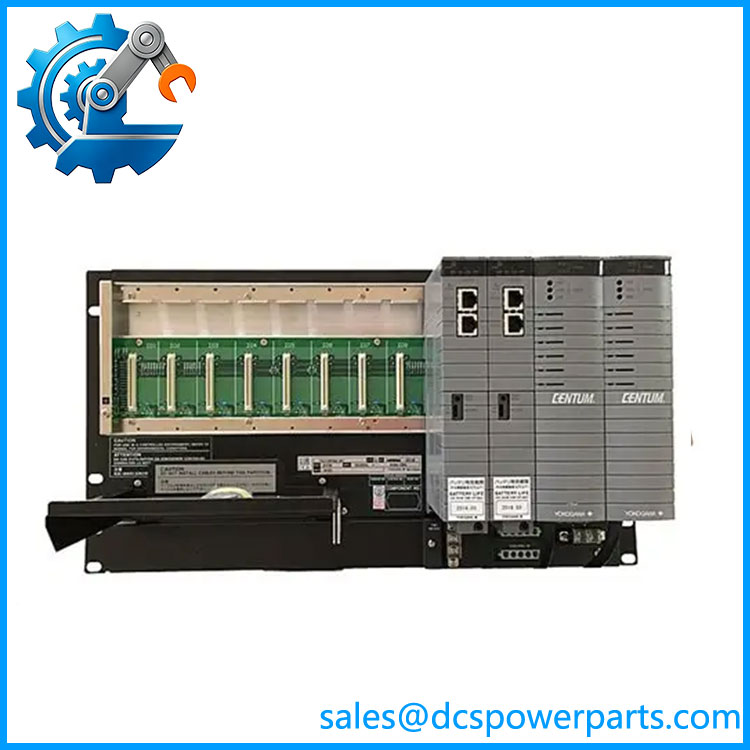
AFV10D-S41201
Related Products
These components are related to the field-control architecture. They are not automatically interchangeable.
| Model | Description |
|---|---|
| Yokogawa AFV10S | Single-type Field Control Unit in the AFV10 family. |
| Yokogawa CP451 | Processor module referenced for configurations; confirm the required revision and redundancy arrangement. |
| Yokogawa PW482 | Power-supply module referenced for compatible FCU configurations; verify voltage and hardware requirements. |
| Yokogawa EC401 | ESB bus coupler module used in applicable field-node configurations. |
| Yokogawa EB401 | ER bus interface master module for applicable FIO node arrangements. |
Frequently Asked Questions
Q1: Can the -S41201 be hot-swapped?
Do not assume that the complete FCU can be hot-swapped. Redundancy may support continued operation during certain component faults, but replacement procedures depend on the hardware, system state, and Yokogawa instructions. Follow the approved maintenance and isolation procedure.
Q2: Does this model require specific software or configuration?
Yes. The FCU operates within a configured CENTUM VP system. Verify the control function, system software compatibility, node assignments, and application configuration before commissioning a replacement.
Q3: Is the -S41201 compatible with every unit?
No. The suffix codes identify important configuration differences, including power supply and control function. Compare the complete ordering code, installed processor and power modules, and system revision before approving a substitute.
Q4: What power supes the use?
The 2 power-supply code in this model corresponds to 220–240 V AC. Confirm the cabinet supply and unit nameplate before connecting power.
Q5: Could a controller replacement cause configuration or data loss?
Incorrect replacement or configuration transfer can affect control execution and system communication. Back up available configuration data, record installed hardware and software revisions, and validate controller and I/O communication during commissioning.
Q6: How can the buyer verify condition and authenticity?
Request clear nameplate photographs, serial number, hardware revision, photographs of the connector and terminal areas, and available inspection or functional-test records. Confirm whether the unit is new, used, repaired, or refurbished; do not infer condition from the part number alone.
Q7: What should be checked before returning the unit to service?
Confirm redundant network and power status, processor health, field-node communication, control execution, alarms, and relevant I/O signals. Complete the site’s approved testing and commissioning procedure before returning the affected process to normal operation.