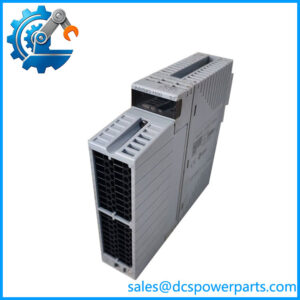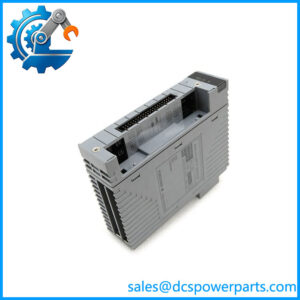
Description
Technical Specifications
| Parameter | Specification |
|---|---|
| Model | AAI143-H50/K4A00 |
| Manufacturer | Yokogawa |
| Module type | Isolated analog input |
| Number of channels | 16 |
| Input range | 4–20 mA DC |
| Maximum allowable input current | 24 mA |
| Input resistance, powered | Approximately 270 Ω at 20 mA to 350 Ω at 4 mA |
| Input resistance, unpowered | 500 kΩ or greater |
| Accuracy | ±16 µA |
| Data update period | 10 ms |
| Input-to-system withstand voltage | 1,500 VAC for 1 minute, subject to cable configuration |
| Transmitter supply | At least 19.0 V at 20 mA; no more than 25.5 V at 0 mA |
| Transmitter current limit | 25 mA |
| Transmitter wiring | 2-wire or 4-wire, selected per channel |
| HART communication | Supported |
| Maximum current consumption | 230 mA at 5 VDC; 540 mA at 24 VDC |
| Interface option | KS Cable Interface Adapter ATK4A-00 |
| Approximate module weight | 0.3 kg |
Specifications are based on published module documentation and technical listings. Confirm the applicable hardware revision and field-cable arrangement before using the withstand-voltage rating for an installation decision.
Product Overview
The AAI143-H50/K4A00 is a Yokogawa 16-channel isolated analog input module designed to acquire 4–20 mA process signals in compatible distributed control system installations. It is used to bring measurements from field instruments—such as pressure, flow, level, and temperature transmitters with current outputs—into the control system for monitoring, alarm handling, trending, and closed-loop control. Its isolated input architecture helps separate field signal circuits from system-side electronics, while the HART-capable version supports digital communication with compatible smart instruments.
The model suffixes matter when planning a replacement. The -H designation identifies HART digital communication, while 5 indicates the version without explosion protection and 0 identifies the basic type in Yokogawa’s ordering scheme. The /K4A00 option specifies the KS Cable Interface Adapter, identified as ATK4A-00, for connection to the relevant AEA4D terminal-board arrangement. It should not be treated as a generic terminal block or assumed to fit every FIO node without checking the installed wiring hardware.
For maintenance teams, the main selection checks are the exact model and suffix, the terminal-board and cable configuration, the FIO node and controller compatibility, and the HART requirements of the application. A module with the same channel count is not necessarily a valid substitute if its isolation, communication, or connection option differs. Before installation, verify the system documentation and current Yokogawa compatibility information rather than relying on the front label alone.
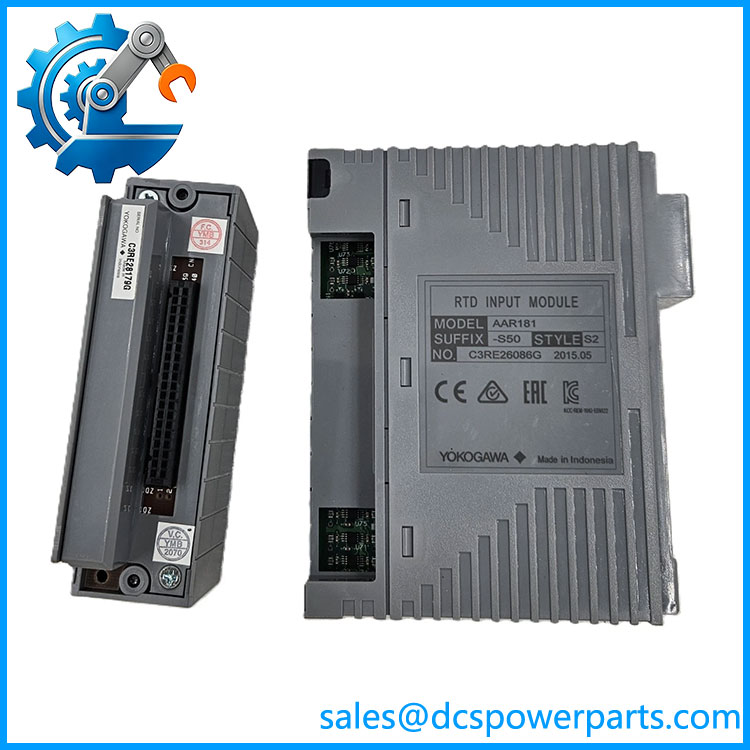
AAR181-S50 S2
Major Features and Advantages
1. Sixteen isolated current-input channels
The AAI143-H50/K4A00 accepts 16 separate 4–20 mA DC signals. This channel density supports multiple process measurements in a single I/O module, helping reduce the number of individual modules required in a properly engineered FIO node. The isolated-input design is relevant where field signal integrity and separation from system electronics are important. Actual isolation boundaries and wiring limitations must be checked against the applicable field connection specification.
2. HART digital communication
The HART option allows supported smart field instruments to communicate digital information over the analog current loop. Depending on the device, configuration, and host software, this can support access to instrument variables and diagnostic information beyond the primary process value. HART availability alone does not guarantee that every instrument parameter will appear in the operator interface; the installed software, firmware, and system configuration must support the required functions.
3. Defined measurement performance
Published technical data lists an accuracy of ±16 µA and a 10 ms data-update period. These figures are useful when assessing whether the module suits a process measurement loop, but they should not be confused with the accuracy of the complete measurement chain. Transmitter error, loop wiring, grounding, calibration, configured scaling, and controller processing can all affect the value presented to operators.
4. Support for two-wire and four-wire transmitters
The module supports 2-wire and 4-wire transmitter arrangements, with selection made for each channel using the specified setting pin. Before wiring, confirm the required channel setting and transmitter power arrangement. An incorrect setting can produce misleading readings or prevent the loop from operating as intended.
5. Defined cable-interface option
The /K4A00 suffix identifies the KS Cable Interface Adapter ATK4A-00 for the applicable AEA4D terminal-board configuration. This is a hardware connection detail, not an additional signal-processing feature. Confirm that the existing terminal board, cable type, pinout, and cabinet wiring match the intended arrangement before ordering or installing a replacement.
Applications
The AAI143-H50/K4A00 is suitable for compatible Yokogawa FIO installations that need to acquire standard 4–20 mA process signals. Typical measurement points include pressure transmitters on process lines, flow transmitters on utility and production systems, level transmitters on tanks and vessels, and temperature transmitters that provide a current output. The module receives the electrical signal; the instrument itself determines the measured physical variable.
In continuous-process facilities, analog input modules often form part of the signal path between field instrumentation and the control system. The controller uses the resulting measurements for display, alarm evaluation, sequence permissives, and regulatory control. The suitability of this particular module depends on the control-system architecture, channel allocation, configured ranges, and engineering requirements of the application.
The HART capability can be useful when compatible smart instruments are installed and the system is configured to access their digital data. Maintenance staff may be able to retrieve additional instrument information without treating the analog process value as the only available source. However, the presence of HART hardware does not by itself confirm that asset-management software, instrument configuration tools, or all diagnostic variables are enabled.
The module is also relevant to planned maintenance and like-for-like replacement work. When an existing unit fails, the correct replacement must match the installed module type and connection arrangement. Verify the node configuration, terminal-board model, cable assembly, firmware requirements, and any HART-related dependencies before commissioning. The / option is particularly important because the physical interface must match the existing field wiring arrangement.
Related Products
The following models and accessories belong to related Yokogawa analog I/O or connection hardware families. They are not automatically interchangeable with the AAI143-H50/.
| Model | Relationship |
|---|---|
| AAI143 | Same 16-channel isolated 4–20 mA analog input module family; verify suffix and HART capability. |
| AAI135-H | Related isolated analog input module with 8 channels and HART option. |
| AAI543-H | Related analog output module family with HART functionality; output module, not a direct substitute. |
| AAI835-H | Related analog I/O module family; verify exact function and system compatibility. |
| AAV144 | Related analog voltage-input module; different input signal type. |
| ATA4D-00 | Dual pressure-clamp terminal block option for the applicable analog I/O configuration. |
| ATA4S-00 | Pressure-clamp terminal block option for analog I/O. |
| ATK4A-00 | KS Cable Interface Adapter identified by the / option. |
| ACCC01 | Connector cover option for applicable MIL-cable arrangements. |
These relationships are based on Yokogawa’s analog I/O model and option-code documentation. Confirm the exact terminal-board and cable requirements against the system’s engineering records.
Installation and Maintenance
Before installing the AAI143-H50/, record the complete part number from the module label, including the / option. Compare it with the existing unit and the approved bill of materials. Check the installed FIO node, terminal-board type, KS cable arrangement, channel assignment, and required HART functionality. Do not assume that a module with the same base model but a different suffix or connection option will fit the existing configuration.
Isolate the relevant field circuits and follow the site’s electrical safety and control-system maintenance procedures before removing or inserting hardware. Inspect connectors, cable ends, terminal boards, and the module’s physical condition for contamination, corrosion, bent contacts, or signs of overheating. Confirm that transmitter wiring and channel settings match the approved drawings, especially where two-wire and four-wire devices are mixed.
After installation, verify each configured channel with a known signal source or a controlled field test. Check the displayed value at representative points across the operating range, confirm engineering-unit scaling, and test relevant alarms and control interlocks under the site’s approved commissioning procedure. If HART is required, confirm communication with the intended field devices and verify that the expected digital variables or diagnostics are accessible through the installed system software.
The published data indicates that HART use on a remote node can have firmware dependencies; the applicable Yokogawa documentation should be checked for the installed node hardware and revision. Do not treat successful analog measurement as proof that HART communication is functioning correctly. Record test results and any differences from the original configuration before returning the loop to service.
Product Assurance
For procurement of the /, assurance should focus on exact model identification, physical condition, traceability, and evidence of functional testing. The model label should confirm the AAI143 family, HART suffix, non-explosion-protected configuration, and / interface option. If the unit is supplied as used, refurbished, or surplus stock, its condition and test history should be stated accurately rather than inferred from appearance.
A meaningful inspection should include visual checks of the board and connectors, confirmation of the part number, and functional verification appropriate to the available test setup. Where practical, testing should cover analog input response, channel operation, and HART communication if the service requires it. A seller’s general warranty statement is not a substitute for a test report or proof of compatibility with the target system.
Before purchase, confirm availability, lead time, warranty terms, return conditions, and whether the supplied unit includes only the module or any associated connection hardware. The / designation identifies the interface option, but the actual supplied contents should still be checked against the quotation. Final acceptance should be based on the required system configuration and documented inspection results—not on model similarity alone.