Description
Product Overview
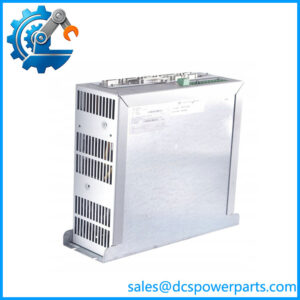
The Woodward 9905-970 is a six-channel analog input module designed to acquire temperature measurements from 100 Ω resistance temperature detectors (RTDs) in compatible LINKnet control systems. It serves as a remote temperature acquisition node rather than a standalone temperature controller. The module receives resistance signals from field sensors and makes the measurements available to the host controller through the LINKnet communication network. This arrangement allows multiple temperature measurement points to be collected at a distributed location instead of routing every sensor directly to the main control cabinet.
In turbine, engine, and power-generation installations, RTD measurements can be used to monitor bearing temperatures, lubrication systems, cooling circuits, and other temperature-sensitive equipment. The 9905-970 provides six RTD input channels, with a documented 100 Ω sensor designation. Woodward’s wiring diagram identifies a 24 VDC module supply and shows separate sense, positive, negative, and shield connections for each channel. This terminal arrangement is important during maintenance: the field wiring must follow the specified sensor connection scheme, and shield termination should be handled according to the installation manual. A 100 Ω RTD input should not be treated as interchangeable with a 4–20 mA temperature transmitter or a thermocouple input.
The Woodward 9905-970 belongs to the earlier LON-based LINKnet generation. Woodward’s obsolescence notice identifies this module as a legacy product and lists CANopen-based LINKnet HT modules as the updated product generation. That change involves a different network architecture and may require hardware and software modifications. A newer RTD module should therefore not be approved as a direct plug-in replacement without checking controller compatibility, node configuration, wiring, and application software. For an existing installation, confirming the original module’s identity and preserving its established network configuration are important parts of a controlled replacement.
Product Introduction
A failed RTD input node can interrupt several temperature measurements at once, leaving operators without important equipment-condition data. The Woodward 9905-970 provides six 100 Ω RTD input channels for compatible legacy LINKnet systems, with individual sensor connections documented for each channel.
Before installation, verify the sensor resistance type, terminal wiring, 24 VDC supply, and network configuration. The module’s legacy LON-based architecture is also a key replacement constraint: a newer CANopen node may require a planned system migration rather than a simple hardware exchange.
Key Technical Specifications
| Parameter | Specification |
|---|---|
| Product model | 9905-970 |
| Manufacturer | Woodward |
| Product family | LINKnet |
| Product type | Analog RTD input module |
| Number of channels | 6 |
| Sensor designation | 100 Ω RTD |
| Input function | Resistance-based temperature acquisition |
| Module supply reference | 24 VDC |
| Sensor wiring | Sense, positive, negative, and shield connections per channel |
| Network architecture | Legacy LON-based LINKnet |
| Application | Remote temperature monitoring |
| Lifecycle status | Obsolete / legacy spare |
Specification note: Woodward documentation confirms the six-channel 100 Ω RTD function and illustrates the 24 VDC supply and channel terminal arrangement. The available references do not establish a sufficiently reliable universal accuracy, resolution, measurement range, isolation rating, or operating-temperature limit. Those values should be checked against the applicable revision of Woodward Manual 02784 or the relevant system documentation rather than assumed from unrelated RTD modules.
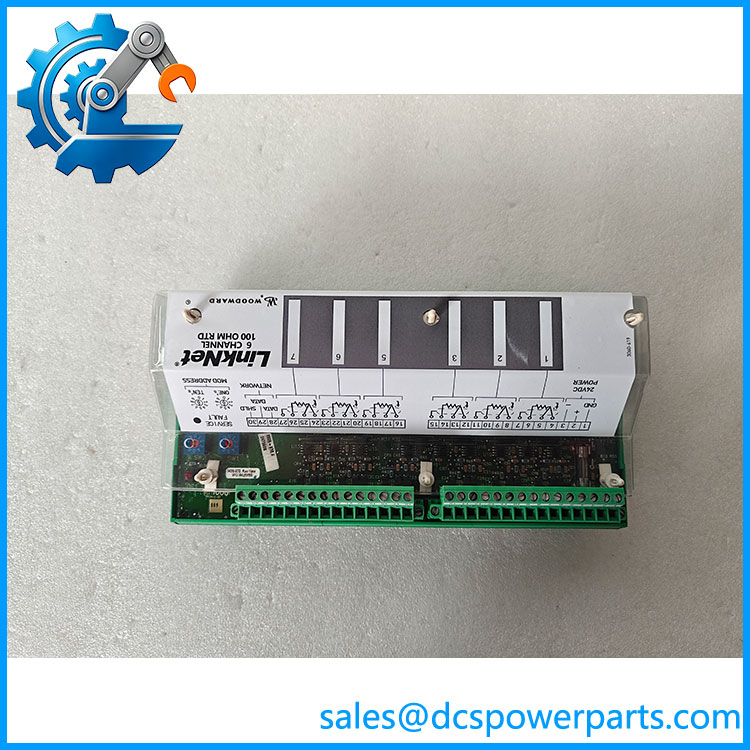
9905-970
Related Products
These models belong to the Woodward LINKnet I/O family. They perform different measurement or control functions and are not direct substitutes for the 9905-970.
- 9905-968 – Six-channel 4–20 mA analog input module without integrated 24 VDC loop power.
- 9905-969 – Six-channel 4–20 mA analog input module with integrated 24 VDC loop power.
- 9905-966 – Six-channel J-type thermocouple input module with fail-high behavior.
- 9905-967 – Six-channel J-type thermocouple input module with fail-low behavior.
- 9905-971 – 16-channel, 24 VDC discrete input module.
- 9905-972 – Six-channel 4–20 mA analog output module.
- 9905-973 – Eight-channel relay output module.
- 8200-1200 – LINKnet HT RTD input module in the newer CANopen-based product generation.
The 8200-1200 is a potential migration reference, not a confirmed direct replacement. Check the controller generation, network architecture, sensor compatibility, channel configuration, and software requirements before selecting it.
Frequently Asked Questions
Q1: What is the Woodward 9905-970 used for?
It acquires temperature measurements from six 100 Ω RTD sensors and transfers the input data through a compatible LINKnet network. It is a remote I/O component, not a standalone temperature controller. Its suitability depends on the sensor type and the host control-system configuration.
Q2: Can I hot-swap the 9905-970 while the control system is running?
Do not assume that live replacement is supported. The available wiring documentation does not establish a universal hot-swap procedure for this module. Review the applicable Woodward installation instructions and the operating procedure for the host controller. Determine the effect of losing all six temperature inputs before disconnecting the node.
Q3: Does the 9905-970 support firmware v3.1?
A general firmware v3.1 compatibility claim cannot be confirmed from the module’s basic product description. The supported combination depends on the LINKnet controller, node configuration, and application software. Verify the exact hardware and software revisions in the relevant Woodward documentation.
Q4: Can I connect a PT100 sensor directly to the 9905-970?
The module is identified as a six-channel 100 Ω RTD input. However, confirm the sensor’s resistance specification and wiring arrangement before connection. The Woodward wiring diagram shows separate sense, positive, negative, and shield terminals for each channel. Do not assume that every three-wire or four-wire sensor arrangement is supported without checking the installation manual.
Q5: Can I replace the 9905-970 with the newer 8200-1200?
Not as an automatic plug-in replacement. The 9905-970 belongs to the LON-based LINKnet generation, while the 8200-1200 belongs to the newer CANopen-based LINKnet HT range. Woodward identifies the newer architecture as requiring hardware and software changes. Confirm the controller platform and migration requirements before approving the substitution.
Q6: Will replacing the 9905-970 erase the controller’s application logic?
The 9905-970 is a remote I/O module rather than the primary controller application-storage device. Replacing it does not, by itself, establish that the main control logic will be erased. However, node addressing, input-channel assignments, scaling, alarm limits, and application references should be checked. Back up the system configuration before maintenance and verify all six temperature readings after installation.
Q7: What should I check when purchasing a new-surplus or refurbished 9905-970?
Confirm the complete part number and hardware revision from the actual unit’s label. Inspect the terminal block, connectors, enclosure, and PCB for corrosion, damage, or previous repair work. Request channel-by-channel RTD simulation test results and evidence of LINKnet communication. A visual inspection or power-on test alone does not confirm that all six measurement channels are functional.
Engineering procurement note: The main risk with the 9905-970 is confusing sensor compatibility with network compatibility. Confirm both the 100 Ω RTD wiring arrangement and the legacy LON-based LINKnet architecture before approving a replacement.