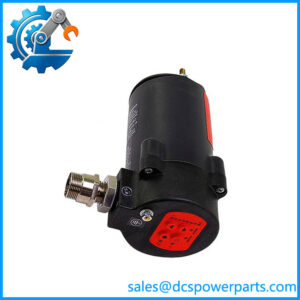
Description
Product Overview
Accurate time stamping becomes important when an automation network contains multiple controllers, protection devices, historians, and supervisory computers that need to agree on event chronology. The T-GPS-300-NTPS is a GPS-referenced network time synchronization device designed to provide a common timing source to connected network equipment. Rather than generating time independently at each PLC, server, or monitoring workstation, the unit uses GPS-derived timing and distributes synchronized time through the Ethernet network.
The T-GPS-300-NTPS fits the network-time layer of an industrial automation architecture. In a DCS or PLC installation, this type of equipment can support consistent event timestamps across control servers, engineering workstations, data acquisition equipment, and other networked devices that support NTP or SNTP. That can be particularly useful when troubleshooting sequence-of-events records, comparing alarms from multiple controllers, or correlating process events with electrical protection and instrumentation data. The unit should not be confused with a PLC communications processor: its primary responsibility is time reference and distribution rather than process I/O or control execution.
For a T-GPS-300-NTPS replacement, the important checks are the timing protocol supported by the receiving devices, network interface configuration, GPS antenna arrangement, and the required accuracy for the application. NTP-based synchronization is adequate for many supervisory and control-network applications, but applications requiring sub-microsecond event correlation may need a different timing architecture. To be completely transparent, the label “GPS time server” alone does not establish suitability for a particular plant network; the receiving equipment and required timing accuracy determine whether the unit is an appropriate replacement.
Product Introduction (Non-Templated)
When alarm records from different systems show conflicting timestamps, the problem can be the time source rather than the PLC logic. The T-GPS-300-NTPS provides GPS-referenced timing and distributes synchronized time through an Ethernet network using NTP/SNTP-type network synchronization.
For a DCS system upgrade or legacy replacement, it can serve as a centralized network timing reference for compatible automation and computing equipment. Confirm the required timing accuracy and protocol before replacing an existing time server.
Key Technical Specifications
- Product Model: T-GPS-300-NTPS
- Product Type: GPS Network Time Server
- Timing Reference: GPS/GNSS
- Network Synchronization: NTP / SNTP
- Network Interface: Ethernet
- Primary Function: GPS-referenced network time distribution
- Application: Industrial automation, control networks, monitoring systems, data acquisition, and computer networks
- Installation Role: Centralized time reference
- Condition: New Surplus, subject to physical inspection and verification

T-GPS-300-NTPS
Related Products
- T-GPS-300 — Base GPS timing platform associated with the T-GPS-300 family. The exact network-time option should be checked when replacing a configured unit.
- T-GPS-300-PTP — A related configuration intended for installations where Precision Time Protocol requirements are involved. It should not automatically be substituted for an NTP-oriented configuration.
- GPS Antenna Assembly — Required to provide the GPS timing reference. Antenna type, cable length, connector, and installation location should be checked when replacing the complete timing system.
- NTP Client Devices — PLCs, servers, HMIs, historians, and network equipment that consume the distributed time signal. Their supported NTP/SNTP behavior determines practical compatibility.
- PTP Grandmaster Clock — An alternative architecture for applications requiring tighter synchronization than conventional NTP can provide. It is a different timing approach rather than a direct drop-in replacement.
Frequently Asked Questions
Can the T-GPS-300-NTPS synchronize PLC and DCS equipment?
Potentially, provided the receiving equipment supports the applicable network time protocol.
The basic arrangement is:
- GPS antenna receives the timing reference.
- T- derives the network time.
- Ethernet distributes the time service.
- PLCs, DCS servers, HMIs, or other clients synchronize their clocks.
The receiving device’s NTP/SNTP implementation still needs to be checked.
Can I hothe T-?
Do not assume that it is hot-swappable.
If it is replacing an active plant time server, first determine whether the automation network has a redundant timing source. Removing the only time reference can cause downstream devices to free-run or switch to their internal clocks. For a live DCS environment, schedule the replacement around the site’s network-maintenance procedure.
Does this support firmware v3.1?
A firmware revision cannot safely be inferred from the model number alone. If firmware v3.1 is a project requirement, verify the exact hardware revision and manufacturer’s firmware documentation before procurement.
Do not treat firmware compatibility as equivalent to NTP compatibility. A device can communicate using NTP while still having a firmware restriction relevant to a particular installation.
Will replhe T- erase my PLC or DCS logic?
No. The time server is separate from the application logic stored in PLC or DCS controllers.
The replacement can, however, affect time-related configuration. Record the existing IP address, subnet settings, NTP server configuration, DNS settings if used, and time-zone/DST behavior before removing the old unit.
Is a Neus T- authentic?
Condition and authenticity should be verified independently.
For procurement acceptance, compare the physical identification label against , inspect the enclosure and connectors, verify the hardware revision, and request a functional test showing that the unit can acquire its GPS reference and provide the expected network time service.
Is NTP accurate enough for an industrial DCS?
That depends on what the timestamps are being used for.
Typical supervisory use: NTP can be appropriate for synchronizing servers, HMIs, historians, and many control-network devices.
Tighter event correlation: Applications involving high-speed sequence-of-events recording, electrical protection, or distributed measurement may require PTP or another higher-precision timing method.
The correct choice should therefore be based on the required timestamp accuracy, network architecture, and capabilities of the receiving equipment.
What warranty should I request for us T-?
For a critical timing component, ask for a defined warranty period plus a clear functional acceptance procedure. At minimum, the test should establish power-up operation, network communication, GPS acquisition, and time-service availability.
That is more meaningful than simply confirming that the front panel powers on.