Description
Key Technical Specifications
| Parameter | Specification |
|---|---|
| Product Model | 7PJ1132-6EA00-0AA0 |
| Manufacturer | Siemens |
| Series | 7PJ11 |
| Product Type | Auxiliary Relay |
| Number of Elements | 3 |
| Coil Voltage | 110 VDC |
| Contact Arrangement | 4 NO per element |
| Total NO Contacts | 12 |
| Reset | Hand reset |
| Indication | Flag indication |
| Burden | Low burden |
| Relay Technology | Electromechanical |
| Typical Application | Protection, trip, alarm, interposing, and control circuits |
The ordering code itself provides useful information: 1132 identifies the three-element hand-reset configuration, 6 corresponds to the 110 VDC coil range, and E specifies four normally-open contacts. The catalog also distinguishes the 7 coil code for 220 VDC.
Product Introduction
The Siemens 7PJ1132-6EA00-0AA0 is a three-element auxiliary relay intended for electrical protection and control panels where several isolated normally-open contact paths are required from relay-operated functions. Each element has four NO contacts, giving the assembly twelve NO contact paths in total. The 110 VDC coil configuration is suited to DC control circuits commonly found in substations, switchgear, generator protection, and industrial electrical control panels.
The hand-reset mechanism and flag indication are particularly useful where an operated relay must remain visibly identified until a technician investigates and manually resets it. This is different from a self-reset auxiliary relay, so substituting a self-reset version can alter the behavior of the protection or alarm circuit. The catalog specifically separates self-reset and hand-reset variants.
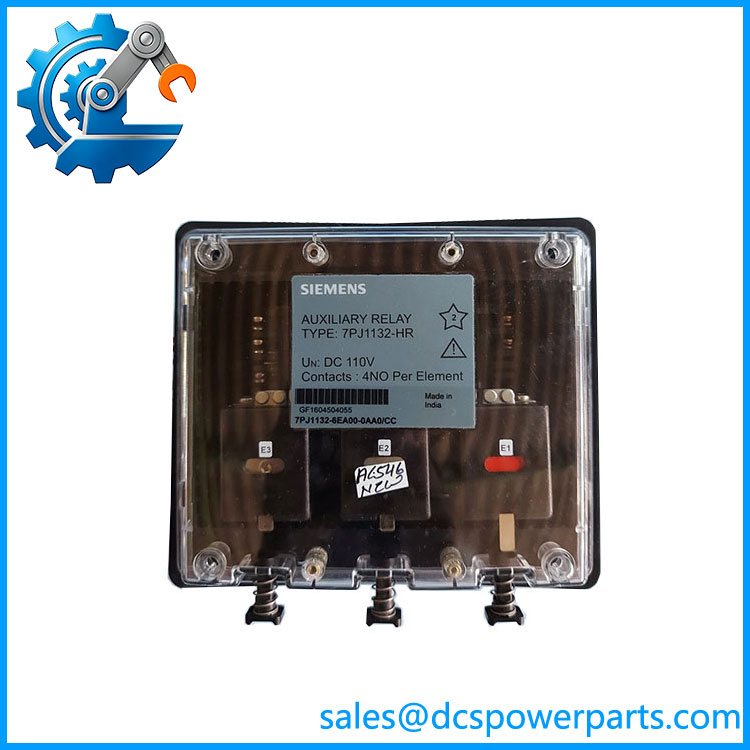
7PJ1132-6EA00-0AA0
Application Scenarios & Field Pitfalls
Engineering Pain Point
The main issue with this type of relay is contact-function matching, not simply coil-voltage matching. A relay with the correct 110 VDC coil but a different number of elements, contact arrangement, or reset mechanism can change trip, alarm, interlock, or annunciation behavior.
Typical Applications
- Substation protection panels for interposing protection and control signals.
- Generator and transformer protection systems where a protection output must operate several downstream circuits.
- Circuit-breaker control circuits requiring multiple auxiliary contacts from one relay function.
- Industrial switchgear and electrical control cabinets for alarm, interlock, trip, and status distribution.
Technical Pitfalls to Avoid
- Verify the 110 VDC coil. The
6ordering code corresponds to the 110 VDC configuration; the visually similar7PJ1132-7EA00-0AA0is the 220 VDC version. - Verify four NO contacts per element. The
Econfiguration is different from theCconfiguration, which provides two NO contacts per element. - Do not substitute a self-reset relay. The 7PJ1132 configuration is specifically a hand-reset relay with flag indication. This behavior can be important in protection and trip circuits.
Related Products
- Siemens 7PJ1132-6CA00-0AA0 — Same three-element, hand-reset architecture and 110 VDC coil, but with two NO contacts per element rather than four.
- Siemens 7PJ1132-7EA00-0AA0 — Three-element, four-NO-per-element configuration with a 220 VDC coil rather than 110 VDC.
- Siemens 7PJ1122-6EA00-0AA0 — Two-element version with 110 VDC coil and four NO contacts per element.
- Siemens 7PJ1122-7EA00-0AA0 — Two-element, four-NO-per-element version for 220 VDC circuits.
- Siemens 7PJ1111-6DA20-0AA0 — Single-element self-reset auxiliary relay with flag indication and a different contact arrangement.
- Siemens 7PJ1114-6DA20-0AA0 — Single-element self-reset auxiliary relay without flag indication; intended for a different control philosophy.
Procurement Check
For 7PJ1132-6EA00-0AA0, verify the complete MLFB, 110 VDC coil, three relay elements, four NO contacts per element, hand-reset mechanism, and flag indication before approving a replacement. The most common substitution mistake is selecting a 7PJ1122 two-element unit or a 220 VDC -7 variant because the external relay construction appears similar. The catalog ordering data makes those distinctions explicit.