Description
Product Overview
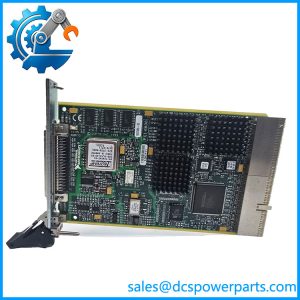
The National Instruments PCI-6036E is a multifunction data acquisition card from the NI E Series, designed to bring analog measurement, signal generation, digital control, and timing functions into a computer-based test or monitoring system. Installed in a compatible desktop or industrial computer with a conventional PCI slot, the board captures electrical signals from sensors and test circuits, converts them into digital data, and makes the measurements available to application software. Its 16-bit analog input resolution supports detailed voltage measurement, while the maximum aggregate sampling rate of 200 kS/s suits laboratory instrumentation, production test stations, equipment characterization, and lower-speed automated measurement tasks.
On the output side, the PCI-6036E provides two 16-bit analog output channels, eight TTL-compatible digital I/O lines, and two 24-bit counter/timers. These resources allow a single card to measure signals, generate control voltages, monitor discrete states, and perform event counting or timing operations. Analog input ranges include ±10 V, ±5 V, ±0.5 V, and ±0.05 V, subject to software configuration and the applicable measurement setup. The board uses a 68-pin SCSI-II-type I/O connector and draws its operating power from the computer’s +5 V supply. Compatible signal-conditioning hardware can extend its use with selected sensors and measurement environments.
For maintenance and test-system engineers, the National Instruments PCI-6036E is most relevant when preserving an established measurement application that depends on the original E Series hardware and its driver behavior. The card works with NI data acquisition software, but operating-system support must be checked carefully: the board belongs to an older hardware generation, and modern 64-bit systems may require a different driver strategy or a supported legacy computer. Before selecting a replacement, confirm the PCI slot type, connector and cable assembly, required sampling rate, calibration status, and software dependencies. A physically compatible card is not necessarily a verified replacement for a calibrated production-test system.
Product Introduction (Non-Templated)
A legacy test station can become difficult to maintain when its data acquisition card, driver, and measurement software depend on a specific PCI hardware generation. The National Instruments PCI-6036E combines 16-bit analog acquisition at up to 200 kS/s with two analog outputs, eight digital I/O lines, and two 24-bit counters.
For a legacy DAQ replacement, verify the computer’s PCI bus, the 68-pin I/O cable, driver compatibility, and calibration requirements before returning the system to service.
Key Technical Specifications
| Parameter | Value |
|---|---|
| Manufacturer | National Instruments |
| Model | PCI-6036E |
| Product Series | E Series |
| Product Type | Multifunction DAQ card |
| Host Interface | Conventional PCI |
| Analog Input Channels | 16 single-ended or 8 differential |
| Analog Input Resolution | 16 bit |
| Maximum Aggregate Input Rate | 200 kS/s |
| Analog Input Ranges | ±10 V, ±5 V, ±0.5 V, ±0.05 V |
| Analog Output Channels | 2 |
| Analog Output Resolution | 16 bit |
| Analog Output Update Rate | Up to 10 kS/s |
| Digital I/O | 8 TTL-compatible lines |
| Counter/Timers | 2 × 24-bit |
| I/O Connector | 68-pin male SCSI-II type |
| Power Supply | +5 VDC from host computer |
| Typical Board Power Requirement | 0.9 A at +5 VDC |
| Physical Dimensions | Approximately 175 × 106 mm, excluding connectors |
| Weight | Approximately 114 g |
| Software Environment | NI-DAQ and compatible application software |
| Signal Conditioning | Compatible external NI signal-conditioning hardware, as required |
Specifications are based on NI’s PCI-6034E/6035E/6036E family documentation. Confirm driver, operating-system, and accessory compatibility against the actual installation.
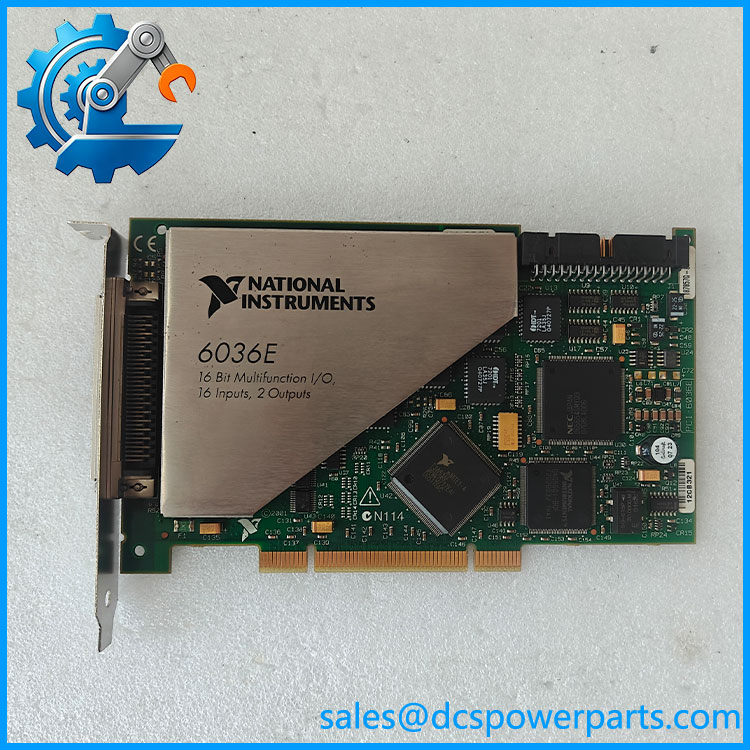
PCI-6036E
Related Products
The following devices are related measurement hardware or supporting accessories. They are not all direct replacements for the PCI-6036E.
NI PCI-6034E
An E Series PCI acquisition card with 16-bit analog inputs and a 200 kS/s aggregate sampling rate. Unlike the , it does not provide analog output channels, so it is unsuitable where the existing application generates analog signals.
NI PCI-6035E
A related E Series PCI board with 16-bit analog inputs, two analog outputs, digital I/O, and counter/timer functionality. Its analog outputs have 12-bit resolution rather than the ‘s 16-bit resolution, making output precision a key selection factor.
NI PCI-6024E
A related multifunction DAQ board with 12-bit analog conversion. It may suit less demanding measurement tasks, but its lower input and output resolution means it should not be treated as an equivalent replacement without reviewing accuracy requirements.
NI PCI-6052E
A higher-throughput E Series option with a maximum analog input rate of 333 kS/s and 16-bit input resolution. Consider it for measurement applications needing greater input throughput, subject to channel, driver, and application compatibility checks.
NI SCB-68
A shielded 68-pin I/O connector block used in compatible NI DAQ wiring arrangements. Verify the exact connector variant, pinout, cable, and electrical ratings before connecting it to a installation.
NI SH68-68 Cable
A 68-conductor shielded cable family for compatible NI data acquisition connections. Confirm the connector gender, cable wiring, shielding, and supported accessory arrangement before reuse.
Frequently Asked Questions (FAQ)
1. Is the NI compatible with my existing LabVIEW test system?
Compatibility depends on the LabVIEW version, NI-DAQ driver, operating system, host computer, and any external signal-conditioning hardware. The card belongs to the older E Series generation, so a system that supports newer NI hardware may not automatically support this board.
Before purchase, record the computer’s PCI slot type, application version, driver version, and required DAQ functions. Validate the complete software and hardware combination before deploying the card in a production test station.
2. Can I replace the with a PCI-6035E?
Not without checking the application’s analog output requirements. Both boards offer 16-bit analog inputs and related E Series functionality, but the PCI-6035E has 12-bit analog outputs, while the has 16-bit analog outputs.
If the application uses analog outputs for precision stimulus generation or closed-loop test signals, the reduced output resolution may affect results. Compare channel configuration, output resolution, timing behavior, and driver compatibility before substitution.
3. Does the support Windows 10 or Windows 11 with 64-bit drivers?
Do not assume that it will work with a current 64-bit operating system. NI’s legacy driver documentation identifies limitations for the on 64-bit Windows versions, including Windows 7, 8.1, and 10.
For a Windows 10 or Windows 11 deployment, check the exact supported driver version and hardware support matrix. An older supported operating system or a validated legacy test computer may be necessary if the required driver is unavailable on the target platform.
4. Can I measure a 4–20 mA industrial sensor directly with the ?
The board measures voltage, not industrial loop current directly. A 4–20 mA sensor generally requires a suitable precision shunt resistor or compatible signal-conditioning module to convert current into a voltage within the configured input range.
Check the sensor’s loop supply, isolation requirements, grounding arrangement, resistor power rating, and expected voltage drop. Never connect a current loop without confirming the wiring and electrical limits.
5. How can I verify that a new-surplus is genuine and functional?
A new-surplus label does not prove that the card is unused, calibrated, or fully operational.
Request:
- Photographs of the actual board, labels, and connector.
- Confirmation of the part number and hardware revision.
- Inspection results for corrosion, damaged contacts, and component condition.
- Functional test results covering analog inputs, analog outputs, digital I/O, and counters.
- Calibration documentation if the application requires traceable measurements.
For a measurement system, a successful power-on test is not equivalent to a calibration or accuracy verification.
6. What should I check if the is detected but returns incorrect measurements?
Start by separating configuration problems from hardware faults.
- Confirm the channel number and input configuration.
- Check the selected voltage range and terminal configuration.
- Inspect signal wiring, grounding, shielding, and connector pinout.
- Apply a known reference voltage and compare the measured value.
- Check the calibration status and run the appropriate diagnostic utilities.
If the error persists across channels, investigate the driver, reference source, cabling, and calibration before concluding that the card has failed.
7. What warranty should I expect for an older DAQ card?
Warranty coverage depends on the seller’s written terms and the actual condition of the board. Do not assume that historical manufacturer coverage applies to surplus stock.
Before ordering, confirm the warranty period, return conditions, test coverage, and whether calibration documentation is included. For a production test system, also establish how a failed card will be handled and whether a validated replacement can be supplied without delaying operations.