Description
Key Technical Specifications
| Parameter | Specification |
|---|---|
| Manufacturer | Motorola Computer Group |
| Model Family | MVME147 / MVME147A |
| Module Type | VMEbus Single-Board Computer |
| CPU | Motorola MC68030 |
| CPU Architecture | 32-bit |
| CPU Frequency | 16, 25, or 33.33 MHz depending on variant |
| Floating-Point Processor | MC68882 |
| DRAM | 4, 8, 16, or 32 MB depending on variant |
| DRAM Parity | Programmable parity on applicable configurations |
| SRAM | 4 KB battery-backed SRAM |
| Serial Interfaces | 4 EIA-232-D serial ports |
| Parallel Interface | Centronics-compatible |
| SCSI | Onboard SCSI controller with DMA |
| Ethernet | Ethernet transceiver interface on applicable variants |
| VMEbus | A32/D32 master/slave interface |
| VMEbus System Controller | Supported |
| Timers | Two 16-bit timers plus watchdog timer |
| RTC | Battery-backed time-of-day clock/calendar |
| ROM Sockets | Four ROM/PROM/EPROM/EEPROM sockets |
| VMEbus Interrupts | 7-level interrupter and interrupt handler |
| Form Factor | Double-height VMEmodule |
Motorola’s ordering information shows several MVME147 variants, ranging from 16 MHz/4 MB configurations through 25 MHz/32 MB and 33.33 MHz/32 MB configurations. The standard family includes four serial ports and one parallel port; Ethernet and SCSI are included on the Ethernet-capable variants.
Product Introduction
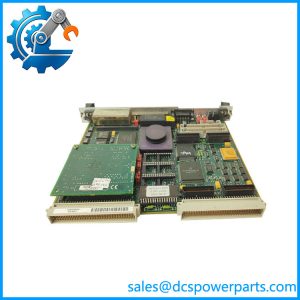
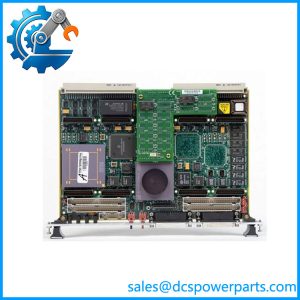
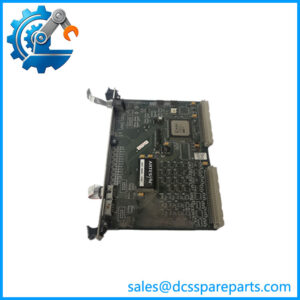
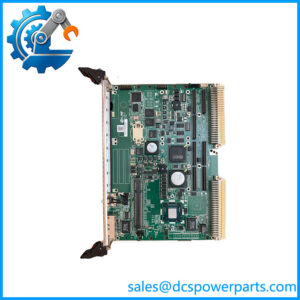
The Motorola MVME-147A is a legacy 32-bit VMEbus single-board computer built around the MC68030 processor. It was designed to function as the main computing element in embedded VME systems, with onboard memory, serial communications, SCSI, timers, battery-backed SRAM and clock circuitry, and a VMEbus interface capable of master/slave operation and system-controller functions.
Unlike a PLC CPU, the MVME-147A is an embedded computer board intended for a VMEbus backplane. Its usefulness in an existing machine depends heavily on the installed software, 147Bug firmware, memory configuration, transition module, VMEbus settings, and the exact MVME147 ordering variant. Motorola documentation also identifies compatible MVME712 transition modules for bringing the board’s serial, Ethernet, parallel, and SCSI interfaces out to external connectors.
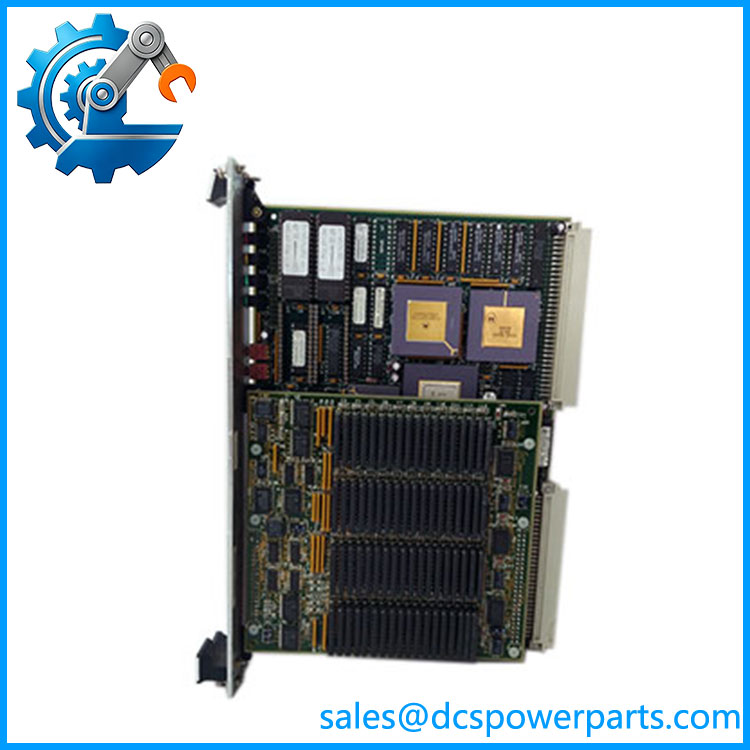
MVME-147A
Application Scenarios & Field Pitfalls — Engineer’s Perspective
Engineering Pain Point
The main replacement risk with an MVME-147A is treating the board as a generic VME CPU. The MVME147 family was sold in multiple processor-speed and memory configurations, so a board with the same family designation can still differ materially from the installed unit.
Typical Applications
- Legacy VME industrial computers — embedded computing within VME chassis.
- Industrial control and test systems — applications requiring a 32-bit processor with VMEbus access.
- Legacy data-acquisition systems — onboard SCSI and serial interfaces can support peripheral or instrumentation subsystems.
- Embedded machine controllers — VMEbus provides communication with additional processor, memory, graphics, or I/O boards.
Technical Pitfalls to Avoid
- Match the complete ordering number, not only MVME-147A.
Motorola documented variants such as MVME147-010A, -011A, -012A, -013A, -014A, -022A, -023A and -024A, with different CPU speeds and DRAM capacities. - Do not confuse MC68030 with later MVME processors.
The MVME147 is based on the MC68030 and MC68882. Later MVME families such as MVME167 use different processors and system architectures and should not be treated as direct substitutes simply because they use the VMEbus. - Check the transition module and P2 wiring.
External serial, Ethernet, parallel, and SCSI connections may depend on an MVME712-series transition module. Replacing the CPU board without preserving the transition-module arrangement can leave an otherwise functional system without its external interfaces. - Preserve the 147Bug/software environment.
The family has dedicated 147Bug debugging/monitor firmware and separate SCSI firmware documentation. The application image and startup configuration should be backed up before removing a working processor.
Related Products
- — 16 MHz configuration with 4 MB DRAM and SCSI.
- — 25 MHz configuration with 4 MB DRAM, Ethernet and SCSI.
- — 25 MHz, 8 MB DRAM configuration.
- — 25 MHz, 16 MB DRAM configuration.
- — 25 MHz, 32 MB DRAM configuration.
- — 33.33 MHz, 8 MB DRAM configuration.
- — 33.33 MHz, 16 MB DRAM configuration.
- — 33.33 MHz, 32 MB DRAM configuration.
- MVME712M — transition module providing external serial, parallel, Ethernet and SCSI connections.
- MVME712P2 — P2 adapter used to interface the with transition-module cabling.
Procurement and Replacement Notes
For an MVME-147A replacement, the safest procurement description is:
Motorola MVME-147A VMEbus Single-Board Computer, MC68030 32-Bit MPU VMEmodule, Four Serial Ports, SCSI, VMEbus Master/Slave Interface, Exact Memory and Processor-Speed Configuration to Be Verified.
Before approving a replacement, verify:
- Complete ordering number
- MC68030 processor speed
- Installed DRAM capacity
- Parity configuration
- Ethernet presence
- SCSI usage
- ROM/PROM contents
- 147Bug revision
- SCSI firmware revision
- MVME712 transition-module type
- VMEbus system-controller configuration
- Existing application software and boot parameters
- Battery condition for SRAM and RTC
The key distinction is straightforward: is a VMEbus computer/CPU board, not a PLC I/O module. Its replacement must be matched to the complete VME hardware and software environment, not just the processor family.