Description
Product Overview
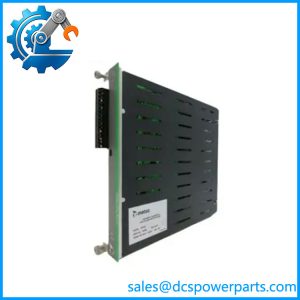
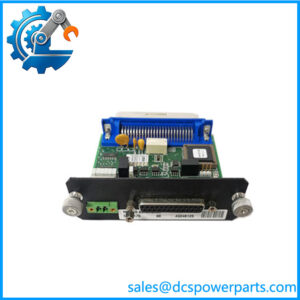
The Metso IOP314 is a dedicated 3-wire RTD input module used within the MaxPAC process automation hardware family associated with Metso Automation and its Valmet Automation lineage. Available equipment records explicitly describe IOP314 as a 3W RTD module for MaxPAC, while a Valmet-associated hardware drawing identifies the corresponding hardware inscription as 69230I314A.
The Metso IOP314 is intended for temperature measurement using resistance temperature detectors rather than conventional 4–20 mA transmitters. A documented equipment description identifies IOP314 as an analog input card receiving temperature signals and specifies 24 VDC for the model. In a process-control installation, the module receives the RTD measurement from field instrumentation and makes the temperature value available to the associated DPU and control application through the MaxPAC I/O architecture.
The Metso IOP314 should therefore be treated as a dedicated temperature-input module, not as a generic analog input card. This distinction matters when replacing hardware in an older DCS cabinet. IOP312, for example, is separately documented as an isolated high-level 4–20 mA input module, while IOP324 is identified as an analog output module. The Valmet-associated hardware drawing lists IOP312, IOP313, IOP314, IOP324 and IOP329 as separate module types.
Technical Specifications
| Parameter | Specification |
|---|---|
| Product Model | |
| Module Number | 69230I314A |
| Manufacturer | Metso Automation / Valmet Automation |
| Product Type | 3-wire RTD input module |
| System Family | MaxPAC / MaxDNA |
| Primary Function | Temperature measurement |
| Input Signal | 3-wire RTD |
| Signal Category | Resistance / temperature input |
| System Supply | 24 VDC reported |
| System Interface | MaxPAC I/O architecture |
| Communication | MaxPAC I/O bus/backplane |
| Standalone Ethernet | Not verified |
| RTD Sensor Types | Verify from applicable documentation |
| Input Resistance Range | Verify |
| Channel Count | Verify |
| Accuracy | Not reliably established |
| Isolation | Verify |
| Operating Temperature | Not reliably established |
| Protection Rating | Not reliably established |
| Installation | MaxPAC I/O chassis |
| Hardware Inscription | 69230I314A |
The 69230I314A identification is important for procurement. The hardware drawing lists it directly against , reducing the risk of confusing the module with neighboring IOP-series cards.
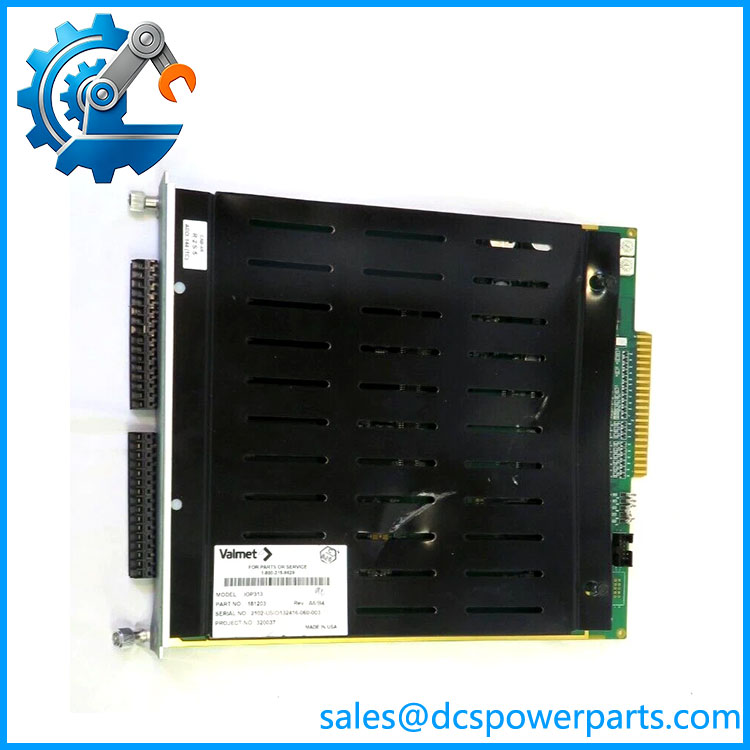
IOP313
Main Features and Engineering Considerations
Dedicated 3-Wire RTD Measurement
The defining characteristic of the is its 3-wire RTD input function. Three-wire RTD circuits are widely used in industrial temperature measurement because the wiring arrangement allows the input system to compensate for part of the lead-wire resistance.
This makes the module fundamentally different from a standard current-input card. A 4–20 mA transmitter connected to an IOP312, for example, should not simply be rewired into an . The sensor technology, terminal assignment, signal conditioning, and software scaling are different. Available shipping documentation explicitly separates as a 3-wire RTD module and IOP312 as an isolated 4–20 mA input.
MaxPAC Integration
belongs to the MaxPAC I/O architecture. Its role is to acquire temperature measurements and pass the resulting process values into the associated control system. It is not a standalone temperature transmitter and does not independently provide a modern Ethernet or fieldbus interface.
The DPU and I/O architecture handle the system-level processing and communications. This means replacement work should include the controller configuration, I/O database, terminal assembly, and physical rack position rather than focusing only on the module’s front-panel designation.
RTD Wiring Matters
Three-wire RTD measurement depends heavily on correct field wiring. Before replacement, identify the two conductors belonging to the same side of the RTD element and the third compensation conductor. Incorrectly landing the three wires can produce a temperature value that appears plausible but is systematically wrong.
For critical measurements, compare the indicated temperature against a calibrated reference after replacement rather than relying only on the module’s normal-status indication.
Legacy Hardware Considerations
is associated with a legacy Metso/Valmet automation platform. The exact module revision and termination hardware should be recorded before ordering. The Valmet-associated drawing confirms that multiple IOP variants occupy the same broader hardware family, so physical similarity does not establish functional interchangeability.
Do Not Invent RTD Compatibility
The available evidence establishes the 3-wire RTD function, but I would not publish a specific RTD type, resistance range, channel count, excitation current, or accuracy without the original technical manual. A generic statement such as “supports all Pt100/Pt1000 sensors” would be an unsupported assumption.
Application Scenarios
- Process temperature measurement
- Boiler and steam-system temperature monitoring
- Heat-exchanger temperature monitoring
- Tank and vessel temperature measurement
- Pulp and paper process temperature monitoring
- Power-generation process control
- Industrial process instrumentation
- Legacy MaxPAC / MaxDNA DCS installations
- Replacement of failed RTD input modules
Engineer’s Guide: Field Pitfalls
1. Confirm the complete part identification.
Specify / 69230I314A rather than ordering only an “RTD input card.”
2. Confirm that the field sensor is actually 3-wire.
Do not assume the existing temperature transmitter is an RTD merely because the control system displays temperature.
3. Preserve the original terminal arrangement.
Photograph and document the existing wiring before removing the module. RTD lead compensation depends on correct wiring.
4. Verify sensor configuration.
Check the configured sensor type, engineering range, linearization, filtering, alarm limits, and sensor-failure handling in the DCS database.
5. Do not substitute IOP312 or IOP324.
These modules have different documented functions. IOP312 is identified as isolated 4–20 mA input, while IOP324 is identified as analog output.
6. Check the termination hardware.
The module’s field connection arrangement should be verified against the installed MaxPAC terminal hardware before energizing a replacement.
7. Validate the temperature after installation.
Compare the displayed value with a known reference or calibrated instrument. RTD wiring errors can produce stable but inaccurate readings.
Frequently Asked Questions
What is the Metso ?
The is a 3-wire RTD input module for the MaxPAC process automation system. Available equipment records explicitly identify it as an “ 3W RTD Module MaxPAC.”
What is the full hardware number?
The documented hardware inscription is 69230I314A, corresponding to type .
What type of signal does receive?
It receives temperature measurements from 3-wire RTD sensors. It is not a conventional 4–20 mA analog input module.
Is the same as ?
No. is documented as an isolated HLAI 4–20 mA input, while is documented as a 3-wire RTD module.
What supply voltage does use?
A trade-data description identifies 24 VDC for . The exact supply arrangement should still be checked against the installed MaxPAC hardware documentation before replacement.
How many RTD channels does have?
I could not verify the exact channel count from sufficiently reliable documentation. It should not be copied from another Metso/Valmet RTD module.
Does communicate over Ethernet?
No standalone Ethernet interface was established in the documentation reviewed. It is a MaxPAC I/O module whose system communication is handled through the associated I/O architecture.
Procurement Note
For a replacement order, specify Metso/Valmet , 69230I314A, 3-wire RTD input module. Ask for photographs of the actual nameplate, PCB revision, terminal arrangement, and any associated terminal/base hardware.
The 3-wire RTD function and 69230I314A identification are well supported. I would not publish an exact channel count, RTD sensor list, accuracy, excitation current, isolation voltage, or temperature rating until those values are confirmed from the original documentation. That level of restraint is important when documenting legacy DCS hardware for replacement procurement.