Description
Honeywell CC-FSMX01 Single-Mode Fiber Optic Module
Product Overview
The Honeywell CC-FSMX01 is a single-mode fiber optic module designed for the Honeywell Experion PKS Series C Control Firewall architecture. Its documented function is specific: it plugs into a port of the Control Firewall I/O Termination Assembly and provides the optical interface required for single-mode FTE connectivity. Honeywell documentation identifies CC-FSMX01 as the FTE Single Mode Fiber Module (SMFIO), while the corresponding CC-FMMX01 is the multi-mode version. This distinction matters during replacement because the two modules use different fiber media and connector arrangements.
From a system-engineering standpoint, the Honeywell CC-FSMX01 should not be treated as a generic Ethernet transceiver. It belongs to a specific Control Firewall installation and is intended to work with the appropriate Honeywell IOTA and FTE architecture. The documented installation uses a dual-fiber single-mode cable with an LC connector. Honeywell’s installation documentation specifies 9/125 µm single-mode glass fiber, 1300 nm wavelength, a maximum distance of 15 km, 3.3 V module voltage, approximately 1 W power consumption, and an industrial temperature range of -40°C to +85°C.
For maintenance teams, the important point is that CC-FSMX01 is an interface component, not the Control Firewall itself. The Control Firewall module is installed on the appropriate IOTA, while the fiber module occupies the designated fiber interface position. Honeywell’s maintenance documentation also lists CC-FSMX01 as an optional spare for the single-mode fiber interface.
Product Introduction
Fiber links in an Experion PKS cabinet are not an area where substitution by appearance is a good idea. The Honeywell CC- is tied to the Series C Control Firewall/FTE architecture and provides the single-mode optical path required for long-distance network connections.
For a legacy system upgrade or maintenance replacement, the critical checks are fiber mode, connector type, Control Firewall/IOTA compatibility, and installed network architecture. The documented 1300 nm single-mode interface supports distances up to 15 km, making it materially different from the CC-FMMX01 multi-mode module.
Key Technical Specifications
| Parameter | Specification |
|---|---|
| Product Model | CC- |
| Manufacturer | Honeywell |
| Product Type | FTE Single-Mode Fiber Optic Module |
| Application | Experion PKS Series C Control Firewall / FTE |
| Fiber Medium | Single-mode glass fiber |
| Fiber Size | 9/125 µm |
| Optical Wavelength | 1300 nm |
| Maximum Distance | 15 km (9 miles), per documented fiber-media specification |
| Connector | LC |
| Fiber Arrangement | Dual-fiber |
| Form Factor | SFP |
| Module Voltage | 3.3 V |
| Approx. Power | 1 W |
| Operating Temperature | -40°C to +85°C |
| Installation | Plugs into the designated Control Firewall IOTA fiber port |
| Network Role | FTE fiber interface |
| Firmware | No separately documented user-configurable firmware |
| Protection Rating | Not independently verified for the standalone module |
The documented Series C hardware planning information lists CC- at approximately 0.040 A and 1.00 W heat dissipation when referenced to the 24 VDC system power calculation. The optical module itself is specified at 3.3 V in the Control Firewall installation documentation, so these figures should not be confused with a 24 V direct module supply rating.
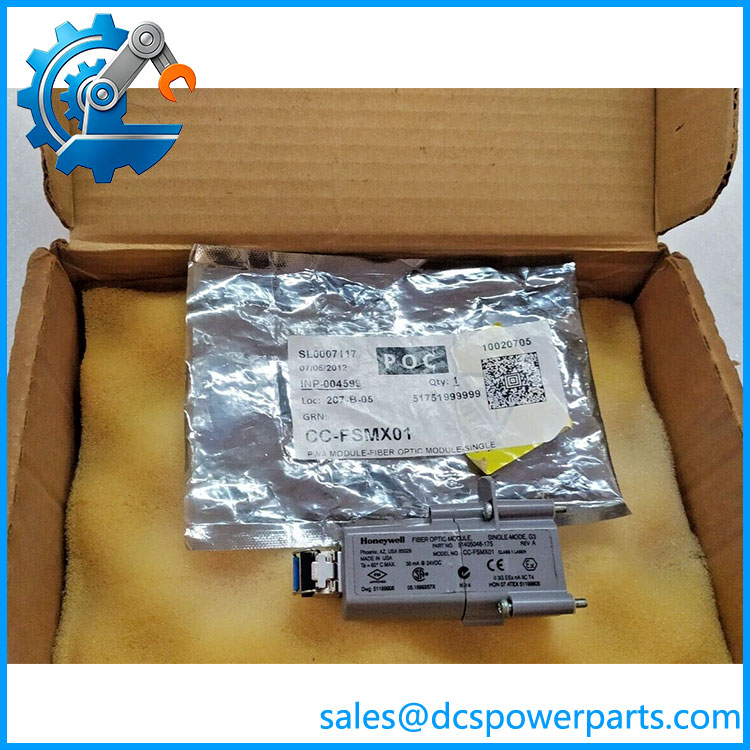
CC‑FSMX01
Major Features and Practical Advantages
1. Purpose-built for Honeywell FTE architecture
CC- is designed for the fiber interface of the Honeywell Control Firewall arrangement. The applicable architecture uses the Control Firewall IOTA to provide the physical connection between the firewall module, FTE cabling, and the optical interface. This makes system-level compatibility more important than simply matching optical specifications.
2. Single-mode fiber for extended network distances
The module is specified for 9/125 µm single-mode glass fiber with a 1300 nm optical wavelength. The documented maximum fiber distance is 15 km, which is substantially beyond the 2 km specification published for the corresponding CC-FMMX01 multi-mode module.
3. LC optical connection
The CC- uses an LC connector with a dual-fiber cable arrangement. This gives procurement and commissioning personnel a simple physical check: if the existing installation uses the MT-RJ interface associated with the multi-mode CC-FMMX01, it is not the same fiber interface.
4. Industrial temperature specification
Honeywell’s Control Firewall installation documentation specifies an operating temperature range of -40°C to +85°C for CC-. That range is appropriate for the industrial cabinet environment for which the component was designed.
5. Useful as a maintenance spare
Honeywell’s maintenance documentation explicitly lists CC- as the SMFIO Single-Mode Fiber Optic Module and identifies it as an optional spare. For older Experion PKS installations, maintaining the correct optical module can be more practical than attempting to redesign the network interface around a contemporary commercial transceiver.
6. Do not confuse it with CC-FMMX01
This is probably the most important procurement distinction. CC- = single-mode / LC / 15 km, while CC-FMMX01 = multi-mode / MT-RJ / 2 km in the documented Control Firewall installation specification. They are functionally related but are not interchangeable merely because both are fiber modules.
7. Coated-board designation
Honeywell Control Firewall documentation explains that the CC prefix identifies components whose printed wiring boards are coated for additional environmental protection, while CU-designated versions are uncoated. This is relevant when maintaining the original Series C cabinet environment and hardware configuration.
Related Products
- — Multi-mode fiber optic module for the same Control Firewall architecture; uses 62.5/125 µm multi-mode fiber and MT-RJ connection rather than the CC- single-mode LC interface.
- CC-PCF901 — Honeywell Control Firewall module that works with the applicable CF9 IOTA and fiber interface architecture.
- CC-TCF901 — Series C Control Firewall I/O Termination Assembly providing the physical connection for the Control Firewall and FTE interfaces.
- DC-TCF901 — Series C Mark II Control Firewall IOTA variant associated with the later cabinet architecture.
- CC-HCN911 — Horizontal nine-port FTE Control Firewall IOTA used in applicable Series C configurations.
- CC-PCNT01 — C300 non-redundant controller module used within the same broader Series C/Experion PKS control architecture.
- CC-TCNT01 — C300 controller IOTA providing the controller-side physical termination.
- CC-PFB401 — Series C Fieldbus Interface Module used elsewhere in the Series C control architecture.
FAQ
Can CC- be used with any Ethernet switch that accepts an SFP?
No. Although the module uses an SFP form factor, its documented application is the Honeywell Control Firewall/FTE architecture. Treating it as a generic commercial SFP is not a safe substitution strategy. The host IOTA, Control Firewall architecture, fiber type, connector, and network design all need to match.
What fiber should be used with CC-?
The documented specification calls for single-mode glass fiber, 9/125 µm, using a dual-fiber cable and LC connector. The specified optical wavelength is 1300 nm.
What is the maximum communication distance?
Honeywell’s Control Firewall installation specification gives a maximum distance of 15 km (9 miles) for CC-. Actual link performance still depends on the installed fiber, connector losses, patching, and optical link budget.
Can I substitute CC- for CC-?
Not as a direct replacement. CC- is the multi-mode version and uses a different fiber medium and connector. The documented CC- specification is 62.5/125 µm multi-mode fiber, MT-RJ, 1300 nm, and up to 2 km.
Can I hot-swap the CC-?
Do not assume hot-swap capability simply because the module is an SFP-format device. Honeywell’s Control Firewall installation instructions contain specific cautions against connecting or disconnecting components while powered in locations where the hazardous-area status is unknown. Follow the site’s approved maintenance procedure and the applicable Control Firewall replacement procedure.
Does CC- have firmware that needs to be matched?
No separately user-configurable firmware specification has been established for this optical module. The more important compatibility factors are the host Control Firewall/IOTA architecture, optical mode, connector, and system configuration.
Is CC- a Series C I/O module?
It is part of the Series C control hardware ecosystem, but it is not a conventional process I/O module such as an analog input or digital output module. Its documented role is the single-mode fiber interface for the Control Firewall/FTE network.
What should be checked before purchasing a replacement?
Confirm the complete part number , the installed Control Firewall/IOTA model, single-mode fiber architecture, LC connector arrangement, optical cabling, board coating requirement, and physical condition of the optical interface. For an installed Experion system, preserve the existing network configuration rather than treating the replacement as an isolated SFP exchange.
Procurement Note
The Honeywell CC- should be purchased as a system-specific Experion PKS/Control Firewall component, not as a generic fiber transceiver. Before installation, compare the part-number marking, connector, optical type, host IOTA, and cabinet generation against the existing hardware.
For New Surplus or previously installed stock, inspect the LC interface, module housing, labeling, board revision where accessible, and packaging history. A clean optical connector is important; contamination can produce intermittent links that are difficult to diagnose from the DCS workstation. If the original module is being replaced because of communication faults, also inspect the fiber patch cable and IOTA port rather than assuming the optical module is the only failure point.
Honeywell documentation confirms the CC- single-mode role, 1300 nm wavelength, LC connection, 15 km maximum distance, 3.3 V module specification, approximately 1 W power, and -40°C to +85°C operating range.