Description
Hirschmann RS2-FX/FX | Managed Industrial Ethernet Rail Switch
Product Overview
The Hirschmann RS2-FX/FX is a managed Industrial Ethernet Rail Switch from Hirschmann’s RS2 family, designed for industrial networks that combine copper Ethernet devices with a fiber-optic backbone. The exact RS2-FX/FX hardware provides five 10/100BASE-TX RJ45 ports and two 100BASE-FX multimode fiber ports with SC connectors. Hirschmann’s documentation specifies store-and-forward switching and identifies ports 6 and 7 as the 100 Mbit/s fiber backbone interfaces.
Unlike an unmanaged office Ethernet switch, the Hirschmann RS2-FX/FX provides network-management functions, diagnostics, redundancy handling, VLAN capability, and industrial network features. The RS2 family supports SNMP and Web-based management, while the integrated HIPER-Ring function can provide redundant ring operation. Hirschmann documents a ring of up to 50 switches with recovery to a line configuration in less than 0.5 seconds following a line-section failure.
The fiber section is particularly important when maintaining older plant Ethernet infrastructure. RS2-FX/FX uses multimode 100BASE-FX at 1300 nm, with Hirschmann documenting maximum fiber distances of up to 5 km for suitable 50/125 µm multimode fiber and up to 4 km for 62.5/125 µm fiber under the specified link-budget conditions. The copper ports support segments up to 100 m.
For a legacy network replacement, do not select the RS2-FX/FX merely because another Hirschmann Rail Switch physically fits the cabinet. The fiber connector type, multimode/single-mode specification, wavelength, ring topology, management configuration, and exact port allocation all need to match the installed network.
Product Introduction — Non-Templated
Fiber backbone failure is not something to discover during a plant shutdown. The was designed specifically for industrial Ethernet installations where copper terminal devices connect through a pair of 100BASE-FX multimode fiber backbone ports. Hirschmann specifies SC fiber connectors on ports 6 and 7 for this variant.
Its managed architecture also matters during a legacy network replacement. SNMP/Web management, VLAN support, port diagnostics, and HIPER-Ring redundancy give maintenance personnel considerably more visibility than a basic unmanaged switch.
Key Technical Specifications
| Parameter | Specification |
|---|---|
| Product Model | /FX |
| Manufacturer | Hirschmann |
| Product Family | Industrial ETHERNET Rail Switch 2 |
| Product Type | Managed Industrial Ethernet Rail Switch |
| Copper Ports | 5 × 10/100BASE-TX |
| Copper Connector | RJ45 |
| Fiber Ports | 2 × 100BASE-FX |
| Fiber Type | Multimode |
| Fiber Connector | SC |
| Fiber Wavelength | 1300 nm |
| Copper Cable Length | Up to 100 m |
| 50/125 µm Fiber Range | Up to 5 km under specified conditions |
| 62.5/125 µm Fiber Range | Up to 4 km under specified conditions |
| Switching Mode | Store-and-forward |
| Switching Latency | 27 µs |
| MAC Address Table | Up to 4,000 entries |
| Static Address Filters | Up to 280 entries |
| VLAN IDs | 1–1024 |
| Simultaneous VLANs | Up to 40 per switch |
| Operating Voltage | 24 VDC, -25% / +33% |
| Power Consumption | Maximum 9 W at 24 VDC |
| Dimensions | 110 × 131 × 111 mm |
| Weight | Approx. 460 g |
| Mounting | Top-hat/DIN rail |
| Management | SNMP / Web-based management |
| Redundancy | HIPER-Ring |
| Additional Interface | V.24 RJ11 |
| Standby Interface | RJ45 |
| Protection | IP20 |
Hirschmann’s technical documentation gives the 24 VDC operating range, redundant uncoupled supply inputs, 9 W maximum consumption, dimensions, weight, DIN-rail mounting, and switching specifications.
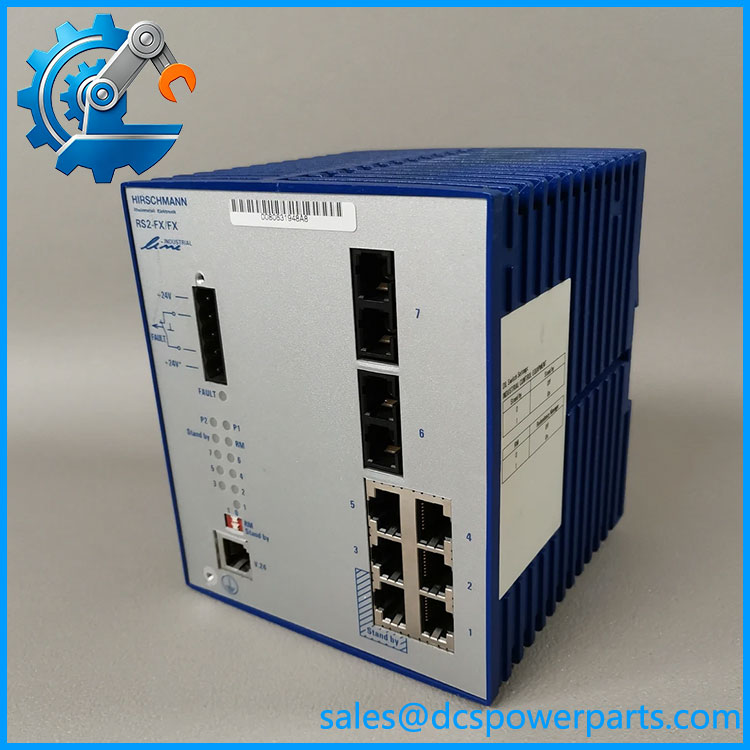
RS2-FX/FX
Major Features / Advantages
Five copper ports plus dual fiber backbone
The /FX combines five 10/100BASE-TX copper interfaces with two 100BASE-FX multimode fiber ports. This arrangement was intended for industrial Ethernet networks where local controllers, operator stations, I/O devices, or other network equipment use copper while the backbone between network segments uses optical fiber.
The distinction between /FX and /FX-ST is important. Both use multimode 100BASE-FX, but the connector differs: the standard /FX uses SC, while the -ST version uses ST connectors. Hirschmann lists them as separate device types and separate order-number families.
Managed industrial Ethernet architecture
This is not simply a media converter with multiple ports. The RS2 family includes management functions through SNMP and a Web interface. The management architecture provides access to device information, port status, diagnostics, configuration, and network-management functions.
For maintenance teams, that distinction is useful. A switch can have correct physical connections and still be wrong at the network-management level.
HIPER-Ring redundancy
The RS2 supports Hirschmann’s HIPER-Ring architecture through fiber ports 6 and 7. In the documented configuration, a ring can contain up to 50 switches, with the network returning to a line configuration in less than 0.5 seconds after a line section fails.
That is a genuine network-availability feature, but it should not be confused with generic Ethernet redundancy. The ring ports require the documented operating parameters, including 100 Mbit/s full duplex with autonegotiation disabled for HIPER-Ring operation.
Redundant 24 VDC power input
The switch accepts 24 VDC through a plug-in terminal block and supports redundant power inputs. Hirschmann specifies an operating range of 24 VDC with -25%/+33% tolerance. The fault-monitoring arrangement can detect loss of one supply input.
For control-system cabinets, this is useful because network availability can be maintained independently of a single DC supply path, provided the cabinet wiring actually uses both inputs.
VLAN and address-management capability
The RS2 management platform supports VLAN IDs from 1 through 1024 and up to 40 VLANs simultaneously per switch. Its MAC address table supports up to 4,000 entries, with up to 280 static address filters documented.
These capabilities are significant when integrating the switch into a structured industrial network. They also mean that a replacement should not be treated as a purely plug-and-play electrical component if the original configuration is still required.
Legacy network replacement
Hirschmann documentation identifies the /FX as a legacy Rail Switch, and replacement listings show newer RS20 hardware associated with the discontinued /FX.
For a running plant, the practical decision is therefore not simply “old switch versus new switch.” The engineering team needs to determine whether maintaining the existing RS2 configuration is preferable for the immediate maintenance window or whether a controlled network migration is appropriate.
Related Products
- Hirschmann /FX-ST — Same general RS2 managed architecture with two 100BASE-FX multimode fiber backbone ports, but uses ST connectors instead of the SC connectors on /FX.
- Hirschmann -SM/FX-SM — RS2 variant using single-mode fiber at 1300 nm; not a direct optical replacement for the multimode /FX.
- Hirschmann -SM/FX-LH — Mixed single-mode configuration with different optical ranges and interfaces; requires a network-level compatibility check.
- Hirschmann -LH/FX-LH — Long-haul single-mode RS2 configuration using 1550 nm optics; substantially different from /FX.
- Hirschmann RS2-TX/TX — Copper-only RS2 configuration with seven 10/100BASE-TX ports; no fiber backbone ports.
- Hirschmann RS20-0800M2M2SDAE — Newer Hirschmann replacement family identified for the discontinued /FX, with 6 × Fast Ethernet TX and 2 × multimode fiber SC interfaces according to Hirschmann replacement information. It should be evaluated as a migration/replacement product, not assumed to be a configuration-identical drop-in.
- Hirschmann RS20-0800M4M4SDAE — Newer RS20 family device associated with replacement of the /FX-ST variant; uses a different fiber connector arrangement.
FAQ
What is Hirschmann /FX used for?
It is a managed Industrial Ethernet Rail Switch used to connect copper Ethernet devices and multimode fiber backbone segments in industrial networks. It supports 10/100 Ethernet and 100BASE-FX fiber communication.
How many Ethernet ports does /FX have?
The primary network interfaces are five 10/100BASE-TX RJ45 ports plus two 100BASE-FX multimode fiber ports. The fiber ports are ports 6 and 7 and use SC connectors. The device also has a V.24 management interface and a standby interface.
Is /FX the same as /FX-ST?
No. They have the same general fiber technology, but the fiber connector differs. /FX uses SC, while /FX-ST uses ST. Do not substitute one solely because the optical specification appears similar.
Can I hot-swap /FX?
Do not treat it as hot-swappable. It is a powered network switch rather than a conventional hot-pluggable I/O module. Before removing it, assess the network redundancy, redundant power arrangement, control-system dependencies, and approved maintenance procedure. If it is the active component maintaining a network segment, removing it can cause communications loss.
Does /FX support a redundant Ethernet ring?
Yes. The RS2 family supports Hirschmann HIPER-Ring using ports 6 and 7. Hirschmann documents a ring capacity of up to 50 switches and a recovery time of less than 0.5 seconds for a failed line section under the specified configuration.
Can /FX use single-mode fiber?
Not this specific variant. /FX is the multimode 100BASE-FX version at 1300 nm. The RS2 family has separate single-mode models such as -SM/FX-SM and -LH/FX-LH.
What should I verify before purchasing an /FX?
Verify the following against the installed switch:
- Exact model: .
- Full Hirschmann order number, including the suffix.
- SC versus ST fiber connectors.
- Multimode fiber type and existing link budget.
- 1300 nm 100BASE-FX optical specification.
- Five copper 10/100BASE-TX ports.
- Existing HIPER-Ring configuration.
- VLAN and management settings.
- 24 VDC supply arrangement and whether redundant inputs are used.
- Hardware/software revision and configuration backup.
- Existing V.24/management access requirements.
- Functional test results for used or surplus equipment.
For a legacy industrial network, the optical interface is the first thing I would verify. An /FX that has the wrong connector, fiber mode, or optical configuration can look perfectly suitable on paper while still being unusable in the installed network. Hirschmann’s own documentation clearly separates the /FX, /FX-ST, and single-mode variants.