Description
Key Technical Specifications
| Parameter | Value |
|---|---|
| Manufacturer | HIMA Paul Hildebrandt GmbH |
| Model | F8652E |
| Order / Part Number | 984865264 |
| Product Type | Central Module / Safety CPU |
| System Family | H41q / HIQuad |
| Processor | Dual Intel 386EX, 32-bit |
| Processor Clock | 25 MHz |
| Operating System Memory | 1 MB Flash EPROM per processor |
| User Program Memory | 512 KB Flash EPROM per processor |
| Data Memory | 256 KB SRAM per processor |
| Serial Interfaces | 2 × RS-485 |
| RS-485 Isolation | Electrically isolated |
| Diagnostic Display | 4-digit alphanumeric display |
| Status Indicators | 2 LEDs |
| Watchdog Output | Fail-safe, 24 VDC, up to 500 mA |
| Supply | 5 VDC, approximately 2 A |
| Physical Format | Eurocard, approximately 8 TE |
| Primary System | HIMA H41q |
| Safety Application | Process safety / PES |
| Lifecycle | Legacy / discontinued |
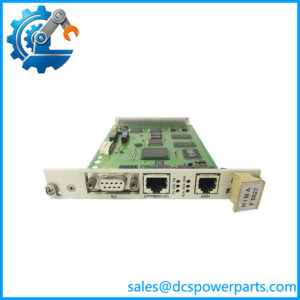
The available technical documentation identifies the F8652 family as a central module with two synchronized operating microprocessors, memory, interfaces, display, and error-handling functions. HIMA’s approval record specifically lists F8652E as the H41q central module.
One important correction: some secondary listings incorrectly describe F8652E as a digital-input module. That conflicts with HIMA’s approval documentation and the F8652 technical documentation, which identify it as the Central Module.
Product Introduction
HIMA F8652E 984865264
The HIMA F8652E 984865264 is the central processing module for the H41q safety controller family within the HIQuad platform. It executes the safety application, supervises system operation, manages communications, and performs internal diagnostics using two synchronized processors.
This is a safety-system CPU, not a conventional PLC processor. The dual-processor architecture and diagnostic design are intended for safety-related process control. For a replacement, the exact H41q configuration, firmware/application compatibility, hardware revision, and safety validation requirements must be checked before commissioning.
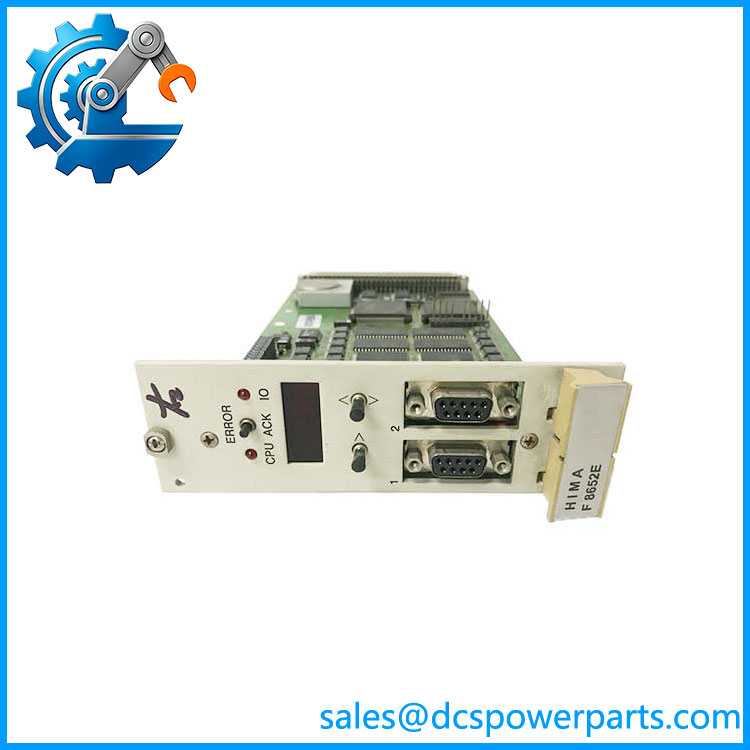
F8652E
Application Scenarios & Field Pitfalls
Engineering Pain Point
When a legacy HIMA safety controller stops executing its application, the CPU is often blamed first. That can be a mistake. A failed backplane supply, communication interface, configuration issue, or another module can prevent the F8652E from reaching a healthy operating state. On a safety system, diagnosis must be methodical because unnecessary module replacement can introduce a second configuration problem.
Typical Applications
- Oil & Gas — Emergency shutdown systems, burner management, and process safety interlocks.
- Petrochemical — Reactor, compressor, furnace, and high-pressure process protection.
- Power Generation — Turbine protection, boiler safety, and auxiliary-system shutdown logic.
- Process Manufacturing — Safety instrumented functions requiring certified safety-controller architecture.
HIMA’s approval documentation covers the H41/H41q/H51/H51q automation-system families for process-engineering applications involving digital and analog signal processing.
Technical Pitfalls to Avoid
- Do not mistake for an I/O module.
It is the central module/CPU of the H41q system. The available HIMA approval documentation is explicit on this point. - Check both processor sides.
The F8652 architecture uses two synchronized processors. A diagnostic condition affecting only one processor can produce behavior that looks different from a complete CPU failure. - Verify the 5 VDC backplane supply.
Do not replace the CPU until the rack supply has been measured under load. A marginal backplane supply can create CPU, memory, and communication symptoms simultaneously. - Record the complete part number.
Match / 984865264, not simply “F8652.” HIMA produced multiple variants within the F8652 family. - Preserve the existing application configuration.
A replacement CPU is not necessarily a plug-and-run operation. The installed application, firmware, configuration, and system-specific parameters must be verified. - Do not assume a later HIMA CPU is a drop-in replacement.
HIQuad and later HIMA platforms have different architectures. Migration should be treated as an engineered safety-system change, not a simple board swap. - Check the RS-485 interfaces.
The provides two electrically isolated serial interfaces. Damaged cabling or incorrect termination can create communication diagnostics that are mistaken for CPU failure. - Use the diagnostic display.
The four-digit alphanumeric display is an important first-level diagnostic tool. Record the displayed status/error information before power-cycling the controller. - Do not alter safety configuration casually.
Changes to a certified safety application require the appropriate engineering, verification, validation, and change-control process. - Control ESD during replacement.
This is processor and memory hardware. Use the site’s approved ESD handling procedure and avoid touching board-level circuitry unnecessarily.
Related Products
- HIMA F8652 — Earlier central-module variant for H41q systems. It shares the same general central-processing architecture, but the exact hardware and firmware compatibility must be verified before substitution.
- HIMA F8652A — Another H41q central-module variant identified in HIMA approval documentation. It should not automatically be treated as interchangeable with .
- HIMA F8650E — Central module associated with the H51q system. It belongs to a different controller family and should be selected according to the installed HIMA architecture.
- HIMA F8651E — Related central-processing hardware within the HIQuad family. Exact system compatibility depends on the controller type and application configuration.
- HIMA F6217 — Analog input module used within HIMA safety-system architectures. It performs field-signal acquisition rather than central logic execution; HIMA’s approval documentation identifies F6217 as an 8-fold analog input module.
- HIMA F3221 Series — Digital-input hardware used for acquiring discrete field signals. It complements the CPU rather than replacing it.
- HIMA F3330 Series — Digital-output modules used to drive safety-related field devices. They operate at the I/O layer while handles the application logic.
- HIMA F7133 — Power-supply hardware used with HIMA safety-system assemblies. Power integrity should be checked when diagnosing an -related system fault.
- HIMA F8627 — Communication hardware for HIMA system integration. It provides a communication function distinct from the central processor.
- HIMA K 1409 System Rack — Rack hardware used for installing HIMA HIQuad modules, including central and I/O modules. Mechanical and backplane compatibility should be confirmed before replacing a CPU.