Description
Product introduction
When an established industrial computer or test platform relies on a VME rack, replacing a failed processor board requires matching the physical interface, processor configuration, memory, and rear I/O connections. The GE Fanuc VMIVME-7807 provides embedded computing in a single-slot 6U VME format, allowing compatible systems to run supported operating systems and application software while retaining the existing chassis architecture.
The VMIVME-7807 combines Pentium M processing with Ethernet, serial ports, USB 2.0, video, IDE and optional CompactFlash storage, plus a PCI-X PMC expansion site. Its exact configuration depends on the original ordering code: processor speed, memory capacity, storage, and optional interface features may differ between units. Confirm the installed hardware and software image before choosing a replacement.
Key technical specifications
| Parameter | Specification |
|---|---|
| Product model | VMIVME-7807 |
| Manufacturer | GE Fanuc Embedded Systems |
| Product type | VMEbus single-board computer |
| Form factor | 6U VME Eurocard, single-slot |
| Cooling | Passive |
| Processor | Intel Pentium M |
| Processor speed | Configuration-dependent; family references list 1.1, 1.4, 1.6, and 1.8 GHz options |
| Chipset | Intel 855GME |
| System memory | DDR SDRAM; one 200-pin SODIMM and optional soldered memory |
| Maximum memory | Up to 1.5 GB in the documented configuration |
| Ethernet | 10/100 Ethernet and dual Gigabit Ethernet options, depending on configuration |
| Serial interfaces | Four UART-compatible ports; rear-port routing depends on the configuration |
| USB | Four USB 2.0 connections across front and rear I/O |
| Video | Front-panel SVGA and rear-I/O digital video support |
| Storage | IDE, SATA via rear I/O, and optional CompactFlash |
| Expansion | One PCI-X PMC site, 66 MHz |
| VME interface | VMEbus; compatible with system-controller or peripheral-slot use |
| Operating system support | Legacy Windows and embedded operating systems, depending on drivers and configuration |
| Working voltage | Supplied through the compatible VME chassis; confirm the required rails in the manual |
| Operating temperature | Verify the specified limits for the exact hardware revision |
| Protection rating | No verified IP rating |
These specifications describe the VMIVME-7807 family. The actual processor, memory, storage, and interface options should be confirmed using the board label and original configuration record.
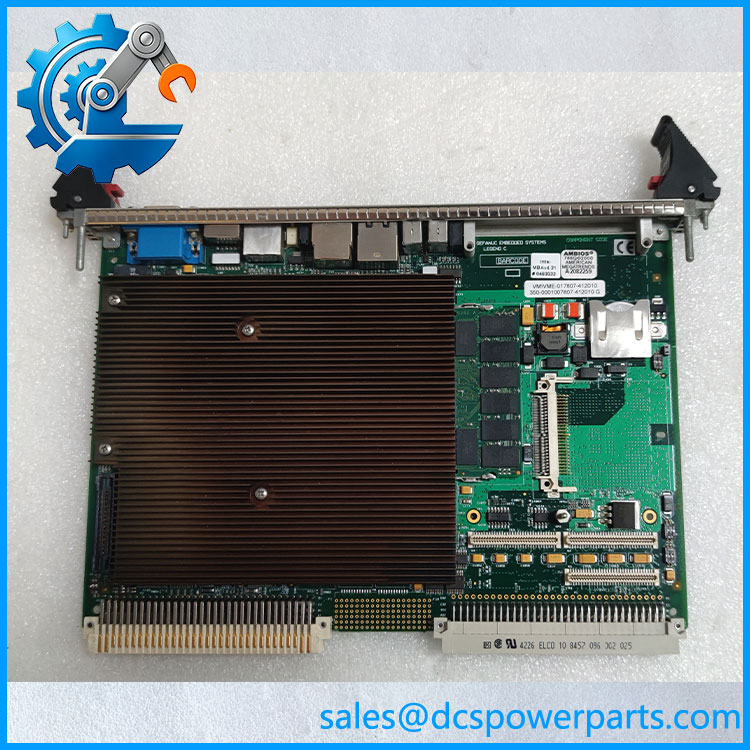
VMIVME-7807
Major features and advantages
- VMEbus integration: Fits compatible 6U VME chassis, supporting legacy embedded-computing systems without automatically requiring a chassis redesign.
- Pentium M processing: Provides local computing for control, instrumentation, monitoring, and test applications.
- Multiple network interfaces: The documented family offers standard Ethernet and optional dual Gigabit Ethernet, depending on the selected configuration.
- Flexible peripheral connections: Serial ports, USB, video, and storage interfaces support a range of industrial computing and diagnostic requirements.
- PMC expansion: The PCI-X mezzanine site supports compatible expansion hardware when the system design requires additional functionality.
- Legacy operating-system support: The platform was designed to run supported desktop and embedded operating systems, subject to the specific software image, drivers, and installed options.
Application scenarios and common pain points
Typical application areas include industrial control, process monitoring, factory automation, automated testing, instrumentation, and data acquisition.
Common maintenance considerations:
- Boot failure: Check the power rails, memory seating, BIOS settings, storage device, and operating-system image.
- Network connectivity problems: Confirm which Ethernet controllers are fitted and whether the required ports are routed to the front panel or rear I/O.
- Missing rear I/O signals: Verify the compatible rear transition module and P2/P0 connector arrangement.
- Memory or storage mismatch: Check the installed SODIMM, optional onboard memory, and CompactFlash configuration.
- PMC incompatibility: Confirm the mezzanine card’s electrical interface, mechanical clearance, and software driver requirements.
- Replacement board differences: Match the full ordering code rather than relying on VMIVME-7807 alone.
Related products
| Model | Relationship |
|---|---|
| VME-7807RC | Related VME-7807 family variant |
| VMIVME-7750 | Different GE Fanuc VME single-board computer family |
| VMIVME-7486 | Related VME embedded CPU module family |
| VMIVME-7802 | Related legacy VME computer family; verify exact configuration |
| VMIACC-0586 | Rear transition module associated with the VMIVME-7807 family |
| VMIACC-0590 | Alternative rear transition module family reference |
| VMIVME-3125 | VME analog-to-digital conversion board for data acquisition |
These products are related by platform or application, not guaranteed direct substitutes. In particular, the rear transition module must match the board’s connector routing and installed options.
Engineer’s guide before ordering
- Confirm the configuration code. Record the complete part number, processor speed, memory size, and storage options from the installed board.
- Check chassis and rear I/O compatibility. Verify VME slot requirements, transition-module model, connector routing, and any PMC expansion card.
- Validate the software environment. Confirm the operating-system image, boot media, BIOS configuration, and application dependencies before commissioning a replacement.
Important: The is a legacy embedded computer, not a universal plug-in replacement for every VME CPU board. Check the full hardware configuration and the host system’s requirements before installation.
Frequently asked questions
What is the GE Fanuc ?
It is a 6U VMEbus single-board computer based on the Intel Pentium M processor, intended for embedded computing and industrial applications.
What processor speed does the support?
The product family includes multiple Pentium M speed configurations. Published references list 1.1, 1.4, 1.6, and 1.8 GHz options, but the speed of a specific board must be verified.
How much memory can it support?
The documented design supports a 200-pin DDR SDRAM SODIMM and optional soldered memory, with up to 1.5 GB total in the specified configuration. Confirm the actual memory fitted to the unit.
Does the have Gigabit Ethernet?
The family supports dual Gigabit Ethernet on documented configurations, in addition to 10/100 Ethernet. Port availability and routing depend on the ordered hardware options.
Can the replace the VMIVME-7750?
Do not assume direct compatibility. These are different VME computer families and may differ in processor architecture, connectors, memory, firmware, and software requirements. Verify the host-system design before substituting.
Does it require a rear transition module?
Rear I/O functions may require a compatible transition module, such as a documented VMIACC-0586 or VMIACC-0590 family unit. Check the installed configuration and connector routing before ordering.
What should buyers confirm before purchasing?
Verify the complete model and ordering code, processor speed, memory and storage configuration, interface options, board condition, functional-test evidence, warranty, and confirmed stock status.