Description
Key Technical Specifications
| Parameter | Specification |
|---|---|
| Model | VMIVME-7658 |
| Manufacturer | VMIC / GE Fanuc |
| Product Type | VMEbus Single Board Computer |
| Processor | 2 × Intel Pentium III |
| Maximum CPU Speed | 1.26 GHz |
| L2 Cache | 512 KB at 1.26 GHz |
| System Bus | 133 MHz |
| SDRAM | PC133 registered ECC |
| Maximum Memory | 2 GB |
| VME Standard | VME64 / Rev. C.1 |
| VME Data Modes | D08(EO), D16, D32, BLT32, MBLT64 |
| VME Address Modes | A16, A24, A32 |
| Ethernet | 2 × 10BaseT/100BaseTX |
| SCSI | PCI-X Ultra320 |
| Serial | 2 × 16550-compatible |
| PMC Expansion | 3.3 V, 64-bit, 66 MHz |
| USB | 2 × front-panel |
| Operating Temperature | 0–45°C for 733/866 MHz; 0–40°C for 1/1.26 GHz |
| Cooling | Minimum 450 LFM forced airflow |
| Humidity | 10–90%, noncondensing |
| Power | +5 V, +12 V, and -12 VDC rails |
The published power requirement is +5 VDC at 10 A typical/14 A maximum, +12 VDC at 100 mA typical/500 mA maximum, and -12 VDC at 50 mA typical/100 mA maximum. The temperature rating depends on the installed processor speed, so a generic “-40 to +70°C” listing should not be used for this board.
Product Introduction
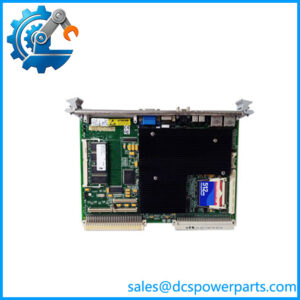
The GE Fanuc VMIVME-7658 is a high-performance-for-its-generation dual Pentium III VMEbus single-board computer designed for embedded computing inside VME systems. It combines PC-class processing with a VMEbus interface, dual Fast Ethernet, Ultra320 SCSI, serial interfaces, USB, and a PMC expansion site. The board can operate as a VMEbus master, slave, requester, interrupt handler, interrupter, and system controller.
For legacy industrial systems, the important distinction is that the VMIVME-7658 is a computer/controller board rather than an I/O module. It may host control software, data-acquisition applications, simulation workloads, or networked automation functions while communicating with other VME boards through the backplane.
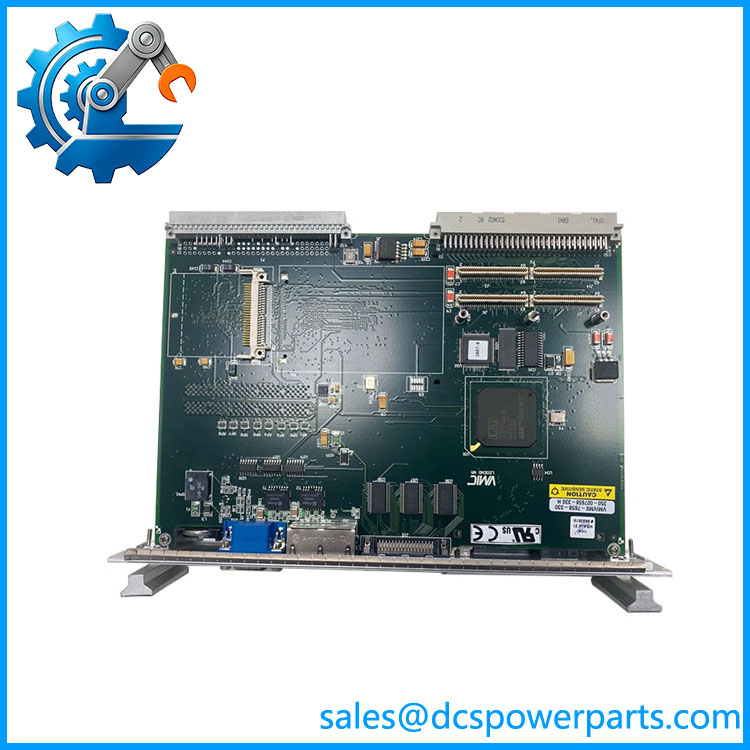
VMIVME-7658
Application Scenarios & Field Pitfalls — The Engineer’s Perspective
Engineering Pain Point
When a legacy VME controller fails, the replacement problem is rarely limited to processor speed. The installed operating system, memory configuration, VMEbus role, PMC card, storage arrangement, rear I/O wiring, and application software can all determine whether a replacement board actually returns the system to service.
Typical Applications
- Legacy industrial control computers — embedded computing within VME-based automation platforms.
- Process monitoring and data acquisition — supports processor-intensive applications alongside VME I/O hardware.
- Factory automation — the original datasheet lists factory automation and intelligent networked PLC controllers among intended applications.
- Simulation and instrumentation — suitable for embedded simulation, instrumentation, and test systems.
- Telecommunications equipment — another application category identified by the original VMIC documentation.
Technical Pitfalls
1. Verify the exact processor variant.
The VMIVME-7658 family supports several processor configurations. The original ordering scheme identifies 1.26 GHz Pentium III as an option, while memory and CompactFlash capacity are also configurable. Do not assume every VMIVME-7658 has the same CPU and memory configuration.
2. Memory configuration matters.
The board uses registered PC133 ECC SDRAM and supports up to 2 GB. A replacement populated with a different memory configuration can behave differently from the original system even when the base board number matches.
3. Cooling is not optional.
The published specification requires a minimum 450 LFM of forced air at the heatsink outlet for the stated operating-temperature ranges. In a crowded VME chassis, airflow should be checked rather than assuming the rack fan arrangement is adequate.
4. Do not confuse VMEbus power with a 24 VDC input.
Some secondary listings incorrectly describe the VMIVME-7658 as a 24 VDC input device. The original specification gives the board’s VMEbus supply requirements as +5 V, +12 V, and -12 VDC.
5. Check the VMEbus system-controller configuration.
The board can function as a VMEbus system controller, but this capability can be disabled when another board assumes that role. Changing the system-controller arrangement during replacement can affect the behavior of the entire VME rack.
6. Check the rear-I/O arrangement.
The uses the VMEbus P2 connector for IDE/floppy signals in supported configurations. The VMIACC-0562 transition board converts these signals to conventional 40- and 34-pin headers. If the original system uses rear-drive connections, this accessory and its cabling should be documented before removal.
7. PMC compatibility must be checked separately.
The PMC site provides 3.3 V signaling, 64-bit PCI, and up to 66 MHz operation. A PMC card that is physically compatible with another VME SBC is not automatically suitable for this board.
Related Products
- — configured variant with the same dual Pentium III family architecture.
- — another configured variant.
- VMIVME-7452 — compatible disk-module family supporting hard-disk and floppy configurations.
- VMIACC-0562 — IDE/floppy transition board for converting P2 rear signals to standard headers.
- VMIACC-0045 — connector adapter kit for the front-panel serial and parallel Micro-D connectors.
- VMIVME-7455 — CD-ROM capability accessory for VME systems.
- VMIVME-7750 — later-generation VME single-board computer family; architecture and processor platform differ substantially.
- VMIVME-7618 — related VMIC VME processor family for legacy embedded computing.
Procurement Note
For a replacement, record the processor speed, installed RAM, CompactFlash/storage configuration, PMC card, rear P2 wiring, operating system, and VME system-controller setting before removing the original board. The base model alone does not capture every configuration detail.
For a used or refurbished board, I would also verify POST behavior, both Ethernet ports, VMEbus access, PMC operation if installed, SCSI/IDE interfaces, serial ports, and memory stability under load before treating it as a direct field replacement.