Description
Product Overview
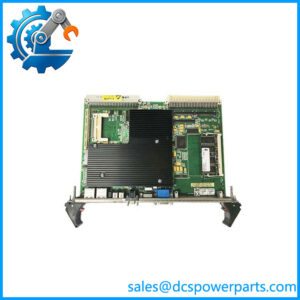
In distributed control and test systems, separate processors often need the same process data at predictable intervals. Conventional network messaging can add software overhead and timing variation, particularly when several nodes exchange high-frequency state information. A reflective memory network addresses this requirement by propagating memory updates between connected nodes, allowing each node to maintain a local copy of shared data. The GE Fanuc VMIVME-5565-110000 is a VMEbus node card designed for this type of deterministic, fiber-optic data exchange.
The GE Fanuc VMIVME-5565-110000 uses a 128 MB memory configuration and multimode fiber transmission. Data written by one node is transferred to the other nodes on the reflective memory network, reducing the need for the host processor to manage every individual transfer. The VMIVME-5565 family supports dynamic packet sizes from 4 to 64 bytes, node-to-node interrupt transfers, error detection, and an optional redundant transfer mode. Actual system performance depends on packet size, network topology, node count, host interface, and driver configuration. When replacing a card in an existing installation, verify the memory option, optical interface, cabling, driver version, and network topology rather than relying on the base model number alone.
Key Technical Specifications
| Parameter | Specification |
|---|---|
| Product Model | VMIVME-5565-110000 |
| Manufacturer | GE Fanuc / VMIC |
| Product Type | Reflective memory node card |
| Host Interface | VMEbus |
| Memory Capacity | 128 MB |
| Optical Interface | Multimode fiber |
| Serial Link Rate | 2.12 Gbaud |
| Packet Size | Dynamic, 4–64 bytes |
| Nonredundant Network Transfer | Approximately 43–170 MB/s, depending on access pattern |
| Redundant Transfer Rate | Approximately 20–87 MB/s, depending on access pattern |
| Network Capacity | Up to 256 nodes |
| Data Synchronization | Hardware-assisted reflective memory updates |
| Interrupt Support | Remote node interrupt transfers |
| Error Handling | Error detection; redundant transfer mode supported |
| Operating Temperature | 0°C to +65°C, with forced-air cooling |
| Storage Temperature | -40°C to +85°C |
| Relative Humidity | 20–80%, noncondensing |
| Power Requirements | +3.3 VDC and +5 VDC; see current draw below |
| Typical / Maximum Current at +3.3 VDC | 0.7 A typical / 1.5 A maximum |
| Typical / Maximum Current at +5 VDC | 0.7 A typical / 1.8 A maximum |
| Cooling Requirement | Approximately 300 LFM forced airflow |
| Installation | Compatible VMEbus card cage |
| Protection Rating | No IP enclosure rating specified |
| Operating Accuracy | Not applicable as a measurement instrument; timing and transfer performance depend on system configuration |
The memory, optical-interface, power, and environmental details above are based on the VMIVME-5565 family documentation and the model’s ordering code. The quoted transfer figures are workload-dependent performance ranges, not guaranteed throughput for every network.
Major Features and Advantages
Hardware-assisted reflective memory
The card propagates data written to one node’s memory to other nodes in the network. This approach can reduce application-level message handling and processor overhead when multiple computers need synchronized data. It is useful for systems that exchange control states, test results, simulation data, or other shared information at predictable intervals.
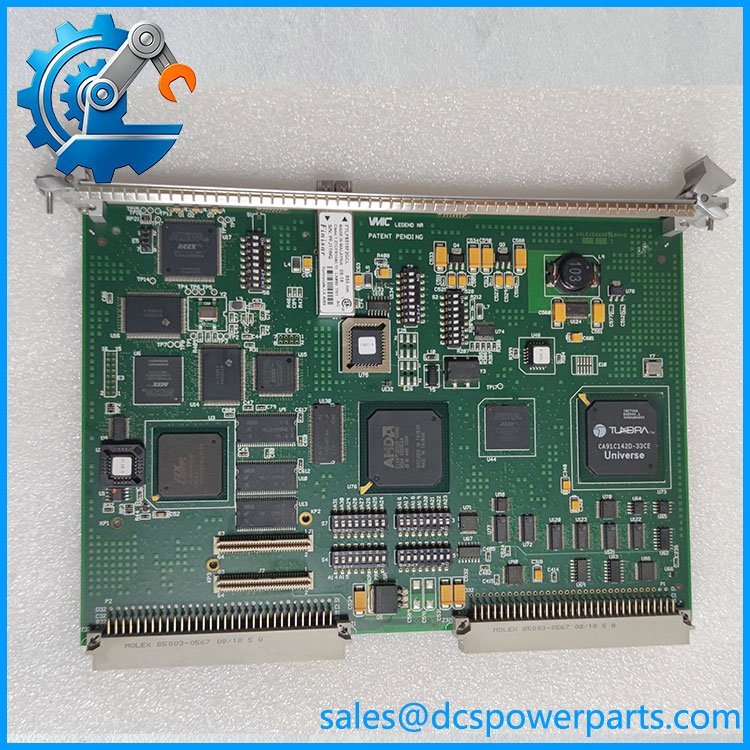
VMIVME-5565-110000
High-speed fiber-optic communication
The VMIVME-5565 family uses a 2.12 Gbaud serial optical link. Multimode fiber can support distances up to approximately 300 meters under the documented cable and link conditions. Fiber provides electrical isolation between connected nodes and reduces susceptibility to conducted electrical interference compared with copper data links.
Dynamic packet sizing
Supported packet sizes range from 4 to 64 bytes. Smaller updates can suit applications that frequently change individual data values, while larger bursts can improve transfer efficiency when several adjacent values are updated together. The actual benefit depends on the application’s write pattern and how the host accesses shared memory.
Node-to-node interrupt support
A node can signal another node through the reflective memory system. This can help an application respond to updated data without continuously polling every shared-memory location. Engineers should still verify interrupt configuration, driver behavior, and application timing on the target operating system.
Redundant transfer capability
The family documentation describes a redundant transfer mode intended to improve error suppression. Redundancy should be evaluated as part of the complete network design; it does not automatically provide full network availability or eliminate the need for suitable topology, cabling, diagnostics, and recovery procedures.
Application Scenarios and Common Pain Points
- Distributed real-time control: Shares common state data between computing nodes without relying exclusively on application-managed message exchanges.
- Industrial test systems: Distributes test measurements, commands, and status information between VMEbus-based processing units.
- Simulation and hardware-in-the-loop systems: Allows multiple processors to work from replicated data during coordinated execution.
- Legacy embedded computing: Supports existing VMEbus architectures where changing the host platform or communication design would require substantial engineering work.
- Multi-node data acquisition: Distributes acquired data among processors for synchronized processing and monitoring.
Common field problems include intermittent optical-link errors, mismatched fiber type, incorrect transmit/receive connections, inconsistent node configuration, and host software that does not support the installed card or operating system. Poor airflow can also cause instability when the board operates outside its documented cooling conditions.
Related Products and Components
These related items are useful when planning a repair or expanding a reflective memory system. They are not all direct replacements for the -110000.
| Model / Component | Description | Procurement consideration |
|---|---|---|
| -111000 | 128 MB single-mode fiber variant | Same general family, but the optical interface differs |
| -120000 | 256 MB multimode variant | Verify memory option and exact ordering-code documentation |
| -121000 | 256 MB single-mode variant | Different memory and optical configuration |
| PCIE-5565RC | PCI Express reflective memory interface family | Host interface differs from the VMEbus card |
| PMC-5565 family | PMC reflective memory interface variants | Requires a compatible PMC carrier or host |
| ACC-5595 | Reflective memory network hub | Used for supported star network configurations |
| VMISFT-RFM2G | Reflective memory driver software family | Check operating-system and hardware-version support |
| Compatible multimode fiber cable | Optical interconnect | Verify connector type, fiber specifications, and link budget |
The listed model variants follow the family documentation; verify exact suffix assignments against the original ordering table before using them as purchase equivalents.
Engineer’s Guide: Three Checks Before Replacement
1. Confirm the complete ordering code. The 110000 suffix identifies the 128 MB multimode configuration in the published ordering information. A single-mode or different-memory version may not suit the existing fiber network or software configuration.
2. Inspect the optical link and network topology. Confirm the fiber is multimode, check connector condition and transmit/receive routing, and verify whether the installation uses a ring or a supported hub-based arrangement. Do not assume that a fiber cable with a matching connector is electrically or optically suitable.
3. Validate host and driver compatibility. Check the VMEbus host interface, memory mapping, interrupt settings, and reflective memory driver. The family documentation lists operating systems including Windows, Linux, VxWorks, and Solaris across documented variants; that does not guarantee compatibility with every release or driver version.
Important: Do not substitute a PCI Express or PMC variant for a VMEbus board based only on the shared family name. The host interface and physical form factor must match the system.
Frequently Asked Questions
1. What is the GE Fanuc -110000 used for?
It is a VMEbus reflective memory node card used to distribute shared data between connected computers. Typical uses include distributed control, test systems, simulation, and embedded computing systems that need predictable data exchange.
2. How much memory does the -110000 have?
This ordering code specifies 128 MB of onboard reflective memory. Other variants offer different memory configurations, so confirm the full suffix when ordering a replacement.
3. What fiber cable does this card use?
The 110000 variant uses multimode fiber. The documented family supports multimode links up to approximately 300 meters under the specified cable conditions. Check connector type, fiber core specifications, and existing network requirements before ordering a cable.
Is the compatible with any VMEbus computer?
No. A compatible VMEbus slot is necessary but not sufficient. The host must support the card’s bus interface, memory mapping, interrupts, and driver software. Confirm compatibility with the existing host hardware and operating system.
5. Can I replace it with a PCIE-5565RC?
Not as a direct plug-in replacement. The PCIE-5565RC uses a PCI Express host while is a VMEbus card. A change would require a compatible host and an engineering review of drivers, software, and system integration.
6. What should I check when purchasing a used or surplus card?
Request the full model label and clear photographs of the board and optical connector. Ask whether the card has been functionally tested, whether the optical link and memory transfer have been verified, and what warranty or return conditions apply. Confirm that the supplied unit is the 128 MB multimode version.
Is the discontinued, and how should I plan lead time?
Some supplier records identify this model as discontinued. Availability may therefore depend on remaining stock, tested surplus units, or refurbished inventory. Confirm the actual unit’s condition, test scope, warranty, and dispatch schedule before treating it as a critical-spares solution.
Procurement recommendation: For a reliable replacement, match the complete part number, 128 MB memory configuration, multimode optical interface, and VMEbus host requirements. For commissioning, request evidence of memory transfer, optical-link operation, and interrupt handling—not just a visual inspection or power-on report.