Description
Product Introduction
When two or more industrial computers must exchange time-sensitive data without depending on conventional network protocol stacks, ordinary Ethernet communication may not meet the application’s timing requirements. Reflective memory addresses this need by distributing writes across connected nodes, allowing each system to access a local memory image of shared data.
The GE PCIE-5565RC-200000 reflective memory interface card uses a PCI Express host connection and multimode fiber-optic networking. Its 256 MB memory configuration suits compatible real-time simulation, data acquisition, test, and distributed control systems. Before ordering, verify the fiber type, driver support, topology, and compatibility with the other 5565-series nodes.
Key Technical Specifications
| Parameter | Specification |
|---|---|
| Manufacturer lineage | GE Intelligent Platforms / VMIC; now associated with Abaco Systems |
| Model | PCIE-5565RC-200000 |
| Product family | 5565 Reflective Memory |
| Product type | PCI Express reflective-memory node card |
| Host interface | PCI Express, four lanes |
| PCIe signaling | 2.5 GT/s per lane, PCIe Gen 1 |
| Onboard memory | 256 MB SDRAM, based on the 2 memory-option code |
| Fiber mode | Multimode, based on the 0 transmission-mode code |
| Fiber-optic rate | Approximately 2.12 Gbaud serial link |
| Maximum transfer rate | Up to 170 MB/s for nonredundant transfer under specified burst conditions |
| Redundant transfer rate | Up to 87 MB/s under specified burst conditions |
| Network capacity | Up to 256 nodes in a compatible reflective-memory network |
| Typical latency | Hundreds of nanoseconds between nodes; exact performance depends on network conditions |
| Data transfer | Hardware-assisted reflective memory with transmit/receive FIFOs |
| Interrupt support | Supported |
| Operating systems | Linux, VxWorks, and supported Windows versions; verify driver and OS revision |
| Fiber distance | Up to 300 m for the documented multimode fiber configuration |
| Operating temperature | 0°C to +65°C with forced-air cooling |
| Storage temperature | −40°C to +85°C |
| Power requirements | PCIe card; confirm current requirements against the hardware manual |
| Product lifecycle | Restricted production phase announced in 2022; confirm current sourcing and support status |
Specifications are based on the PCIE-5565RC family documentation. Maximum throughput figures are dependent on transfer size and network mode; they should not be interpreted as guaranteed application-level throughput.
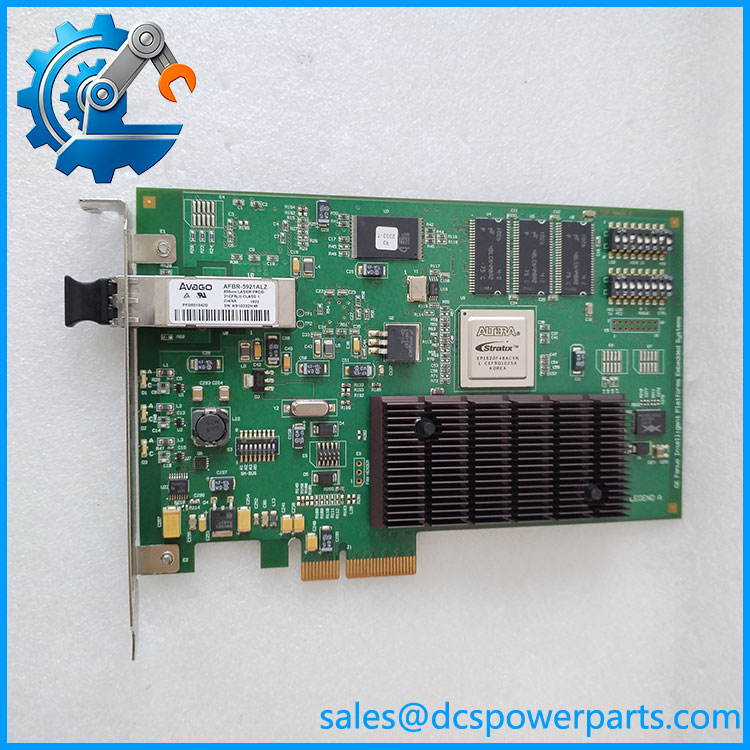
PCIE-5565RC-200000
Application Scenarios & Pain Points
A distributed system can miss real-time deadlines when data exchange depends on unpredictable software scheduling or network overhead. Reflective memory is designed for applications that need fast, consistent sharing of data between multiple compatible computers.
- Real-time simulation: Distribute model states and simulation data between processing nodes with predictable update behavior.
- Automated test systems: Share test measurements, control states, and acquisition data across multiple computers.
- Industrial data acquisition: Provide a shared data image for compatible acquisition and processing nodes.
- Distributed control and defense systems: Support low-latency communication between specialized computers where the system architecture requires deterministic data exchange.
Field note: Fiber mode and topology are easy to overlook when replacing an older card. Confirm that every connected node uses compatible reflective-memory hardware, optical interfaces, and network settings. A card can be correctly detected by the host PC yet fail to join the existing network because of a fiber or configuration mismatch.
Related Products
These products belong to the same reflective-memory ecosystem or provide related networking functions. They are not all direct substitutes.
- PCIE-5565RC — The base PCI Express reflective-memory card family; available memory and fiber options depend on the suffix.
- PCIE-5565PIORC — Low-profile PCIe reflective-memory node card. It is a different hardware variant, so confirm mechanical fit and configuration before considering it.
- PCI-5565 — Legacy conventional PCI reflective-memory interface; uses a different host bus from the PCIE-5565RC.
- PMC-5565PIORC — PMC-form-factor reflective-memory card for compatible carrier systems.
- VME-5565 — VMEbus reflective-memory card for VME-based computers and control systems.
- VMIPCI-5565 — Earlier PCI reflective-memory product family; hardware and driver compatibility must be checked.
- ACC-5595 reflective-memory hub — Network component used in supported reflective-memory topologies where a hub-based architecture is required.
Abaco’s product information lists PCIE-5565PIORC as an alternative to the PCIE-5565RC. However, the form factor and exact system requirements must be assessed before treating it as a replacement.
Engineer’s Guide: Three Replacement Pitfalls
1. Match fiber mode and optical distance. Warning: The 200000 configuration indicates multimode fiber. Do not assume a single-mode card or optical link is interchangeable. Check the installed transceivers, cable type, connector, and required distance.
2. Confirm memory capacity and node compatibility. The 256 MB configuration must be compatible with the existing reflective-memory network and application. Confirm the other nodes’ card models, memory configurations, firmware, and network topology before replacement.
3. Verify host drivers and software before the outage. The card requires a compatible host environment and driver. Check operating-system version, PCIe slot availability, BIOS behavior, driver package, interrupt/DMA requirements, and application access to reflective memory. Preserve existing configuration files and validate data exchange between nodes before returning the system to service.
Frequently Asked Questions
Q1: What is the -200000 used for?
It is a PCI Express reflective-memory interface card. It allows compatible computer nodes to share data through a fiber-optic network, with each node maintaining local memory that reflects writes distributed across the network.
Q2: Does this model have 128 MB or 256 MB of memory?
The 2 memory-option code in the published ordering scheme indicates 256 MB of onboard SDRAM. Verify the complete card label to confirm that the supplied unit matches the specified configuration.
Q3: Does the 200000 suffix indicate multimode fiber?
Yes. In the documented ordering scheme, the memory option 2 identifies 256 MB, and the transmission-mode option 0 identifies multimode fiber. The remaining 000 positions are reserved in that ordering scheme.
Q4: What data-transfer speed can it achieve?
The documented maximum is up to 170 MB/s for nonredundant transfers using 64-byte bursts. The specified redundant transfer rate is up to 87 MB/s under similar burst conditions. Actual performance depends on transfer size, topology, and host behavior.
Q5: Can it replace a PCI-5565 or VME-5565 card?
Not directly. These cards use different host-bus interfaces. The PCI Express requires a compatible PCIe host and corresponding software support; replacing a PCI or VME card may require a different computer platform and engineering work.
Q6: Is the still in production?
Abaco Systems announced that the entered a Restricted Production Phase on January 31, 2022. For current procurement, confirm availability, warranty, repair support, and any recommended migration path directly with the supplier.
Q7: What should I check when buying a refurbished card?
Request photos of the actual card and its identification label, confirmation of the 256 MB configuration and multimode optical interface, and details of the functional test. Where possible, ask for evidence that the card is recognized by a compatible host and can exchange data with another reflective-memory node. Confirm the included bracket, optical connectors, condition declaration, and warranty in writing.