Description
Key Technical Specifications
| Parameter | Value |
|---|---|
| Manufacturer | GE |
| Model | IS420ESWBH3A |
| Product Type | Industrial Ethernet IONet Switch |
| Series | Mark VIe / Mark VIeS |
| Functional Abbreviation | ESWB |
| Network Interface | IONet Ethernet |
| Ethernet Ports | 16 × RJ45 copper ports |
| Data Rate | 10/100 Mbps Auto-Negotiation |
| Ethernet Standard | IEEE 802.3 / 802.3u / 802.3x |
| Fiber Ports | None |
| Duplex Mode | Full/Half Duplex Auto-Negotiation |
| MAC Address Table | Up to 4K MAC addresses |
| Packet Buffer | 256 KB |
| Power Supply | 24/28 VDC |
| Power Inputs | Dual redundant diode-OR power inputs |
| Power Consumption | Approx. 1 A maximum |
| Cooling Method | Convection cooled |
| Mounting | DIN rail / panel mounting |
| Dimensions | 188 × 86 × 56 mm |
| Operating Temperature | -40°C to +70°C |
| Storage Temperature | -40°C to +85°C |
| Hazardous Location Rating | Class I Div 2 / Zone 2 capability |
| Application | Mark VIe turbine control communication network |
Product Introduction
GE IS420ESWBH3A Overview
The GE IS420ESWBH3A is an industrial Ethernet IONet switch module designed for GE Mark VIe and Mark VIeS turbine control systems. It provides the communication infrastructure required to connect distributed control components, including controllers, I/O packs, and other network devices within a turbine automation architecture.
The GE IS420ESWBH3A operates as an ESWB series industrial Ethernet switch with sixteen copper Ethernet ports supporting 10/100Base-TX communication. It is designed specifically for GE control networks where deterministic communication between control components is required. Unlike general-purpose office Ethernet switches, the module is intended for industrial cabinet environments with continuous operation requirements.
The GE IS420ESWBH3A provides the connection layer for Mark VIe IONet architectures, allowing multiple I/O devices and controllers to exchange process data. The switch includes redundant 24/28 VDC power inputs, enabling continued operation in systems designed with separate power feeds.
The GE IS420ESWBH3A is commonly installed in gas turbine, steam turbine, and power plant automation cabinets. It supports communication between Mark VIe controllers and field-level I/O hardware, making it an important component in turbine protection, sequencing, monitoring, and control applications.
When replacing an , engineers should verify the exact Mark VIe cabinet design, network topology, cable arrangement, firmware compatibility, and switch hardware revision. Although the unit functions as an Ethernet switch, it is part of a specific turbine control communication architecture.
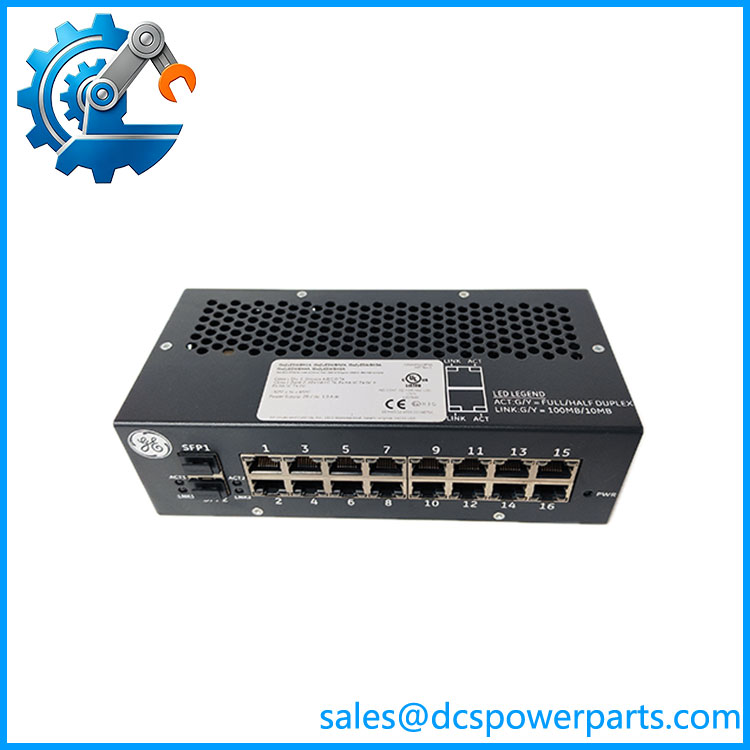
IS420ESWBH3A
Application Scenarios & Field Considerations
Engineering Pain Point
A turbine control system reports communication faults, intermittent I/O pack loss, or controller network alarms. The Ethernet switch may be suspected, but network faults can also originate from cabling, connectors, power supply issues, or incorrect topology.
Recommended troubleshooting steps:
- Check switch power LEDs
- Verify RJ45 link/activity indicators
- Inspect Ethernet cable condition
- Confirm redundant power inputs
- Review IONet communication diagnostics
- Check network topology against drawings
The provides the communication path, but reliable operation depends on the complete industrial network installation.
Typical Applications
Gas Turbine Control Systems
Used for:
- Mark VIe controller communication
- I/O pack networking
- Turbine sequencing systems
- Protection and monitoring networks
Steam Turbine Automation
Applied for:
- Control cabinet networking
- Distributed I/O communication
- Plant auxiliary systems
Combined Cycle Power Plants
Used for:
- Multi-controller architectures
- Balance-of-plant integration
- Distributed control communication
Industrial Power Generation
Applied for:
- Generator control systems
- Plant monitoring networks
- Safety-related communication structures
Technical Pitfalls to Avoid
1. Verify Network Architecture
Before replacement, confirm:
- IONet topology
- Port assignments
- Controller connections
- Cable routing
Incorrect network arrangement can prevent controllers or I/O packs from communicating.
2. Check Power Supply Configuration
Verify:
- 24/28 VDC input wiring
- Redundant power connections
- Terminal assignments
- Cabinet protection circuits
A network failure may actually be caused by loss of switch power.
3. Inspect Ethernet Cabling
Common issues include:
- Damaged Cat5e cables
- Loose RJ45 connections
- Excessive cable bending
- EMI interference
Industrial Ethernet performance depends heavily on cable quality and installation.
4. Confirm Replacement Revision
Check:
- Exact catalog number
- Hardware revision
- Mark VIe system version
- Existing engineering documentation
Similar-looking ESW modules may have different fiber port configurations or system applications.
Related Products
- GE IS420ESWAH3A
Mark VIe IONet switch with 8-port configuration for smaller network installations. - GE IS420ESWBH1A
ESWB IONet switch variant with fiber communication capability. - GE IS420UCSBS1A
Mark VIe controller module used with ESWB communication networks. - GE IS230 Series I/O Packs
Distributed I/O modules connected through Mark VIe IONet architecture. - GE Mark VIe / Mark VIeS Control System
Turbine control platform using ESWA and ESWB Ethernet switch modules.