Description
GE IS400TCATH1ACB TCA Thermocouple Input Terminal Board
Product Introduction
The GE IS400TCATH1ACB is a TCA thermocouple input terminal board used within the GE Mark VIe turbine control architecture. Its primary job is to provide the field termination and signal interface for thermocouple temperature measurements before those signals are processed by the associated Mark VIe I/O electronics. This makes it a field-interface component rather than a standalone controller or conventional analog input card. The board is intended for turbine applications where temperature measurements are part of monitoring, sequencing, regulation, and protection functions.
The GE IS400TCATH1ACB supports Type E, J, K, and T thermocouple inputs according to available product documentation. The board incorporates cold-junction compensation, EMI filtering, open-thermocouple detection, and surge suppression. Field wiring terminates at screw terminals, while the board connects to the associated PCAA analog I/O pack through a flat ribbon-cable connection. The architecture can be configured for simplex, dual, or triple-modular-redundant arrangements, depending on the Mark VIe control design.
For procurement, the exact part-number spelling is important. The supplied identifier IS400TCATHIACB is reported by one current source as a transcription error; IS400TCATH1ACB is the corresponding documented GE identifier. Do not silently substitute related IS400TCATH1A, IS230TCATH1A, or other TCAT variants without checking the complete Mark VIe I/O configuration and physical board markings. Related TCAT assemblies can have different hardware arrangements and system connections.
Technical Specifications
| Parameter | Specification |
|---|---|
| Product Model | IS400TCATH1ACB |
| Manufacturer | GE |
| Product Type | TCA Thermocouple Input Terminal Board |
| Control System | Mark VIe |
| Application | Turbine control / temperature measurement |
| Thermocouple Types | Type E, J, K, T |
| Cold Junction Compensation | Integrated |
| EMI Filtering | Yes |
| Open Thermocouple Detection | Yes |
| Surge Suppression | Yes |
| Field Interface | Screw terminal blocks |
| I/O Pack Interface | Flat ribbon cable |
| Associated I/O Pack | PCAA family |
| Redundancy | Simplex / Dual / TMR |
| Supply | Mark VIe system/backplane arrangement; verify exact system configuration |
| Mounting | Mark VIe I/O terminal-board assembly |
| Operating Temperature | 0 to +60°C reported by secondary documentation |
| Storage Temperature | -40 to +85°C reported by secondary documentation |
| Humidity | 5–95% RH, non-condensing, reported by secondary documentation |
| Protection Rating | Not established for the bare terminal board |
| Communication Protocol | No standalone fieldbus protocol |
| Primary Function | Thermocouple signal termination/interface |
The temperature and humidity values above come from secondary documentation and should be confirmed against the applicable GE Mark VIe hardware manual for the exact revision. The board should not be assigned a standalone IP rating because it is an internal control-system terminal board rather than a field enclosure.
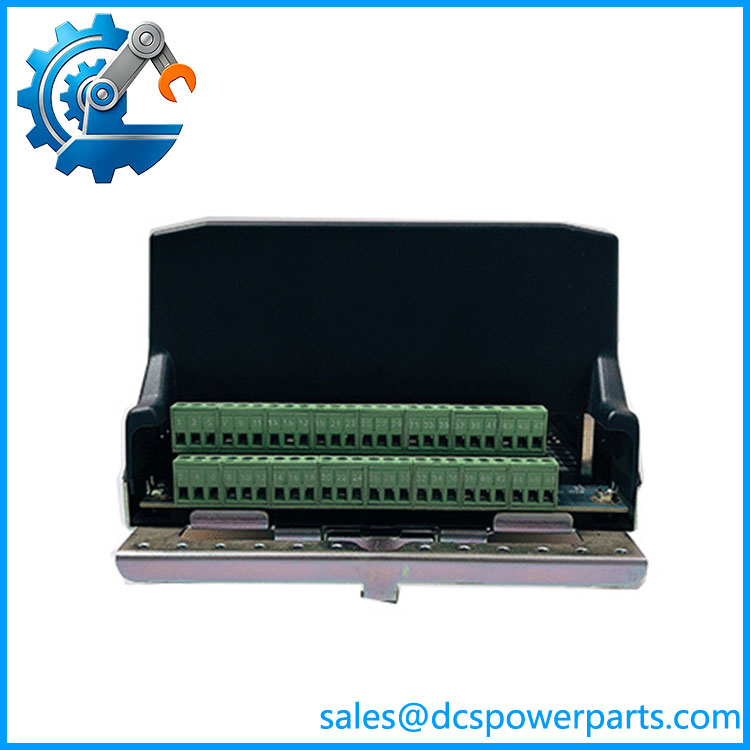
IS400TCATHIACB
Main Features and Engineering Considerations
Thermocouple Field Interface
The board provides the physical termination point for thermocouple wiring in the Mark VIe system. This is important because thermocouple signals are low-level millivolt signals and are sensitive to wiring quality, grounding, temperature gradients, and electromagnetic interference.
Cold Junction Compensation
Integrated cold-junction compensation is a key part of the TCA architecture. The thermocouple measurement depends on the temperature at the termination point, so the CJC arrangement must remain correctly installed and connected when replacing the board.
PCAA Integration
The IS400TCATH1ACB should not be treated as an independent analog input module. Available documentation identifies the TCA board as working with the PCAA analog I/O pack. The field signals are routed from the terminal board to the I/O electronics through the specified interconnection.
Redundant Turbine Control
The Mark VIe architecture supports simplex, dual, and TMR configurations. In a redundant turbine installation, the wiring arrangement and number of associated I/O packs are therefore part of the replacement specification. Replacing one terminal board without confirming the corresponding redundant-channel arrangement can create commissioning problems.
Signal Integrity
Thermocouple circuits should be checked for correct polarity, thermocouple alloy, extension-wire compatibility, shielding, grounding, and terminal condition. A terminal-board replacement can appear successful electrically while still producing temperature errors if field wiring is incorrectly landed.
Exact Revision Matching
Related GE boards can have similar names and physical appearances. The distinction between , IS400TCATH1A, and other TCAT assemblies matters. The physical label should therefore be checked rather than relying only on the cabinet slot designation.
Application Scenarios
- GE Mark VIe gas turbine control systems
- Steam turbine control systems
- Combined-cycle power plants
- Turbine exhaust-temperature measurement
- Turbine casing temperature monitoring
- High-temperature process measurement
- Mark VIe TCA thermocouple input maintenance
- Simplex, dual, and TMR turbine control architectures
Engineer’s Guide: Field Pitfalls
Verify the part number first. If the physical board says , use that complete identifier. The supplied IS400TCATHIACB appears to be a transcription error in current secondary records.
Do not confuse TCA with TCAS or TCAT assemblies. The names are similar, but their functions and system connections differ.
Do not treat the board as a standalone thermocouple converter. The associated Mark VIe PCAA I/O electronics perform the applicable signal-processing functions.
Check thermocouple type and polarity. Type E, J, K, and T circuits have different thermoelectric characteristics. Incorrect type selection or polarity can produce apparently plausible but incorrect temperatures.
Inspect CJC hardware and wiring. A damaged terminal, poor thermal contact, or wiring problem around the CJC area can create temperature errors that are difficult to distinguish from a sensor fault.
Check redundant wiring. For dual or TMR applications, identify every associated I/O channel and field termination before removing the original board.
Do not use generic 4–20 mA specifications. Some secondary listings incorrectly describe this part as a general analog-input board. Its documented role is specifically associated with thermocouple termination/interface.
Frequently Asked Questions
What is GE ?
It is a TCA thermocouple input terminal board for the GE Mark VIe turbine control system.
What does TCA mean in this application?
TCA refers to the thermocouple-oriented terminal-board function within the Mark VIe analog I/O architecture. The board provides field thermocouple termination and interfaces with the associated PCAA electronics.
Which thermocouple types are supported?
Available documentation identifies Type E, J, K, and T thermocouple inputs for this specific board.
Does the board provide cold-junction compensation?
Yes. The documented TCA configuration incorporates cold-junction compensation for thermocouple measurement.
Is a PLC or CPU module?
No. It is a thermocouple terminal/interface board used within the Mark VIe I/O architecture.
Does it communicate directly over Ethernet?
No standalone Ethernet or fieldbus communication function should be attributed to the terminal board. Communication and signal processing are handled by the associated Mark VIe I/O electronics.
Is the same as IS400TCATH1A?
They are related TCAT variants, but they should not automatically be considered interchangeable. The complete hardware marking and Mark VIe system configuration should be checked before substitution.
Procurement Note
For purchasing, specify rather than the supplied IS400TCATHIACB spelling, and request a photograph of the actual board label before acceptance. Confirm the associated PCAA I/O pack, redundancy configuration, thermocouple types, field-terminal arrangement, and board revision.
For a used or refurbished unit, inspection should include terminal condition, connector integrity, PCB contamination, corrosion, conformal-coating condition where applicable, and functional verification of the thermocouple interface. The exact Mark VIe system configuration should be documented before replacing the board.