Description
GE IS220PHRAH1B Mark VIe HART Analog I/O Module
Product Overview
The is a Mark VIe HART-enabled analog I/O pack designed to interface process instrumentation with the GE turbine control system. Its channel configuration is 10 analog inputs plus 2 analog outputs, making it different from the Mark VIe PAICH family even though both occupy the distributed analog-I/O layer. The PHRA accepts voltage and current inputs, provides two 0–20 mA analog outputs, and can relay HART communication between compatible field devices and an Asset Management System. GE documentation identifies the PHRA as an interface between one or two I/O Ethernet networks and the associated analog I/O terminal board.
From an engineering standpoint, the is not simply an analog signal converter. It contains a processor board common to Mark VIe distributed I/O packs and an acquisition section dedicated to the PHRA function. Inputs 1–8 support 4–20 mA and ±5 VDC; inputs 9–10 support 4–20 mA or ±1 mA. The two analog outputs support 0–20 mA operation. The input converter uses 16-bit A/D conversion, while the output section uses a 14-bit D/A converter. Normal input scanning is specified at 5 ms, with the Mark VIe controller operating at its own control-frame rate.
For a plant maintaining an existing Mark VIe installation, the is primarily a replacement I/O-pack decision, not an opportunity to substitute an arbitrary analog card. The terminal-board model, I/O wiring, HART requirements, controller configuration, and installed hardware revision all need to agree. GE’s documentation also describes automatic hardware identification and diagnostics covering RAM, flash memory, Ethernet ports, internal supplies, and hardware-set matching.
Product Introduction
A failed PHRA pack can take a group of turbine analog signals and associated HART communications out of service even when the terminal board and field instruments remain healthy. The sits directly between the Mark VIe IONet architecture and the SHRA analog terminal-board family, so replacement should begin with hardware identification rather than software assumptions.
The practical specification is straightforward: 10 AI + 2 AO, HART support, 16-bit input conversion, 14-bit output conversion, and a 5 ms normal scan. That combination makes PHRA suitable for process measurement and analog control functions where smart-transmitter communication is part of the maintenance strategy.
Key Technical Specifications
| Parameter | Specification |
|---|---|
| Product Model | |
| Manufacturer | GE |
| Control System | Mark VIe |
| Product Type | HART-enabled analog I/O pack |
| Analog Channels | 12 total: 10 AI + 2 AO |
| Analog Inputs 1–8 | 4–20 mA DC or ±5 VDC |
| Analog Inputs 9–10 | 4–20 mA DC or ±1 mA |
| Analog Outputs | 2 × 0–20 mA |
| Input Resolution | 16-bit A/D |
| Output Resolution | 14-bit D/A |
| Output Accuracy | 0.5% according to GE system documentation |
| Maximum Output Load | 800 Ω for 0–20 mA output |
| Normal Scan Time | 5 ms / 200 Hz |
| AC Common-Mode Rejection | 60 dB at 60 Hz |
| DC Common-Mode Rejection | 80 dB |
| Common-Mode Voltage | ±5 V |
| I/O Network | One or two I/O Ethernet networks |
| Ethernet Interface | Dual RJ45 |
| Field Interface | DC-62 connector to terminal board |
| Compatible Terminal Boards | SHRA family, including ISx0ySHRAH1A / ISx0ySHRAH2A |
| HART | Supported |
| Supply | 28 VDC nominal; certified configuration data specifies 28 VDC |
| Ambient Temperature | -30 to +65°C for the H1B certified configuration |
| Dimensions | Approx. 8.26 × 4.19 × 12.1 cm |
| Mounting | Mark VIe distributed I/O architecture |
| Diagnostics | Power-up and continuous hardware diagnostics |
GE’s Mark VIe system documentation specifies the PHRA input spans, conversion resolution, scan time, common-mode rejection, output load, and physical dimensions. GE certification documentation specifies a 28 VDC supply and -30 to +65°C ambient range for the configuration.
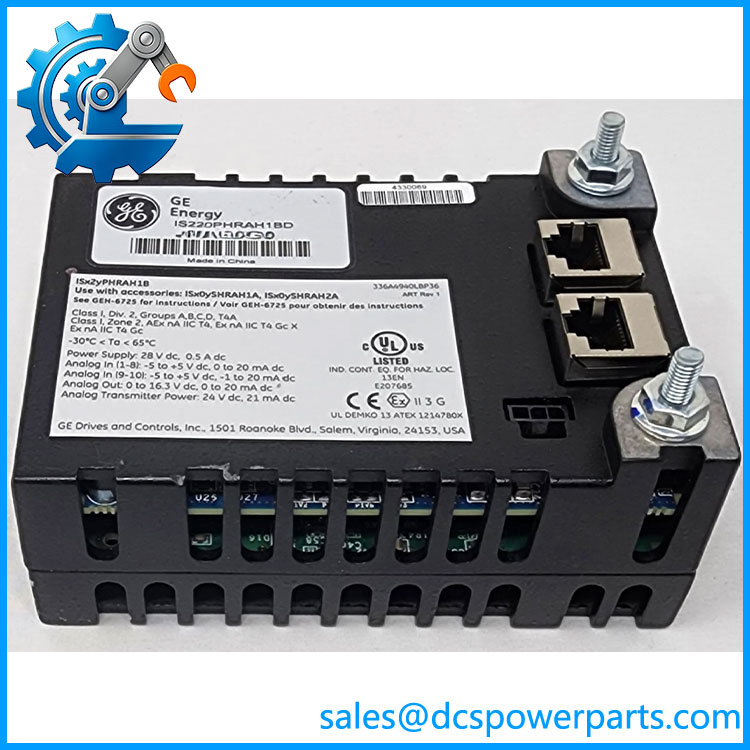
IS220PHRAH1B
Major Features / Practical Advantages
1. 10 Analog Inputs Plus 2 Analog Outputs
The PHRA configuration provides 10 analog inputs and 2 analog outputs per terminal board. Inputs 1–8 accept either ±5 VDC or 4–20 mA, while inputs 9–10 add ±1 mA capability. The two analog outputs provide 0–20 mA operation. This makes channel assignment important during replacement because not every PHRA input has exactly the same electrical range.
2. HART Communication
HART support is one of the defining characteristics of PHRA. When the field circuit is configured for 4–20 mA operation, the pack can relay HART messages between HART-capable field instruments and an Asset Management System. This is useful for transmitter diagnostics and maintenance data without requiring a separate HART communication module.
3. Mark VIe Distributed I/O Architecture
The uses the Mark VIe distributed I/O architecture rather than behaving like a conventional centralized PLC analog card. Communication with the controller occurs over the Mark VIe I/O Ethernet network, while the pack connects to its terminal board through the dedicated field connector. GE’s system documentation shows support for one or two Ethernet connections.
4. 16-Bit Analog Acquisition
A 16-bit A/D converter provides the input conversion resolution. GE specifies measurement accuracy better than 0.1% of full scale across the documented -30 to +65°C range, with typical accuracy at 25°C considerably tighter. Actual loop accuracy in a plant still depends on transmitter accuracy, wiring, termination resistance, grounding, calibration, and the configured signal range.
5. Built-In Hardware Diagnostics
The PHRA performs power-up checks covering RAM, flash memory, Ethernet ports, and processor-board hardware. It also continuously monitors internal power supplies and verifies electronic identification across the processor, acquisition, and terminal-board hardware. That matters during troubleshooting because a communication fault is not automatically evidence of a failed analog acquisition circuit.
6. B-Revision Hardware
The H1B designation belongs to the later Mark VIe I/O-pack technology generation. GE’s product-life-cycle documentation identifies as the available replacement technology for the earlier IS220PHRAH1A. GE stated that the updated Mark VIe I/O packs were backward-compatible with the earlier technology.
That does not mean every PHRA replacement can be approved without checking the installed system. Controller software, terminal-board identification, I/O configuration, and site-specific wiring still need verification.
7. Hazardous-Area Certification
GE certification documents include among Mark VIe equipment with hazardous-location certifications. The published certification data identifies the PHRAH1B within an Ex nA / Ex ec IIC T4 Gc certified equipment family and specifies a -30 to +65°C ambient range for this model. The exact installation must still conform to the applicable certificate, system configuration, and site hazardous-area requirements.
Related Products
- IS220PHRAH1A — Earlier PHRA HART analog I/O pack technology. The H1B version was introduced as the updated technology replacement.
- IS220PAICH1B — Mark VIe analog I/O pack with 10 analog inputs and 2 analog outputs, but without the PHRA-specific HART function.
- IS220PAICH2B — Analog I/O pack variant with high-current analog output capability; electrically different from PHRA.
- IS220PAOCH1B — Eight-channel 0–20 mA analog output pack.
- IS220PCLAH1B — Core analog I/O pack intended for aero-derivative turbine applications.
- IS220PCAAH1B — Core analog I/O pack associated with heavy-duty gas turbine applications.
- IS200SHRAH1A — SHRA-family analog terminal board associated with PHRA.
- IS200SHRAH2A — Alternative SHRA terminal-board configuration used with PHRA.
- IS220PPRFH1B — Mark VIe PROFIBUS communication I/O pack; communications function rather than analog acquisition.
- IS220PTCCH1B — Mark VIe thermocouple I/O pack for temperature measurement.
FAQ
What is the GE used for?
It is a Mark VIe HART-enabled analog I/O pack providing 10 analog inputs and 2 analog outputs. It interfaces the analog terminal board with the Mark VIe I/O Ethernet network and supports HART communication on compatible 4–20 mA circuits.
How many analog channels does the PHRAH1B have?
There are 12 channels per terminal board: 10 analog inputs and 2 analog outputs. GE’s documentation specifically identifies the PHRA configuration this way.
What input signals can the accept?
Inputs 1–8 support 4–20 mA or ±5 VDC. Inputs 9–10 support 4–20 mA or ±1 mA. This difference matters when checking an existing I/O configuration.
Does the PHRAH1B support HART?
Yes. In 4–20 mA mode, the PHRA can relay HART messages between HART-enabled field devices and an Asset Management System.
Can I hot-swap the ?
Do not assume hot replacement simply because the module is a Mark VIe distributed I/O pack. The applicable Mark VIe system architecture and site procedures determine whether a particular replacement can be performed online. Before removal, confirm the I/O configuration, network arrangement, terminal-board condition, and approved maintenance procedure.
Does it support firmware v3.1?
The catalog number does not establish firmware v3.1. The pack has application code and hardware identification mechanisms, but the installed firmware/software revision must be checked from the actual Mark VIe system rather than inferred from the part number. GE documentation describes the pack checking its loaded application code against the identified hardware set.
Can PHRAH1B replace PHRAH1A?
GE’s lifecycle documentation identifies as the updated technology replacement for IS220PHRAH1A and states that the updated Mark VIe I/O packs were backward-compatible with the earlier technology. Even so, verify the terminal board, controller software, configuration, and site certification before approving the replacement.
What should be checked before purchasing a replacement?
Check the complete catalog number, hardware revision, terminal-board part number, I/O channel assignments, HART requirements, controller configuration, and physical condition. For a used or New Surplus pack, request evidence that the Ethernet interfaces, power-up diagnostics, analog channels, and terminal-board identification have been tested.
Procurement Note
The is a relatively well-documented Mark VIe I/O pack, but the main procurement mistake is treating it as interchangeable with every GE analog I/O pack. PHRA is specifically the HART-enabled 10-AI/2-AO configuration, and its terminal-board and channel characteristics must match the installed Mark VIe application.
For a replacement purchase, record the existing revision, SHRA terminal-board number, IONet connection arrangement, channel configuration, and HART requirements before ordering. If the unit is listed as New Surplus, that designation should not be treated as proof that it has never been installed; request actual hardware and functional test evidence.
One other point worth checking: GE documentation distinguishes the H1B from the earlier H1A technology generation, so the B suffix is meaningful procurement information, not cosmetic labeling.