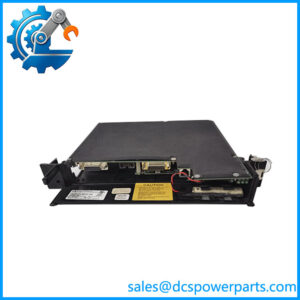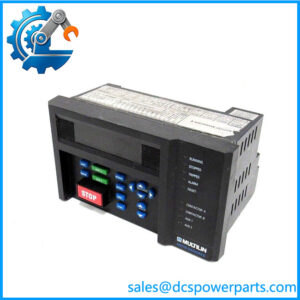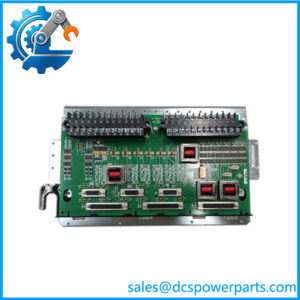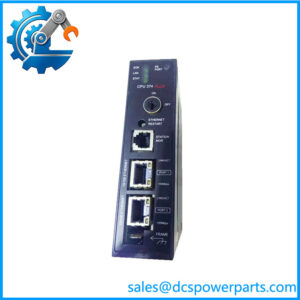
Description
GE Multilin EPM9650 Advanced Power Quality Meter
Product Overview
The GE Multilin EPM9650 is an advanced electrical power meter from the EPM 9000 Series, designed for applications that require more than basic voltage, current, power, and energy measurement. It combines high-accuracy revenue metering with detailed power-quality analysis, event recording, waveform capture, harmonic measurement, communications, and expandable I/O. GE Vernova identifies the EPM 9650 as a legacy product and states that sales have been discontinued, with the EPM 9700 offered as the current alternative.
For engineering teams maintaining an installed GE Multilin EPM9650, the unit can monitor more than 15,000 electrical parameters and perform real-time harmonic analysis through the 128th order, while harmonic magnitudes can be recorded through the 255th order. Waveform recording supports up to 512 samples per cycle in the documented configuration, allowing the meter to capture disturbances for post-event investigation rather than relying only on instantaneous readings. Built-in GPS time synchronization is also available for applications where event timestamps from multiple electrical devices must be correlated.
The meter is suited to critical power monitoring, utility interconnection points, process facilities, generation systems, substations, and other installations where electrical consumption and power quality need to be analyzed together. Four independent communication ports support Modbus RTU/ASCII and DNP 3.0, while selected configurations provide Ethernet with Modbus/TCP. The EPM9650 can also operate as a high-speed transducer, with instantaneous readings available at 50 ms update intervals according to GE’s product documentation.
For a legacy installation, the important point is configuration matching. EPM9650 ordering codes determine voltage system, frequency, control power, communication options, current-input rating, memory/features, and other options. A bare “EPM9650” identifier therefore does not completely define the installed meter.
Product Introduction
Power-quality troubleshooting often fails when the meter records only steady-state values. The addresses that limitation with waveform recording, transient/event capture, harmonic analysis, flicker evaluation, and extensive data logging in addition to conventional revenue metering.
For a legacy replacement, the complete ordering code matters. GE documentation shows variants for 50/60 Hz operation, 120/208 or 277/480 V systems, 90–276 VAC/DC or 18–60 VDC control power, different communications, and 1 A or 5 A current inputs. Matching only the front-panel model can therefore result in an electrically incompatible replacement.
Key Technical Specifications
| Parameter | Value |
|---|---|
| Product Model | |
| Manufacturer / Brand | GE Multilin / GE Vernova |
| Product Family | EPM 9000 Series |
| Product Type | Advanced Power Quality Meter |
| Measurement Function | Revenue metering, power quality, energy, demand and electrical analysis |
| Measured Parameters | More than 15,000 |
| Real-Time Harmonic Analysis | Up to 128th order |
| Harmonic Magnitude Recording | Up to 255th order |
| Waveform Sampling | Up to 512 samples/cycle |
| Flicker | Supported; EN50160-related functionality available by option/configuration |
| Communication Ports | 4 built-in communication ports |
| Serial Protocols | Modbus RTU/ASCII, DNP 3.0 |
| Ethernet Option | 10/100Base-T with Modbus/TCP |
| Built-In Digital Inputs | 8 digital status inputs, wet/dry auto-detect, up to 300 VDC |
| Relay Outputs | Up to 4 Form C, 5 A, 125 VAC/DC configuration |
| Pulse Outputs | 4 solid-state pulse outputs, Form A or C KYZ |
| Control Power Options | 90–276 VAC/DC or 18–60 VDC, depending on order code |
| Current Input Options | 1 A or 5 A, depending on order code |
| GPS Time Synchronization | Available |
| Expandable I/O | Up to 256 points |
| Product Status | Legacy / discontinued |
The exact electrical configuration must be established from the complete order code. GE’s published ordering information specifically distinguishes control-power, system-voltage, frequency, communications, current-input, and feature options.
Major Features / Practical Advantages
Advanced power-quality measurement
The was built for applications where a conventional multifunction meter is not enough. GE documentation specifies analysis of voltage and current harmonics through the 255th order, with real-time harmonic magnitude analysis through the 128th order. THD and K-factor are also available.
That capability is useful when investigating nonlinear loads, converter installations, large drives, UPS systems, industrial furnaces, data-center loads, and other sources of waveform distortion.
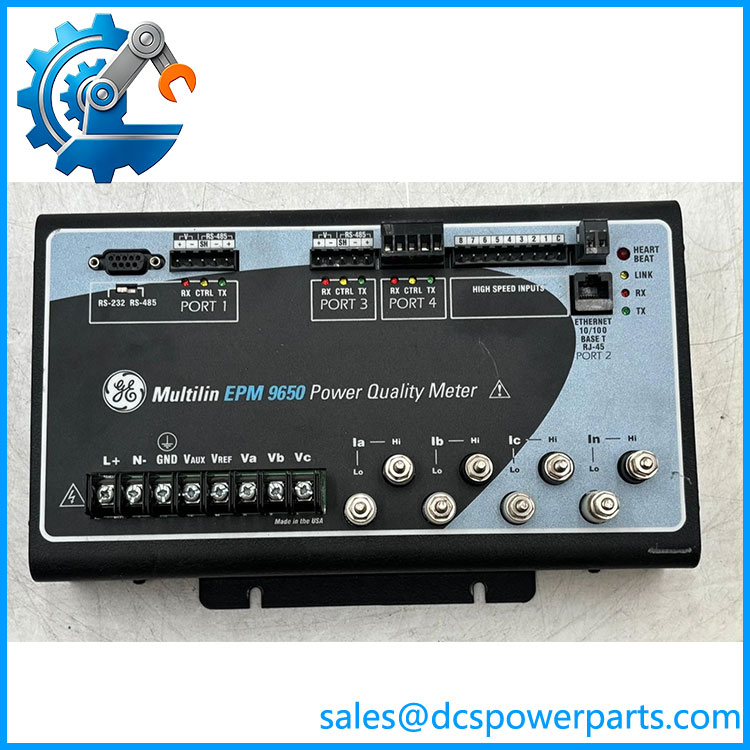
EPM9650
High-resolution waveform recording
Waveform recording is one of the more useful features during fault investigation. Depending on configuration, the meter can record up to 512 samples per cycle and retain pre- and post-event information. GE describes applications including power-quality surveys, fault analysis, breaker timing, and motor-start investigations.
A meter that only provides a numerical RMS trend cannot answer the same troubleshooting questions. The can preserve the actual electrical waveform around a triggered event.
Revenue-grade measurement
The combines power-quality functionality with high-accuracy energy measurement. GE documentation states that the meter exceeds the referenced ANSI C12 and IEC 687 specifications and uses temperature-compensated calibration.
The exact accuracy depends on the measurement quantity, time interval, input configuration, and ordering option, so procurement should use the applicable manual and order code rather than applying one accuracy number to every measured parameter.
Four communication ports
The meter provides four built-in communication ports. GE specifies Modbus RTU/ASCII and DNP 3.0 as standard protocols, with the communication ports capable of independent operation. An Ethernet configuration provides 10/100Base-T communication with Modbus/TCP.
This makes the suitable for integration into SCADA, DCS, EMS, and plant power-monitoring architectures without requiring a separate protocol gateway in every installation.
DNP 3.0 capability
The supports DNP 3.0 Level 2 functionality. The documented implementation can expose measurement points, binary inputs, binary counters, analog inputs, relay controls, and event-related data through the DNP point map.
For utility-facing installations, this is a meaningful distinction from meters limited to basic Modbus register polling.
High-speed transducer operation
The can also serve as a high-speed transducer for control-related applications. GE specifies 50 ms updates for instantaneous readings. This can support applications such as generator monitoring, transmission-line synchronization, and other electrical control schemes where a slower energy-metering update would be inadequate.
That should not be confused with a protection relay’s operating time. A 50 ms measurement update is not equivalent to a sub-cycle protection decision.
Expandable I/O
The supports expandable I/O for control, data acquisition, and alarm functions, with GE documenting configurations up to 256 points. The available I/O depends on the installed hardware and ordering configuration.
This allows the meter to participate in a broader electrical monitoring architecture rather than functioning only as a local display.
GPS time synchronization
Built-in GPS clock synchronization is available for accurate event and alarm timestamping. This is especially useful when the is installed alongside protection relays, disturbance recorders, or other power-quality meters and the engineering team needs to correlate events across devices.
Related Products
- EPM9450 — Earlier member of the same EPM 9000 family, sharing much of the advanced metering architecture but with different power-quality and communications capabilities.
- EPM9700 — GE Vernova’s current successor/reference replacement for the legacy . GE identifies it as a direct upgrade with the same wiring and cutout for the meter-unit/display installation.
- EPM9800 — Higher-end member of the EPM family for advanced power-quality and electrical monitoring applications.
- EPM7000P — Current power-quality meter with flexible communications and I/O, positioned for a broader range of industrial and utility metering applications.
- EPM7000 — Earlier EPM-family meter used for power and energy monitoring; less extensive than the in advanced waveform and harmonic-analysis capability.
- EPM9900P — Higher-level EPM family metering platform intended for advanced electrical measurement and monitoring.
- Multilin Meter Enclosure — Associated installation hardware for compatible GE Multilin meter configurations.
- EPM9450Q / EPM9650Q — Related configuration/designations encountered in legacy GE documentation; verify the complete model and option code before treating them as interchangeable.
FAQ
Can I replace an directly with an EPM9700?
GE Vernova identifies the EPM9700 as the alternative to the discontinued and states that it is a direct upgrade with the same wiring and cutout for the meter unit/display installation. Even so, the complete order code and the required EPM9700 options should be checked before a site replacement.
Can I hot-swap the ?
Do not assume hot replacement. The is a complete electrical measuring instrument rather than a plug-in PLC I/O card. Replacement normally requires following the site’s electrical isolation, CT/VT safety, control-power, and commissioning procedures. In particular, CT circuits require appropriate precautions before disconnecting the meter.
What current input does the use?
The ordering documentation shows 1 A and 5 A current-input variants. The correct input rating must match the installed CT secondary. A 1 A version should not be substituted for a 5 A configuration simply because both carry the model designation.
Does the support Modbus?
Yes. GE specifies Modbus RTU/ASCII, with Ethernet configurations supporting Modbus/TCP. DNP 3.0 is also supported. The four communication ports can operate independently under the supported configurations.
Does the support DNP3?
Yes. The supports DNP 3.0 Level 2 functionality. Its DNP implementation can expose measurement and status information and supports control functions through the documented point map.
Does the measure harmonics?
Yes. GE specifies real-time harmonic magnitude analysis through the 128th order and harmonic magnitude measurement/recording through the 255th order. THD and K-factor calculations are also supported.
Does the record waveforms?
Yes. Depending on configuration, waveform recording can reach 512 samples per cycle, with pre- and post-event recording available for event analysis. The recorded waveform can be used for fault investigation, breaker timing, motor-start analysis, and power-quality studies.
Does the support firmware v3.1?
The model number alone does not establish firmware version 3.1. GE’s resource library lists firmware releases separately; for example, GE currently provides an EPM 9650 Firmware Version 636 resource. Firmware compatibility should therefore be checked against the actual installed revision and application configuration.
Is the still manufactured?
No. GE Vernova currently classifies the as a legacy product and states that sales have been discontinued. GE identifies the EPM9700 as the alternative.
Procurement Note
When sourcing a , the model number by itself is not enough. The ordering code determines critical electrical characteristics such as 50/60 Hz frequency, 120/208 or 277/480 V system connection, 90–276 VAC/DC or 18–60 VDC control power, communications configuration, and 1 A or 5 A current inputs.
For a replacement, capture the complete nameplate/order code from the installed unit before purchasing. Confirm the CT secondary rating, VT/PT arrangement, control-power range, communications interfaces, I/O modules, memory/features, and display configuration. This is particularly important with units because two meters carrying the same basic family designation can have materially different electrical configurations.
The discontinued status also changes the procurement strategy. If an existing plant has standardized its SCADA or DCS integration around registers, event files, communications ports, and I/O, compare the actual migration requirements against the EPM9700 rather than assuming that a physically similar meter will reproduce every legacy behavior. GE states that the is a direct upgrade for the EPM9450/9650 installation arrangement, but application-level verification is still appropriate.
For new-surplus or refurbished inventory, request the complete model/order-code label and firmware information. A unit advertised simply as “” should be treated as configuration incomplete until the electrical options have been confirmed.