Description
GE DS2020DACAG2
Product Overview
The GE DS2020DACAG2 is an AC/DC power conversion assembly used within GE EX2100 excitation-control systems. Its job is straightforward but critical: convert the available AC control-power source into the DC power required by the excitation controller’s internal power-distribution architecture. Available technical references identify the DACA assembly with 115/230 VAC input, approximately 125 VDC power distribution, a 9.5 A maximum output current for one module, and a 1000 W output rating.
Within an EX2100 cabinet, the GE DS2020DACAG2 is not a processor, analog input card, or digital output module. It is power infrastructure. The converted DC output is diode-coupled with other DC sources to establish the control-system DC bus, which supplies controller electronics and gate-pulse amplifier circuitry. This distinction matters during troubleshooting: a DACA failure can present itself as a broader controller power problem even when the control logic itself is healthy.
For maintenance teams working on installed EX2100 equipment, GE DS2020DACAG2 also has an important replacement relationship with DS2020DACAG1. Available documentation identifies the G2 assembly as the replacement for the earlier G1 version. The DACA design can also be used in parallel configurations when additional power capacity is required; when two modules are paralleled, the available documentation specifies that they should use the same AC source so their input voltages remain matched.
One practical issue deserves attention: this assembly contains electrolytic capacitors. Age, temperature exposure, and storage history therefore matter more than a simple visual inspection suggests. A supposedly unused surplus unit can still have aged capacitors if it has spent years in uncontrolled storage. For a plant outage replacement, I would verify the nameplate, revision, capacitor condition, insulation/functional test results, and actual output behavior rather than treating “new surplus” as equivalent to factory-fresh.
Product Introduction
Power faults in an EX2100 cabinet are not always controller faults. The GE DS2020DACAG2 sits upstream of the DC distribution path and converts 115/230 VAC into the approximately 125 VDC supply used by the excitation-control architecture. With a 1000 W rating and up to 9.5 A output from one DACA module, it is sized for substantially more than a small signal-power application.
For a legacy replacement or EX2100 power-system upgrade, the important comparison is usually DS2020DACAG2 versus DS2020DACAG1—not a generic industrial power supply. Cabinet wiring, DACA/EPDM relationships, DC-bus configuration, and the installed excitation-system documentation should all be checked before substitution.
Key Technical Specifications
| Parameter | Specification |
|---|---|
| Product Model | |
| Manufacturer / Brand | General Electric (GE) |
| Product Series | EX2100 Excitation Control |
| Functional Acronym | DACA |
| Product Type | AC/DC Power Conversion Assembly |
| AC Input | 115/230 VAC |
| DC Distribution | 125 VDC |
| Maximum Output Current | 9.5 A DC, single DACA module |
| Output Power Rating | 1000 W |
| Environmental Temperature | -22 to +140 °F (-30 to +60 °C), free convection |
| Humidity | 5–95%, non-condensing |
| Replacement | DS2020DACAG1 |
| Primary Documentation | GEH-6632; GEH-6721L |
| Parallel Operation | Multiple DACA modules can be used where the system design permits |
| Installation Architecture | power-distribution system |
The published figures above are drawn from available technical references. Some third-party listings contain conflicting dimensions, weight, and application descriptions, so those values should not be used for mechanical acceptance without checking the actual unit and GE documentation.
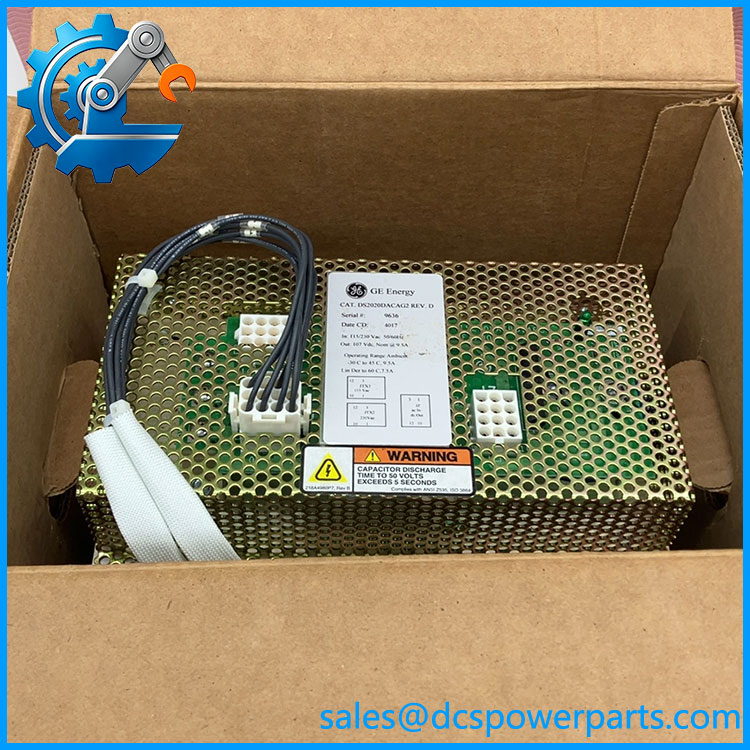
DS2020DACAG2
Major Features and Engineering Advantages
1. Dedicated Power Conversion
The was designed around the power requirements of GE excitation-control equipment rather than as a generic DIN-rail power supply. Its role is to establish the DC power source used by the internal distribution architecture.
2. 125 VDC Distribution Architecture
The DACA converts the AC input into a DC supply associated with the 125 VDC control-power architecture. The resulting DC bus can be diode-coupled with other DC sources, allowing the excitation system to maintain its required power path under the intended system configuration.
3. 1000 W Output Capability
A single module is documented with a 1000 W output rating and 9.5 A maximum output current. This makes load calculation important when replacing or reconfiguring DACA assemblies; do not size the replacement from voltage alone.
4. DS2020DACAG1 Replacement Position
For plants carrying the earlier DS2020DACAG1, the G2 version is specifically identified as its replacement. Even so, the correct engineering practice is to verify the cabinet wiring, system drawing, revision level, and load configuration before installation rather than assuming every cabinet is identical.
5. Parallel DACA Capability
The available technical documentation describes parallel use of DACA modules for increased power capability. A particularly important installation detail is that parallel modules should be connected to the same AC source so that their input voltages remain equal.
6. Electrolytic Capacitor Aging Is a Real Procurement Issue
This is an area where purchasing teams should be careful. The assembly uses electrolytic capacitors, so calendar age and storage temperature can matter even when a unit has never been installed. A visually clean board does not establish capacitor health.
7. No User Application Logic
Unlike a GE control processor or I/O pack, the does not contain the plant’s control application that needs to be uploaded or downloaded during replacement. Its function is power conversion. The important configuration question is therefore the surrounding power architecture, not a PLC program image.
System Compatibility
The belongs to the GE Excitation Control power architecture and is also documented in GE Mark VI/Mark VIe hardware documentation. Its primary engineering relationship is with the excitation-system power-distribution hardware rather than with conventional controller I/O.
Typical associated hardware can include the EPDM Exciter Power Distribution Module, DACA wiring assemblies, controller modules, and gate-pulse amplifier circuitry. Exact cabinet architecture varies by excitation-system design, so the terminal-board and wiring drawings for the specific generator unit should be checked before replacement.
Related Products
- DS2020DACAG1 — Earlier DACA AC/DC power-conversion assembly; the is documented as its replacement.
- EPDM — Exciter Power Distribution Module associated with the DACA power path; verify the exact cabinet configuration.
- IS2020JPDF — Power-distribution interface hardware referenced in DACA wiring documentation.
- IS2020JPDB — Associated wiring/interface hardware used in the DACA AC supply path.
- Excitation Controller — The control-system platform in which the DACA power-conversion assembly operates.
- Mark VIe Control System — GE control-system platform whose hardware documentation also references the DACA assembly.
- GEH-6632 — Excitation Controller documentation containing DACA system information.
- GEH-6721L — GE Mark VIe hardware documentation containing power-distribution information relevant to the DACA architecture.
FAQ
What does the GE actually do?
It converts AC input power into the DC power used by the power-distribution architecture. The published configuration identifies 115/230 VAC input and approximately 125 VDC distribution, with up to 9.5 A from a single module.
Is an I/O module?
No. Treating it as a conventional PLC/DCS I/O card is a mistake. It is a DACA AC/DC power-conversion assembly. Its job is to establish and support the DC power bus serving the excitation-control hardware.
Is a replacement for ?
Yes. Available technical references identify as the replacement for . The actual cabinet should still be checked against the applicable GE drawings before installation.
Can I hot-swap this module?
Do not assume that you can. This is power-conversion hardware feeding an excitation-control power architecture, so removing it can affect downstream controller and gate-pulse circuitry. Follow the plant’s approved shutdown, isolation, discharge, and electrical-safety procedure.
Can two modules be connected in parallel?
The available documentation describes parallel DACA operation for higher power requirements. When two modules are paralleled, they should be connected to the same AC source so their input voltages are equal.
Does it support firmware v3.1?
There is no reliable evidence that a user-upgradable firmware version such as “v3.1” is the relevant identification criterion for this assembly. Unlike a controller CPU or intelligent I/O module, the should primarily be verified by its exact part number, hardware revision, system compatibility, and electrical condition.
What should I verify when buying a New Surplus ?
Ask for clear photos of the complete part number and revision markings, confirmation of the actual condition, and evidence of electrical testing. For an older unit, I would pay particular attention to the electrolytic capacitors and storage history. “New surplus” describes the sales condition; it does not by itself prove recent manufacture or unused capacitor life.
Does replacing the DACA require reprogramming the ?
The DACA itself is a power-conversion assembly rather than the location of the excitation-control application logic. Replacement therefore should not be treated like replacing a controller CPU. The surrounding power-distribution configuration, wiring, DC-bus condition, and downstream equipment still need to be verified before energization.