Description
G.M. International D5011D
Product Introduction
In a hazardous-area measurement loop, the interface has to do more than simply pass a 4-20mA signal. The G.M. International D5011D supplies conventional 2-wire transmitters installed in hazardous areas while repeating the measured current to a safe-area load. It is a two-channel D5000 Series repeater power supply designed for safety-related applications requiring SIL 3 capability. G.M. International specifies Zone 0/Division 1 input applications and Zone 2/Division 2 installation.
The D5011D also preserves bidirectional HART communication, which matters when transmitters need configuration or diagnostic access without removing the isolator from the loop. The manufacturer specifies three-port galvanic isolation between input, output, and supply, along with short-circuit protection and high signal-transfer accuracy. For DCS migration, safety-system refurbishment, or replacement of older analog input barriers, the exact loop architecture and hazardous-area certification still need to be checked against the installed system documentation.
Key Technical Specifications
| Parameter | D5011D Specification |
|---|---|
| Product Model | D5011D |
| Manufacturer | G.M. International |
| Product Series | D5000 |
| Product Type | SIL 3 intrinsically safe repeater power supply / analog input isolator |
| Number of Channels | 2 |
| Input Signal | 4-20mA, 2-wire transmitter |
| Input Reading Range | 0-24mA |
| Transmitter Supply | 15.0V typical, 14.5V minimum at 20mA |
| Output Signal | 4-20mA source output |
| Maximum Output Load | 550Ω typical |
| HART | Compatible |
| Isolation | Three-port galvanic isolation |
| Safety Level | SIL 3 / SC 3 |
| Hazardous-Area Input | Zone 0 / Division 1 |
| Installation Area | Zone 2 / Division 2 |
| Supply Voltage | 24VDC nominal, 18-30VDC |
| Supply Protection | Reverse-polarity protected |
| Typical Current Consumption | 90mA at 24VDC with 20mA output |
| Typical Power Dissipation | 1.35W at 24VDC with 20mA output |
| Response Time | 5ms, 0-100% step change |
| Calibration Accuracy | ≤ ±0.1% FSR |
| Linearity Accuracy | ≤ ±0.05% FSR |
| Temperature Influence | ≤ ±0.01% FSR per °C |
| Operating Temperature | -40 to +70°C |
| Storage Temperature | -45 to +80°C |
| Protection Rating | IP20 |
| Mounting | 35mm DIN rail |
| Connection | Plug-in screw terminal blocks |
| Terminal Capacity | Up to 2.5mm² |
| Width | 12.5mm |
| Depth | 123mm |
| Height | 120mm |
| Approx. Weight | 140g |
The manufacturer lists 550Ω as the typical maximum output load in source mode and specifies a 5ms response time. The environmental and mechanical values above are also supported by published D5011D documentation.
Application Scenarios & Pain Points
1. Hazardous-area pressure, temperature, and flow transmitters
The is intended for conventional 2-wire 4-20mA transmitters located in hazardous areas. It provides the transmitter excitation while maintaining an isolated signal path toward the safe-area control system.
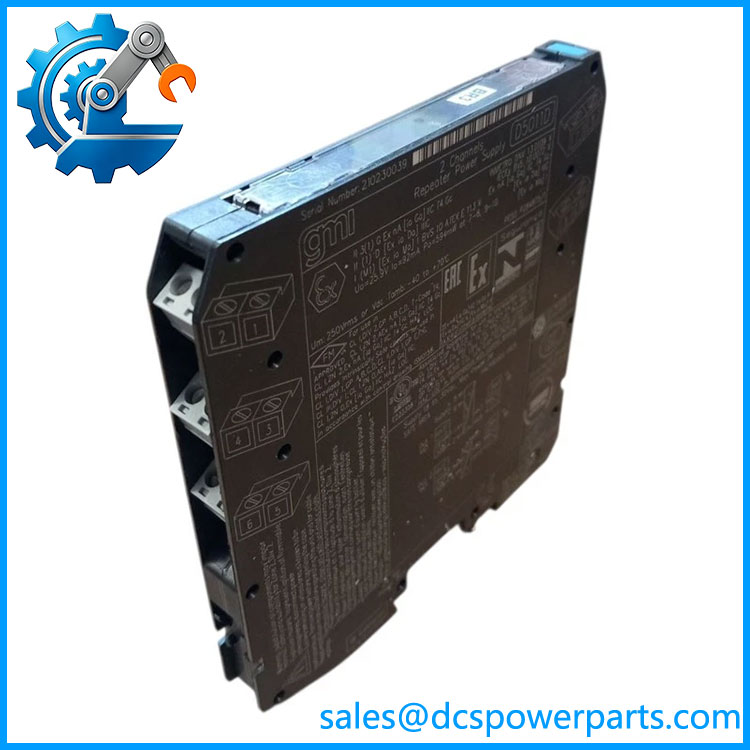
D5011D
2. Safety instrumented systems
Where an analog measurement participates in a safety-related function, the SIL 3 / SC 3 classification is relevant. This does not mean that installing a automatically makes the complete loop SIL 3; the transmitter, logic solver, final element, proof-test interval, architecture, and safety calculations all remain part of the overall assessment.
3. DCS analog-input interfaces
The two independent channels allow two field transmitters to be interfaced through a compact DIN-rail assembly. Three-port isolation helps prevent ground-loop and signal-reference problems between field wiring, control-system inputs, and the DC supply.
4. HART-enabled transmitter maintenance
HART compatibility is useful when the maintenance team needs transmitter configuration or diagnostic communication. A replacement should still be checked against the actual DCS AI card, HART multiplexer arrangement, loop resistance, and installed termination scheme.
Related Products
- G.M. International D5011S — single-channel version of the D5011 repeater power supply. The provides two channels.
- G.M. International D5014D — D5000 Series 2-channel 2/4-wire HART transmitter power supply; do not treat it as a direct substitute without checking loop wiring and certification.
- G.M. International D5014S — single-channel counterpart within the same general analog-interface family.
- G.M. International D5020D — powered isolating driver for analog output applications; function is different from .
- G.M. International D1014D — two-channel high-integrity 4-20mA transmitter repeater power supply. G.M. International identifies as the alternative to D1014D, so this relationship is useful when handling legacy-system replacements.
Engineer’s Guide — Field Pitfalls to Avoid
1. Do not confuse SIL-rated hardware with a SIL-rated loop
A carries SIL 3 / SC 3 capability, but that rating belongs to the interface device and its specified safety use. It does not automatically certify the complete measurement or shutdown loop.
2. Check transmitter loop power, not just the 4-20mA range
The provides approximately 14.5V minimum to the transmitter at 20mA according to the published technical data. Long cable runs, barriers, terminals, and transmitter voltage requirements all contribute to the available loop budget.
3. HART compatibility still depends on the complete loop
A HART-compatible isolator does not guarantee successful communication in every installation. Verify the DCS input impedance, total loop resistance, field transmitter configuration, and HART master arrangement before commissioning.
4. Verify the hazardous-area installation concept
The is specified for hazardous-area transmitter inputs and Zone 2/Division 2 installation. The actual certificate, entity parameters, area classification, wiring method, and associated apparatus must match the project design. Do not approve a replacement merely because the terminal count appears identical.
5. Check the exact channel variant
is the two-channel model; D5011S is the one-channel version. This distinction matters when replacing equipment on densely populated termination assemblies.
FAQ
Is the G.M. International a PLC or DCS I/O module?
No. It is an intrinsically safe analog interface and repeater power supply. It sits between hazardous-area 2-wire transmitters and the safe-area control system rather than acting as a general-purpose PLC/DCS I/O card.
What signal does the accept?
The accepts a 4-20mA signal from a conventional 2-wire transmitter. The manufacturer specifies a 0-24mA reading range and approximately 15V transmitter line voltage at 20mA.
Does the support HART?
Yes. G.M. International specifies bidirectional HART communication for the . This allows HART-enabled field transmitters to retain configuration and diagnostic communication through the interface.
What is the supply voltage?
The nominal supply is 24VDC, with an operating range of 18-30VDC. The supply input is reverse-polarity protected.
How many channels does provide?
It provides two independent channels. G.M. International identifies D5011S as the one-channel variant and as the two-channel version.
Can replace an older analog isolator directly?
Not automatically. Even when the signal type and channel count appear compatible, verify the hazardous-area certification, terminal arrangement, transmitter loop-power requirement, output load, HART behavior, mounting arrangement, and safety-system documentation before approving a replacement.
What should procurement verify before buying a ?
At minimum, match the complete part number, channel configuration, certification markings, revision/date code where applicable, physical condition, terminal accessories, and documentation. For used or surplus inventory, the published electrical specifications do not establish the actual condition of a particular unit; inventory condition should be verified separately.