Description
Foxboro FBM206b RH927AB — Product Page
Product Overview
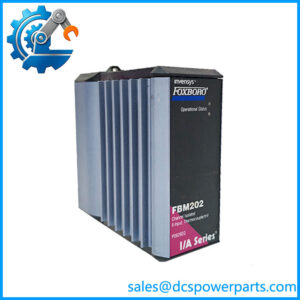
The Foxboro FBM206b RH927AB is a combined pulse input and analog output module designed for industrial process-control systems. It provides four independently isolated pulse input channels and four isolated 0–20.4 mA analog output channels in one module. This configuration is useful when a control strategy requires pulse-based measurement and associated analog control signals within the same I/O subsystem. Typical pulse sources include turbine and vortex flowmeters, solid-state sensors, and compatible electromechanical contacts. Depending on the configured application, pulse signals can be used for rate measurement, totalization, or other supported pulse-processing functions.
Each pulse input accepts a configurable signal in the 7–27 VDC range and supports rates up to 25 kHz. The module’s pulse-processing functions include configurable pulse-rate totalization, resolution, and meter scaling factor at the module level. Four separate analog outputs provide current signals for compatible downstream control devices. The published output range is 0–20.4 mA, with ±0.05% of span accuracy at 25°C, 12-bit resolution, and a maximum load of 735 ohms. Output settling time is specified as 100 ms to settle within a 1% band following a 10–90% step change. These figures are useful when checking signal requirements, but actual loop performance also depends on the receiving device, wiring resistance, and configured control strategy.
For system integration, the Foxboro FBM206b RH927AB communicates with its associated Fieldbus Communication Module or Control Processor over the redundant 2 Mbps module fieldbus. Its modular design supports installation on compatible baseplates, including DIN-rail or rack-mounted arrangements. The module can also be used in certain 100 Series upgrade configurations when the approved conversion mounting structure or termination arrangement is applied.
Procurement teams should confirm the full module label, revision, baseplate type, termination assembly, cable length, and field wiring before ordering a replacement. The RH927AB designation supersedes P0927AB in the published product specification, but the correct termination hardware still depends on the installation. A replacement should be evaluated against both the pulse-input characteristics and the analog-output load requirements, not simply the module name.
Product Introduction — Practical Field Focus
When pulse totals drift or a speed measurement becomes unreliable, the cause may be sensor output levels, wiring, pulse width, grounding, or module configuration. The Foxboro FBM206b RH927AB combines four isolated pulse inputs with four analog current outputs, allowing compatible measurement and control functions to share a single DCS module.
Before installation, check the sensor’s voltage and pulse-rate range, the output loop burden, and the termination assembly. Commissioning should verify pulse recognition at representative operating rates and analog output current at the required test points.
Key Technical Specifications
| Parameter | Specification |
|---|---|
| Module model | FBM206b |
| Part number | RH927AB |
| Previous part number | P0927AB |
| Manufacturer | Foxboro / Schneider Electric |
| Module type | Pulse input / analog output |
| Pulse input channels | 4 |
| Pulse input voltage | 7–27 VDC |
| Pulse input frequency | 10 Hz to 25 kHz specified operating range |
| Pulse count accuracy | No missing pulses over the specified 0–25 kHz range |
| Pulse-rate accuracy | 0.01% of reading |
| Input channel impedance | 10 kΩ |
| Field-device supply | 24 VDC ±10%, up to 30 mA per channel |
| Analog output channels | 4 |
| Analog output range | 0–20.4 mA DC |
| Maximum output load | 735 Ω |
| Compliance voltage | 18.6 V nominal at 20 mA at I/O field terminals |
| Output accuracy | ±0.05% of span at 25°C |
| Output resolution | 12 bits |
| Output linearity error | ±0.025% of span, monotonic |
| Output temperature coefficient | 100 ppm/°C |
| Output settling time | 100 ms to within a 1% band for a 10–90% step change |
| Module fieldbus | Redundant 2 Mbps |
| Redundant module power input | 24 VDC, +5%/-10% |
| Maximum power consumption | 7 W |
| Maximum heat dissipation | 5 W |
| Operating temperature | -20°C to +70°C |
| Storage temperature | -40°C to +70°C |
| Relative humidity | 5–95%, noncondensing |
| Operating altitude | -300 to +3,000 m |
| Vibration | 0.75 g from 5 to 500 Hz |
| Module dimensions | 102 × 45 × 104 mm |
| Height including mounting lugs | 114 mm |
| Approximate module weight | 284 g |
| Mounting | Modular baseplate; DIN rail or rack arrangement |
| Termination assemblies | P0924QN or P0924QP, depending on requirements |
| Maximum termination cable length | 30 m |
| Cable connection | 37-pin D-sub at baseplate; 25-pin D-sub at termination assembly |
Specifications are based on the published Foxboro FBM206/206b product specification. Confirm the precise module revision, termination assembly, and application configuration before engineering approval.
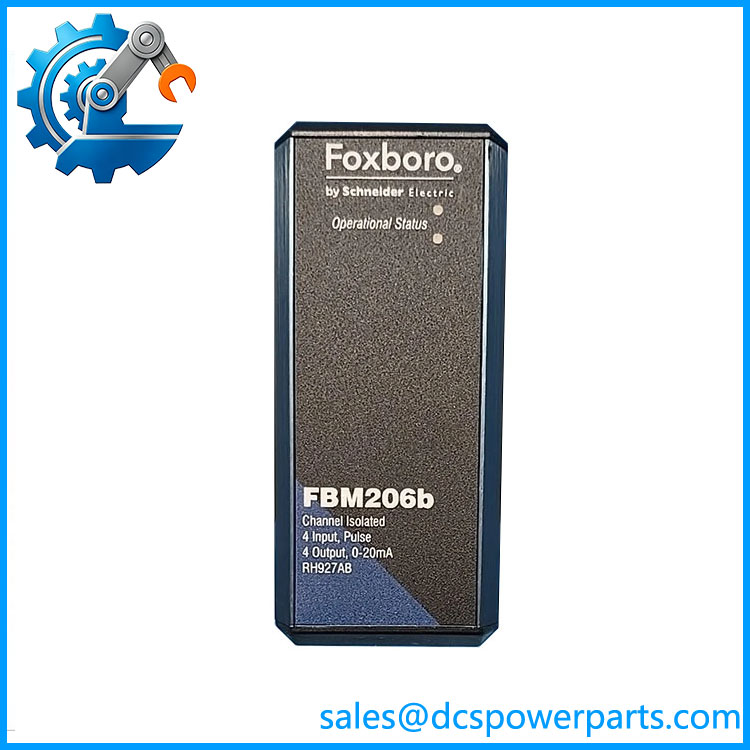
FBM206b RH927AB
Related Products
- FBM206 RH916CQ — Eight-channel pulse input module without the FBM206b’s four analog output channels.
- FBM204 — Analog current I/O module for compatible 0–20 mA signal applications.
- FBM205 — Redundant 0–20 mA analog I/O module for installations designed around its redundancy architecture.
- FBM207 — Voltage-monitoring input module for supported voltage measurement applications.
- FBM208b RH924EV — Redundant analog I/O module with readback, providing four input and four output channels in its specified configuration.
- FBM211 — Sixteen-channel 0–20 mA analog input module for process measurement.
- P0924QN — Compression-type termination assembly listed for the FBM206b.
- P0924QP — FBM206b compression termination assembly with output bypass jacks.
These products serve different I/O functions. Confirm the control-system configuration and hardware requirements before treating any related model as a replacement.
Frequently Asked Questions
Q1. What is the function of the Foxboro FBM206b ?
It combines four isolated pulse inputs and four isolated 0–20.4 mA analog outputs. It is used for pulse-based measurement, including compatible flow or speed sensors, together with associated analog control signals.
Q2. What is the difference between FBM206 and FBM206b?
The FBM206 provides eight pulse input channels. The FBM206b provides four pulse input channels and four analog output channels. The two modules therefore have different I/O assignments and should not be treated as interchangeable.
Q3. Is the same as P0927AB?
The published product specification identifies as the FBM206b designation that supersedes P0927AB. For replacement work, verify the installed hardware generation, baseplate, termination assembly, and system configuration.
Q4. Can the FBM206b be replaced while the DCS is running?
The product documentation describes module removal and replacement without disconnecting field-device termination, power, or communications cables. Live replacement still requires an approved site procedure, a review of process consequences, and confirmation that the installed system supports the intended maintenance method.
Q5. Which termination assembly is required?
The product specification lists P0924QN and P0924QP for the FBM206b. P0924QP includes output bypass jacks. Confirm the required terminal style, field wiring, and bypass requirements before ordering.
Q6. What should be checked if the pulse input is not registering correctly?
Verify the sensor’s output voltage, pulse polarity, pulse width, frequency, wiring resistance, grounding, and configured input parameters. The source must operate within the module’s specified input characteristics. Do not assume a failed module until the field signal has been checked with suitable test equipment.
Q7. What should be checked if an analog output cannot drive its connected device?
Confirm the configured current range, output wiring polarity, receiving-device impedance, total loop burden, and the module’s 735 Ω maximum output-load specification. Also check the output command and system diagnostics before replacing the module.
Q8. Does the FBM206b require calibration after replacement?
The manufacturer’s specification states that calibration of the module and termination assembly is not required. Site acceptance testing is still appropriate: validate representative pulse rates, pulse counting or scaling, analog output current, channel assignments, and the behavior of the connected control devices.
Q9. What should procurement request for used or refurbished stock?
Request clear photographs of the module label and connectors, confirmation of the exact or P0927AB designation, test scope and results, warranty terms, and details of included termination hardware. A generic “tested” claim does not confirm that all four pulse inputs and all four analog outputs have been checked.