Description
Product Overview
The Auto-Maskin DCU 305 R3 is designed for marine engine supervision where operators need engine data, alarms, and shutdown-related functions in a dedicated control panel. It can be configured for propulsion, auxiliary, emergency, or combined auxiliary/emergency operating modes. The unit receives engine switches and sender signals through the RK-66 wire terminal module, which provides fixed and configurable I/O functions. The final configuration depends on the vessel’s engine instrumentation, control philosophy, and class requirements.
Communication is an important distinction when selecting this model. The DCU 305 R3 supports an engine J1939 CAN bus connection for engines equipped with an electronic control module. It also supports Modbus RTU communication with a ship alarm system and can work with an RSP 305 remote panel. The R3 LT version looks similar but lacks internal CAN bus functionality, so it should not be treated as an equivalent replacement where J1939 data is required.
For replacement procurement, matching the model name alone is not enough. Confirm the existing configuration file, RK-66 terminal wiring, engine interface requirements, operating mode, and remote-panel arrangement before installation. The manufacturer identifies Rudolf R3 as the configuration software for the R3 generation. A replacement unit should be checked against the vessel’s installed configuration and required approvals before it is put into service.
Product Introduction
The Auto-Maskin DCU 305 R3 serves as the main engine control and monitoring panel in the Marine Plus 300 system. It provides a display for engine information and alarms while coordinating configured monitoring and safety functions. It is intended for marine installations that require a dedicated engine panel rather than a general-purpose PLC.
The system can be expanded with additional I/O hardware where the standard terminal arrangement does not cover all required signals. The AK-6 adds six 4–20 mA channels, while the MK-14 adds 14 relay channels. These accessories must be evaluated against the installed system configuration and the required functions.
Key Technical Specifications
| Specification | Details |
|---|---|
| Product model | DCU 305 R3 |
| Manufacturer | Auto-Maskin |
| Product type | Marine engine controller |
| Application | Diesel propulsion engines and generator sets |
| Engine communication | J1939 CAN bus |
| System communication | Modbus RTU |
| Configuration software | Rudolf R3 |
| Associated terminal module | RK-66 |
| Display | 5.6-inch display |
| Display resolution | 240 × 128 pixels |
| Panel dimensions | 260 × 160 × 60 mm |
| Panel cutout | 230 × 146 mm |
| Listed weight | 2.6 kg |
| Expansion options | AK-6 analog unit; MK-14 relay unit |
| Working voltage | Confirm against the applicable installation manual and unit label |
| Operating temperature | Not independently verified |
| Protection rating | Verify the exact panel and installation requirements |
| Mounting method | Panel mounting; confirm cutout and mounting details |
| Condition | Confirm actual condition with supplier |
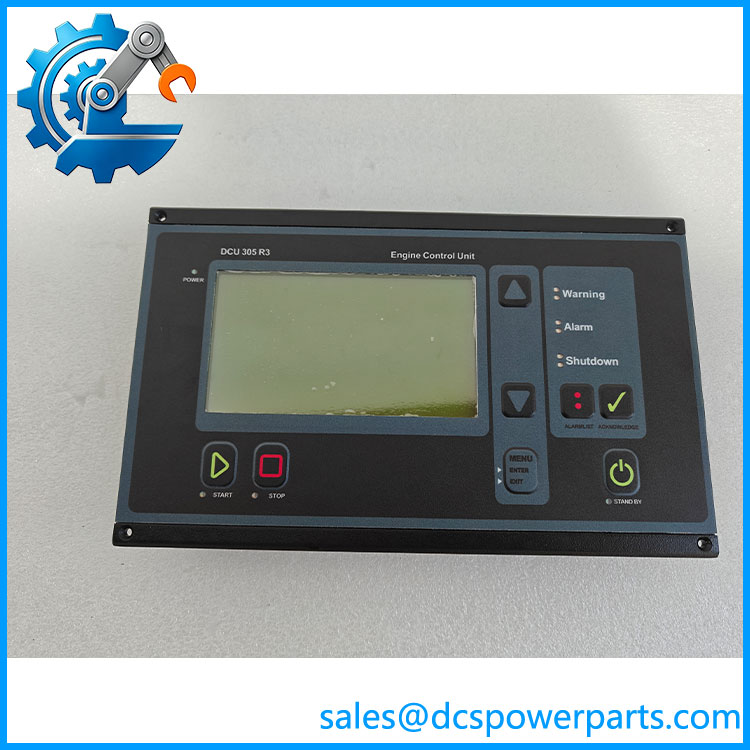
DCU 305 R3
Related Products
These are related system components or model variants, not automatic drop-in substitutes.
- DCU 305 R3 LT — Related engine controller variant without internal J1939 CAN bus functionality.
- RK-66 — Wire terminal and engine signal interface module.
- RSP 305 — Remote panel for engine monitoring and control-system integration.
- AK-6 — Analog expansion unit providing six additional 4–20 mA channels.
- MK-14 — Relay expansion unit providing 14 relay channels.
Frequently Asked Questions
Q1: What is the primary function of the DCU 305 R3?
It controls and monitors diesel engines used for marine propulsion and generator-set applications, including configured alarms and safety-related functions.
Q2: Does the DCU 305 R3 support J1939 CAN bus?
Yes. The standard R3 version supports the J1939 CAN bus interface for compatible electronically controlled engines. The R3 LT version does not provide internal CAN bus functionality.
Q3: Which software is used to configure the controller?
Auto-Maskin specifies Rudolf R3 configuration software for the DCU 305 R3. Confirm the available configuration file and software compatibility before replacing an existing controller.
Q4: Can the controller communicate with a ship alarm system?
Yes. The system supports Modbus RTU communication for connection to a ship alarm system, subject to the correct communication settings and integration configuration.
Q5: Can I replace a DCU 305 R3 with a DCU 305 R3 LT?
Not without checking the application. The LT version lacks internal CAN bus functionality. If the engine controller relies on CAN data from an electronic engine control module, the LT variant may not meet the requirement.
Q6: What should be checked before purchasing a replacement?
Verify the complete model and part number, engine interface, configuration file, RK-66 wiring, expansion modules, remote-panel connections, required marine approvals, and the unit’s actual condition. Ask the supplier whether the offered controller has been tested and whether its configuration status is documented.
Q7: Is the DCU 305 R3 suitable for a safety-critical marine application?
It is designed for marine engine control and monitoring, with separate safety shutdown functionality described in the product documentation. However, suitability for a particular vessel depends on the approved system design, installed configuration, applicable classification requirements, and commissioning checks. Confirm these before placing the unit into service.