Description
Product Overview
The ANC-100e is an Ethernet/IP to Allen-Bradley Data Highway Plus (DH+) communication converter manufactured by Automation Networks. Designed for industrial networking and legacy automation integration, the ANC-100e provides Ethernet-based access to DH+ devices such as Allen-Bradley PLC-5 and SLC 5/04 controllers. It enables modern SCADA, HMI, programming, and monitoring software to communicate with established DH+ networks through an Ethernet/IP connection, helping users modernize communications without immediately replacing proven legacy controllers.
The ANC-100e operates as a compact standalone gateway between Ethernet/IP and DH+, making it particularly valuable in brownfield PLC migration and plant-network modernization projects. Its automatic DH+ polarity and baud-rate detection simplifies commissioning, while web-based configuration provides convenient access to network settings, diagnostics, statistics, and firmware management. The unit supports the DH+ communication rates of 57.6, 115.2, and 230.4 Kbps and can provide access to multiple DH+ nodes through Ethernet.
For PLC, SCADA, HMI, and industrial Ethernet applications, the ANC-100e provides a practical bridge between legacy Allen-Bradley infrastructure and newer Ethernet-based automation systems. It can be used with software environments including RSLinx and other industrial communication packages, reducing the engineering effort associated with maintaining legacy DH+ installations while extending their operational usefulness.
Technical Specifications
| Parameter Name | Parameter Value |
|---|---|
| Product Model | ANC-100e |
| Manufacturer | Automation Networks |
| Product Type | Ethernet/IP to Data Highway Plus (DH+) Converter |
| Ethernet Interface | 10/100 Mbps Ethernet |
| DH+ Interface | Allen-Bradley Data Highway Plus |
| Communication Protocol | EtherNet/IP and DH+ |
| DH+ Baud Rate | 57.6 / 115.2 / 230.4 Kbps |
| DH+ Node Address | Configurable DH+ node |
| Configuration | Web-based configuration interface |
| Auto Configuration | Automatic DH+ baud-rate and polarity detection |
| Compatible Devices | Allen-Bradley PLC-5, SLC 5/04, PanelView and other DH+ devices |
| Installation | Standalone industrial gateway |
| Operating Temperature | Verify according to applicable hardware revision |
| Power Supply | Refer to manufacturer hardware documentation |
The manufacturer’s documentation confirms Ethernet-to-DH+ functionality, automatic polarity/baud-rate detection, web configuration, and compatibility with PLC-5, SLC 5/04 and other DH+ devices. Exact electrical/environmental specifications should be verified against the unit’s hardware revision before replacement engineering.
Main Features and Advantages
Direct Ethernet access to legacy DH+ networks
The ANC-100e solves a common brownfield automation problem: modern computers and Ethernet-based software need access to older Allen-Bradley controllers that communicate through DH+. By converting Ethernet/IP communications into DH+ traffic, the gateway allows programming terminals, SCADA systems, HMIs, and other Ethernet-connected applications to interact with legacy PLC infrastructure without requiring a complete controller replacement.
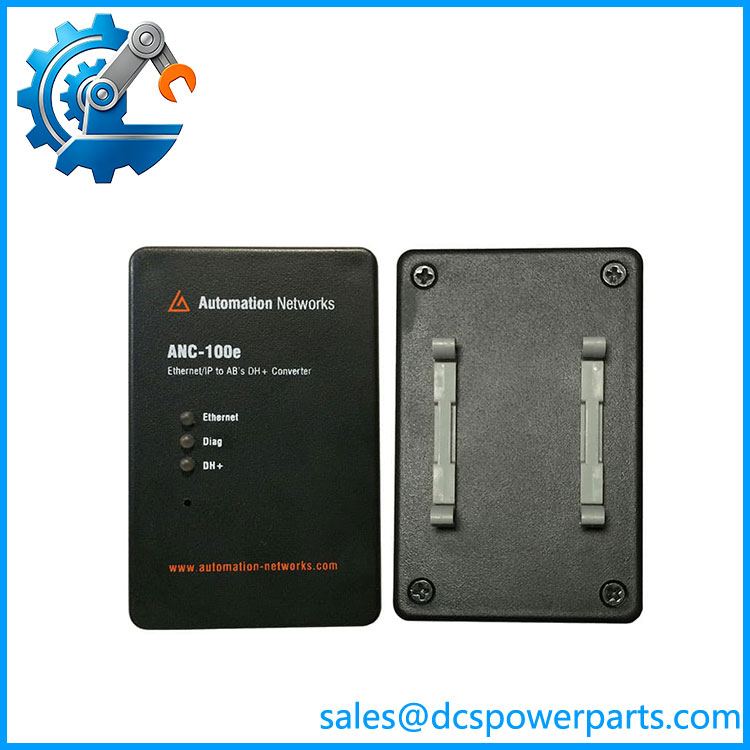
ANC-100E
Broad Allen-Bradley compatibility
The gateway is designed for communication with DH+-enabled equipment including PLC-5 and SLC 5/04 controllers. It can also be incorporated into PanelView and other DH+ applications, making it useful for maintaining older production lines while introducing Ethernet-based supervisory or engineering access.
Automatic DH+ network detection
Automatic baud-rate and polarity detection reduces commissioning effort and helps technicians avoid common DH+ wiring and configuration errors. The gateway supports 57.6, 115.2, and 230.4 Kbps DH+ communication rates.
Web-based configuration and diagnostics
Configuration can be performed through an integrated web interface. Users can manage network settings, DH+ parameters, device settings, statistics, firmware upgrades, and diagnostic information without relying exclusively on specialized programming hardware.
Cost-effective modernization
Rather than replacing functioning PLC-5 or SLC 5/04 controllers solely because of their legacy communication interface, the ANC-100e provides an economical communication upgrade path. This can reduce downtime, engineering changes, rewiring, and capital expenditure during phased automation modernization projects.
Application Fields
The ANC-100e is particularly suitable for industrial plants where legacy Allen-Bradley DH+ networks remain part of the production control architecture. In discrete manufacturing, the gateway can connect PLC-5 and SLC 5/04 controllers to Ethernet-based HMI, SCADA, engineering, and data-collection systems, allowing production information to be accessed without removing established controllers from service.
In chemical processing and oil & gas facilities, the ANC-100e can support phased modernization of older control panels where DH+ remains in use. Ethernet connectivity allows supervisory computers and modern software platforms to access legacy process controllers, helping eliminate isolated data islands while minimizing disruption to operating equipment.
Power-generation and utility-related installations can also benefit when existing Allen-Bradley PLCs continue to perform reliable local control but require integration with newer Ethernet infrastructure. The gateway provides an interface between the legacy field/control layer and higher-level monitoring or engineering systems.
For metallurgy, machine automation, packaging, material handling, and intelligent manufacturing, the ANC-100e is useful for retrofitting production equipment with Ethernet-based connectivity. It can support PLC programming, HMI communication, SCADA integration, remote diagnostics, and migration projects involving PLC-5, SLC 5/04, PanelView, and other DH+ devices.
Related Products
- ANC-120e – USB-to-DH+ converter designed primarily for direct PC access to Allen-Bradley DH+ networks; useful for programming and maintenance where Ethernet connectivity is not required.
- AN-X2-AB-DHRIO – Ethernet/IP to DH+/Remote I/O gateway for phased migration projects involving Allen-Bradley legacy networks and newer Ethernet/IP architectures.
- ProSoft AN-X2-AB-DHRIO – A comparable Ethernet-to-DH+/Remote I/O gateway used for legacy Allen-Bradley network integration and modernization.
- Allen-Bradley 1784-U2DHP – USB-to-DH+ interface used for connecting a PC to legacy DH+ equipment; particularly suitable for engineering and programming access.
- Allen-Bradley 1784-PCMK – Legacy PCMCIA-based communication interface for DH+ and related Allen-Bradley networks, mainly encountered in older programming workstations.
- Allen-Bradley 1756-DHRIO – ControlLogix communication module providing DH+/Remote I/O connectivity within a ControlLogix chassis; more appropriate when DH+ integration is required as part of a chassis-based architecture.
- Allen-Bradley 1756-ENBT – EtherNet/IP communication module for ControlLogix systems; commonly used on the Ethernet side of architectures that bridge modern Logix systems with legacy networks.
- ANC-300e – Ethernet-to-RS-485 industrial converter designed for applications requiring Ethernet connectivity to serial RS-485 equipment rather than DH+ networks.