Description
Allen-Bradley 2098-DSD-030-SE
Product Overview
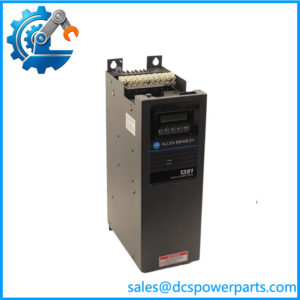
The Allen-Bradley 2098-DSD-030-SE is a 3 kW Ultra3000 digital servo drive equipped with a SERCOS interface for coordinated motion control systems. It accepts 100–240 VAC RMS single-phase input over 47–63 Hz and provides up to 10.6 A RMS continuous motor output, equivalent to 15 A at 0-peak. Peak output capability reaches 21.2 A RMS or 30 A 0-peak. At 230 VAC input, the drive is rated for 3 kW continuous power output.
The 2098-DSD-030-SE is more than a conventional standalone amplifier. The -SE suffix identifies the SERCOS-interface version of the Ultra3000 family. Its front panel provides dedicated SERCOS transmit and receive connections, node-address switches, and a data-rate switch, while CN1 provides 44-pin user I/O and CN2 provides the 15-pin motor-feedback interface. CN3 provides the serial service connection.
In practical machine-control terms, the drive belongs to the older Rockwell SERCOS motion architecture. It is suited to applications where an existing controller and SERCOS interface are already configured around the Ultra3000 platform. Rockwell lists the exact 2098-DSD-030-SE as discontinued as of December 31, 2022, so legacy-system replacement is now the main procurement use case rather than new machine design.
Product Introduction
The 2098-DSD-030-SE sits at the drive level of an older Allen-Bradley SERCOS motion system: the controller handles coordinated motion commands while the Ultra3000 executes the motor-control function. Its 3 kW rating and 15 A continuous 0-peak output make it a substantial servo axis, not a small auxiliary drive.
For a legacy Allen-Bradley servo drive replacement, the important match is not simply the 2098-DSD-030-SE catalog number. Motor winding data, feedback device, SERCOS node configuration, application parameters, shunt requirements, and controller compatibility all need to be checked before commissioning.
Key Technical Specifications
| Parameter | Specification |
|---|---|
| Product Model | 2098–SE |
| Manufacturer | Allen-Bradley / Rockwell Automation |
| Product Series | Ultra3000 |
| Product Type | Digital SERCOS Servo Drive |
| Drive Rating | 3 kW |
| Drive Class | 200 V class / 230 V nominal |
| AC Input Voltage | 100–240 VAC RMS, single-phase |
| Absolute Input Range | 88–265 VAC RMS |
| Input Frequency | 47–63 Hz |
| Nominal Main Input Current | 28 A RMS at 230 VAC |
| Maximum Main Inrush | 50 A, 0-peak at 230 VAC |
| Auxiliary Input | 115 VAC: 1.0 A nominal; 230 VAC: 0.5 A nominal |
| Continuous Output Current | 10.6 A RMS / 15 A 0-peak |
| Peak Output Current | 21.2 A RMS / 30 A 0-peak |
| Continuous Power Output | 1.5 kW at 115 VAC input; 3 kW at 230 VAC input |
| Internal Shunt Resistance | 35 Ω |
| Internal Shunt Continuous Power | 50 W |
| Internal Shunt Peak Power | 4.5 kW |
| Shunt Turn-On Voltage | 420 VDC |
| Shunt Turn-Off Voltage | 402 VDC |
| DC Bus Overvoltage | 452 VDC |
| Bus Capacitance | 2820 μF |
| SERCOS Interface | Dedicated Rx and Tx ports |
| User I/O | CN1, 44-pin |
| Motor Feedback | CN2, 15-pin |
| Serial Interface | CN3, 9-pin |
| Mounting Dimensions | Approx. 349.25 mm high × 91.44 mm wide; depth approx. 243.84 mm |
| Operating Temperature | Up to approximately 55°C, subject to installation/derating requirements |
| Lifecycle | Discontinued December 31, 2022 |
Rockwell’s technical data gives the 2098- 10.6 A RMS continuous output, 21.2 A RMS peak output, 3 kW continuous output at 230 VAC, 35 Ω internal shunt, and 2820 μF bus capacitance. The physical dimensions for the -030-SE are shared with the 3 kW Ultra3000 -030 frame.
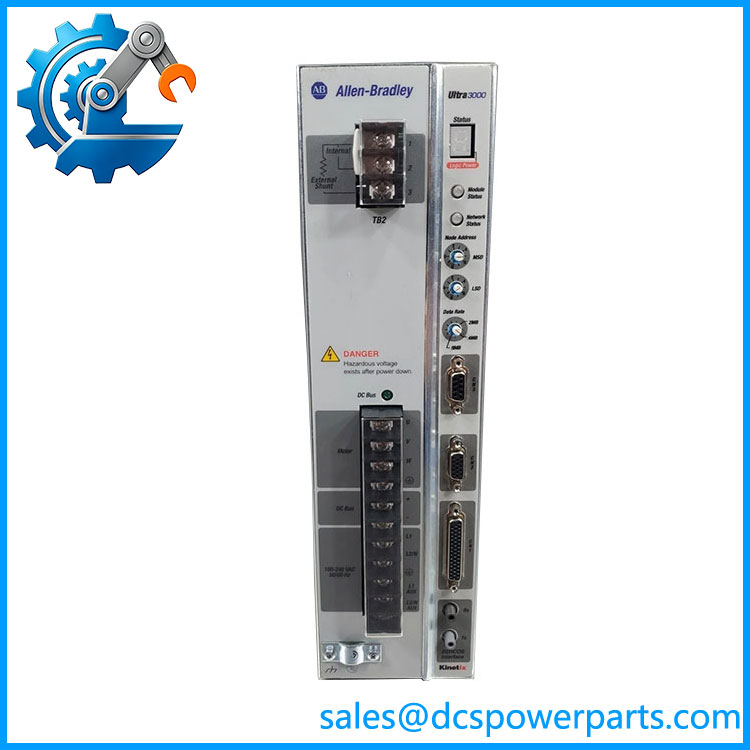
2098-DSD-030-SE
Major Features / Practical Advantages
3 kW Ultra3000 Servo Capacity
The 030 rating identifies the 3 kW class of the Ultra3000 200 V family. At 230 VAC input, the drive provides a documented 3 kW continuous output. Continuous output current is 10.6 A RMS, while peak current reaches 21.2 A RMS for appropriate motion demands.
That distinction matters when matching a replacement. Motor rated current, peak acceleration demand, and load inertia should be checked against the actual application rather than selecting the drive solely from the motor’s nominal horsepower.
SERCOS Motion Interface
The -SE version is specifically the SERCOS-interface drive. The front panel has separate SERCOS receive and transmit connections, node-address switches, and a data-rate switch.
This makes it fundamentally different from Ultra3000 variants using DeviceNet or other control architectures. Substituting a similar-looking 2098--DN or indexing version is not a protocol-neutral replacement.
Dedicated Motor Feedback Interface
CN2 is a 15-pin motor-feedback connector. The feedback circuit is part of the servo control loop, so the exact motor/feedback combination must be confirmed before commissioning. Rockwell’s installation documentation identifies CN2 specifically as the motor feedback connection.
For a legacy machine, retain the original feedback configuration whenever possible. A drive that powers up correctly can still fail to operate correctly if the feedback type or motor data is wrong.
44-Pin User I/O
CN1 provides the 44-pin user I/O interface. Depending on the application, this connector handles command, auxiliary encoder, programmable analog, limits, brake, and other control-related signals. The Ultra3000 integration documentation identifies CN1 as the user I/O interface for the SERCOS drive family.
Do not copy an old CN1 wiring schedule from memory. Use the exact drive manual and the machine electrical drawings during replacement.
Integrated Shunt Management
The 3 kW model has an internal 35 Ω shunt resistor, with 50 W continuous and 4.5 kW peak internal shunt capability. The documented shunt turn-on voltage is 420 VDC, turn-off is 402 VDC, and DC-bus overvoltage is 452 VDC.
This becomes relevant on high-inertia applications where regenerative energy returns to the DC bus during rapid deceleration. If the application historically used an external shunt, that configuration must be preserved rather than assuming the internal resistor is sufficient.
Serial Commissioning Interface
The 9-pin CN3 port supports serial communications. The installation documentation identifies RS-232 and RS-422/RS-485 signals on the connector.
This interface is useful for setup and service, but it should not be confused with the drive’s SERCOS motion network.
Legacy Replacement Availability
Rockwell officially lists as discontinued effective December 31, 2022. The manufacturer categorizes the discontinued product as repairable/replaceable and provides a functional-replacement pathway.
For an installed Ultra3000 machine, retaining a tested spare can therefore be more practical than attempting an unplanned migration during a production outage.
Related Products
- — Ultra3000 3 kW servo drive without the
-SESERCOS designation; the control interface must be checked before considering it as a substitute. - — 3 kW Ultra3000 drive with DeviceNet interface; different network architecture from the SERCOS
-SEversion. - 2098-DSD-030X — 3 kW Ultra3000 indexing servo drive; includes different control functionality and should not be treated as automatically interchangeable.
- 2098-DSD-020-SE — Smaller 2 kW-class Ultra3000 SERCOS drive for lower-power axes.
- 2098-DSD-075-SE — 7.5 kW Ultra3000 SERCOS drive for higher-power applications.
- 2098-DSD-150-SE — 15 kW Ultra3000 SERCOS drive for substantially higher motor power.
- 2098-DSD-HV030-SE — High-voltage Ultra3000 SERCOS family; different input-voltage class and therefore not a direct electrical substitute.
- 2098-DSD-030X-DN — DeviceNet indexing version of the 3 kW Ultra3000 family.
- 1756-M08SE — ControlLogix SERCOS interface module used in Rockwell motion architectures with compatible SERCOS drives.
- 2090 Series motor/feedback cables — Cable families used to connect Ultra3000 drives to compatible Allen-Bradley motors and feedback devices; exact cable selection depends on the motor and feedback configuration.
FAQ
What is the Allen-Bradley 2098–SE?
It is a 3 kW Ultra3000 digital servo drive with a SERCOS interface. It controls a compatible servo motor while receiving coordinated motion information through the SERCOS network.
What input voltage does the 2098–SE use?
The 3 kW 200 V-class drive accepts 100–240 VAC RMS single-phase, 47–63 Hz. The documented absolute input limits are approximately 88–265 VAC RMS.
What is the continuous output current?
The published value is 10.6 A RMS continuous, equivalent to 15 A 0-peak. Peak output capability is 21.2 A RMS or 30 A 0-peak.
Can I replace with a 2098–DN?
Not as a direct protocol substitution. The -SE model uses SERCOS, while the -DN model is a DeviceNet-interface version. The motion controller, network architecture, configuration, and machine software must support the proposed replacement.
Can I hot-swap this servo drive?
No. Treat it as a powered servo drive connected to hazardous AC/DC bus voltage and motor circuitry. Isolate incoming power, allow the DC bus to discharge according to the Rockwell procedure, and verify the bus voltage before touching power terminals. The drive also contains stored energy in its DC bus capacitors.
Does th support SERCOS?
Yes. That is the defining feature of the -SE version. It has dedicated SERCOS Rx and Tx connections, node-address switches, and a data-rate switch.
Does it support firmware v3.1?
The catalog number alone does not establish a specific firmware revision. Rockwell provides Ultra3000 firmware downloads separately from the hardware catalog information. The installed firmware should be read from the actual drive and checked against the existing controller and machine application before replacement.
What should I verify before buying a replacement?
At minimum, match:
- exact catalog number.
- Drive series and hardware revision.
- Motor catalog number and rated current.
- Motor feedback type and CN2 wiring.
- SERCOS controller/module and network configuration.
- SERCOS node address and data-rate settings.
- CN1 user-I/O wiring.
- Internal/external shunt arrangement.
- Existing drive parameters and application data.
- Firmware compatibility and machine commissioning requirements.
Procurement Note
The Allen-Bradle is now a legacy servo-drive procurement item. Rockwell discontinued the model on December 31, 2022, so condition and configuration verification deserve as much attention as the catalog number itself.
For a replacement in an operating machine, do not substitute another 3 kW Ultra3000 merely because its power rating matches. The SERCOS interface, feedback configuration, motor data, user I/O, node address, and shunt arrangement are part of the functional system.
For New Surplus or previously installed equipment, request the actual nameplate photograph, hardware revision, firmware information where available, and evidence that the drive has been powered and tested. Inspect the DC-bus section and cooling path carefully; these are older drives, and long-term storage does not guarantee that capacitors, fans, connectors, or power components remain within original operating condition.
Rockwell’s published technical data also gives a useful hard limit for replacement planning: the 3 kW model has 10.6 A RMS continuous output and 21.2 A RMS peak output. Those figures should be checked against the motor’s continuous and acceleration requirements rather than using the nominal “3 kW” label as the only sizing criterion.
For an existing SERCOS machine, preserving the original parameter set and commissioning records before removing the failed drive is strongly recommended. A replacement that is electrically healthy but incorrectly configured can produce encoder faults, following-error faults, incorrect direction, or unstable motion.