Description
Key Technical Specifications
| Parameter | Specification |
|---|---|
| Manufacturer | ABB |
| Model | PPD115A102 |
| Part Number | 3BHE017628R0102 |
| Product Type | FOCS excitation-control system module |
| System Family | ABB FOCS / PEC800 |
| Primary Application | Excitation control |
| Controlled Equipment | Synchronous generators / motors |
| Current Measurement Technology | Fiber-Optic Current Sensor (FOCS) architecture |
| System Role | Control/interface hardware within excitation system |
| Power Stage Interface | Application-dependent |
| Communication Interfaces | Configuration-dependent |
| Operating Voltage | Verify from the installed system documentation |
| Operating Temperature | Verify from the applicable ABB system documentation |
The public technical record associates PPD115A102 with ABB’s FOCS excitation-control architecture and identifies FOCS as a fiber-optic current-sensing technology used for high-current DC measurement in power-electronics and excitation applications. One source also associates the part with PEC800-PS and PEC800-CO hardware. Because the available public documentation does not provide a sufficiently reliable standalone datasheet for PPD115A102, exact voltage, current, connector, and environmental ratings should be taken from the installed system documentation rather than reseller specifications.
Product Introduction
The ABB PPD115A102 3BHE017628R0102 is a specialized module associated with ABB FOCS-based excitation control systems used with synchronous generators and other power-electronics applications. The FOCS architecture uses optical current measurement to provide feedback for excitation regulation, while the associated control hardware manages the excitation system according to the configured control strategy. This places the PPD115A102 in a very different category from a conventional PLC I/O card or general-purpose DCS controller.
For plant maintenance, the important issue is the relationship between the PPD115A102 and the complete excitation-control system. A replacement cannot be evaluated only by matching the model number. The installed FOCS sensors, control electronics, power stage, firmware/configuration, fiber connections, and excitation-system architecture should all be checked before commissioning. The part number 3BHE017628R0102 should remain attached to the procurement record because similar ABB PPD-series modules serve different functions.
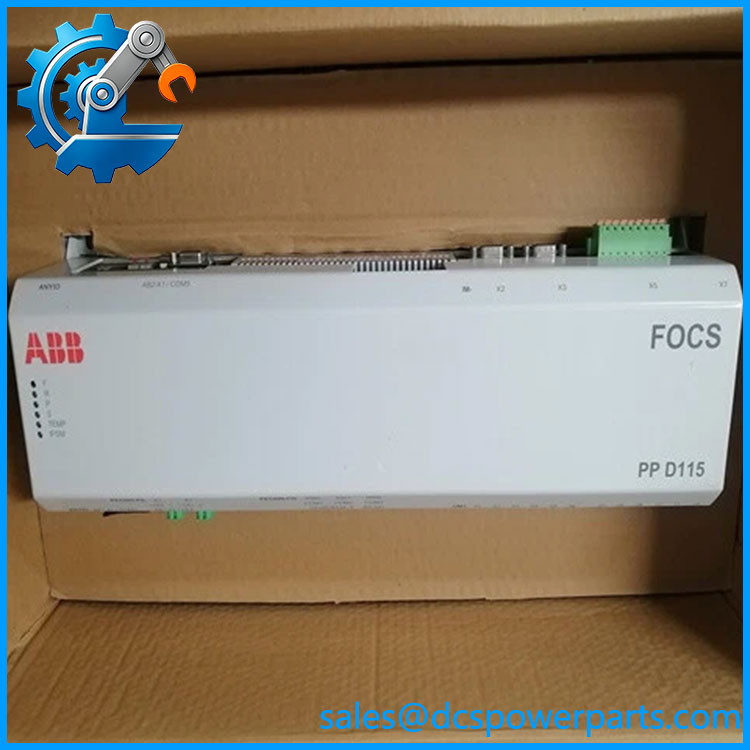
PPD115A102
Application Scenarios & Field Pitfalls — The Engineer’s Perspective
Engineering Pain Point
A fault in an excitation-control system can look like a generator regulation problem, a current-feedback problem, or a power-stage fault. Replacing the first suspected control board without checking the complete feedback chain can create unnecessary downtime.
With the PPD115A102, troubleshooting should consider the relationship between the control electronics and the FOCS measurement path. Fiber-optic current sensing is particularly useful in high-current excitation systems because the measurement path is electrically isolated from the high-current conductor. However, this also means that fiber connections, sensor installation, optical integrity, and configuration must be considered when diagnosing abnormal feedback.
Typical Applications
1. Synchronous generator excitation
The PPD115A102 is associated with ABB FOCS excitation systems used to regulate excitation for synchronous generators. The excitation regulator determines the required excitation output based on system feedback and the configured control criteria.
2. Power-generation plants
FOCS technology is applicable to generator excitation systems where accurate measurement of large DC excitation currents is required. Public technical descriptions of the ABB FOCS architecture identify applications in power-generation and power-electronics systems.
3. Power-electronics control systems
The PPD115 family is associated in secondary documentation with ABB PEC800-related power-electronics hardware. The exact role of a particular PPD115 variant should be confirmed against the system BOM rather than inferred from the family name alone.
4. Legacy excitation-system maintenance
For plants operating older ABB excitation equipment, retaining an exact PPD115A102 spare can reduce the need for an immediate system redesign when a control-system module fails.
Technical Pitfalls
1. Do not confuse PPD115A102 with a generic PLC controller.
The PPD115A102 belongs to a specialized power-electronics/excitation-control architecture. Calling it a standard PLC CPU or general-purpose DCS controller obscures its actual system role.
2. Do not assume every PPD115 module is interchangeable.
The PPD family contains different variants and assemblies. The complete PPD115A102 / 3BHE017628R0102 identification should be matched against the installed hardware. ABB PPD-series part numbers can differ substantially in function despite similar naming.
3. FOCS feedback must be checked as part of the system.
A current-feedback fault does not automatically prove that the PPD115A102 has failed. The optical sensor, fiber path, termination, sensor positioning, and associated electronics should be inspected before replacing the control module.
4. Avoid unsupported electrical specifications.
Some reseller pages publish specific 24 VDC, 10 A, channel-count, or communication-protocol claims for this part. The available evidence does not establish those values as universal specifications for PPD115A102. They should not be used for engineering design without the applicable ABB documentation.
5. Verify the complete excitation architecture.
The excitation power unit and excitation regulator perform different functions. The power unit supplies rotor excitation current, while the regulator determines the required output according to feedback and control criteria. A module-level replacement should therefore be evaluated in the context of the complete excitation system.
6. Check firmware and configuration before commissioning.
If the replacement module is being installed in an operating generator excitation system, record the existing hardware revision, configuration, software/firmware information, and relevant calibration parameters before removing the original unit.
7. Treat a replacement as a controlled engineering activity.
Excitation-system hardware directly affects generator voltage and reactive-power behavior. Functional testing should be completed under the plant’s approved commissioning procedure before the generator is returned to normal operation.
Related Products
- ABB PPD115A102 3BHE017628R0102 — FOCS excitation-control system module; the subject part.
- ABB PPD115 — Related PPD115 hardware family associated with ABB FOCS / PEC800 systems.
- ABB PEC800-PS — Power-supply-related hardware associated with the PEC800 architecture; not automatically interchangeable with PPD115A102.
- ABB PEC800-CO — Control/communication-related PEC800 hardware referenced with the PPD115 family.
- ABB PPD113B01-10-150000 3BHE023784R1023 — Related ABB power-electronics/excitation controller family member.
- ABB PPD512 — Later/different PPD-series controller hardware associated with AC 800PEC systems; not a direct substitute.
- ABB PPD513 — Related PPD-series control hardware with a different system function.
- ABB PPD517A3011 — Excitation-control hardware from a later PPD family; compatibility requires system-level verification.
- ABB PPE091A101 — Related ABB power-electronics control hardware.
- ABB FOCS — Fiber-Optic Current Sensor excitation architecture associated with high-current generator excitation applications.
Procurement Note
For ABB PPD115A102 3BHE017628R0102, request the complete part number, hardware revision, installed FOCS/PEC800 architecture, and available nameplate information before confirming a replacement. Do not substitute another PPD-series board simply because the model numbers look similar.
The strongest practical approach is to match function, revision, system architecture, and feedback configuration, not just the physical appearance of the board. This is especially important for generator excitation equipment, where an incorrect control or feedback component can produce system-level behavior that is much more serious than a normal PLC module mismatch.