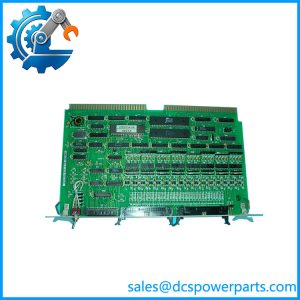
Description
Key Technical Specifications
| Parameter | Specification |
|---|---|
| Product Model | LPD250A |
| Manufacturer | ABB |
| Product Family | Symphony DCS |
| Associated Controller | HCU |
| Product Type | SOE Time Synchronization Module |
| Primary Function | External hardware-timer synchronization |
| Synchronization Interface | RS-485 |
| External Pulse Input | 1PPM |
| Application | Sequence of Events recording |
| Time Source | External synchronized clock |
| System Role | HCU/SOE timing support |
| Typical Environment | Power generation / industrial DCS |
| Installation | ABB Symphony HCU architecture |
The strongest available technical reference identifies LPD250A as the SOE time-synchronization module used with ABB Symphony HCU controllers. It describes an RS-485 synchronization signal generated from an SOE server’s timing master and connected to the LPD250A; the LPD250A’s onboard hardware timer can also accept an external 1PPM synchronization pulse.
This is an important distinction. Some industrial spare-parts pages incorrectly describe LPD250A as an “Advanced Process Control System,” but that description appears in catalog aggregation rather than technical context. The more specific engineering references identify its role as SOE time synchronization hardware.
Application Scenarios & Pain Points
In a power plant, a trip sequence can unfold in milliseconds. If separate controllers carry clocks that drift relative to each other, the resulting event list can show the wrong sequence—or make two nearly simultaneous events impossible to distinguish reliably.
- Power-generation SOE: LPD250A supports time synchronization for HCU controllers so distributed digital events can receive a more consistent time reference.
- Turbine and balance-of-plant monitoring: Where trip, interlock, MFT, ETS, or other critical discrete signals are recorded through the DCS, synchronized timing improves post-event analysis.
- Legacy Symphony systems: The module is relevant when an existing ABB Symphony installation remains operational and accurate SOE timing must be maintained without replacing the entire controller architecture.
- External clock distribution: An external 1PPM or RS-485 timing source can be distributed to the applicable controller timing hardware.
Field note: A common mistake is to equate a controller’s 1 ms scan rate with 1 ms SOE accuracy. Those are not the same thing. Clock synchronization between distributed controllers is a separate engineering issue.
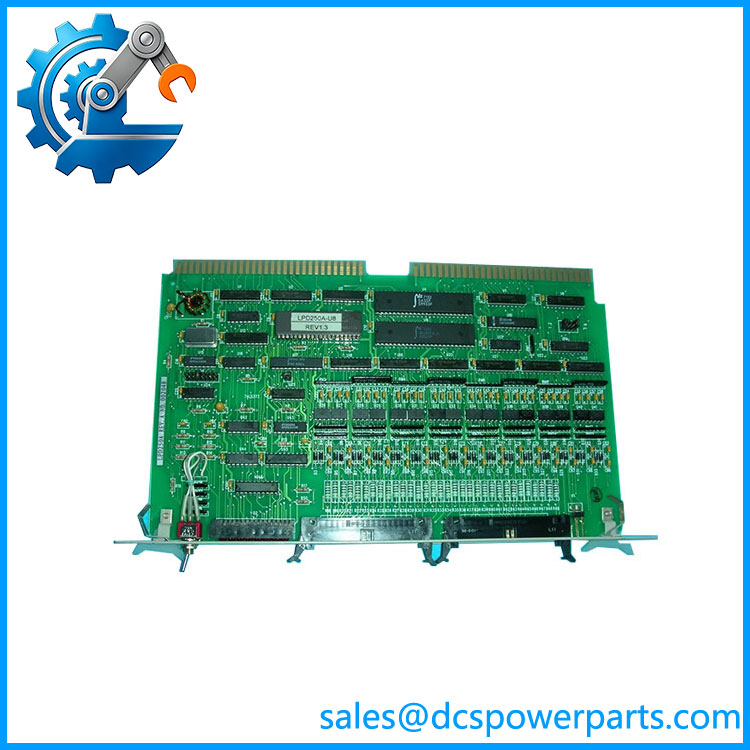
LPD250A
Related Products
- ABB INTKM01 — Timekeeping master module referenced in ABB Symphony SOE architecture. It receives an external IRIG-B timing reference and generates the synchronization signal distributed toward -equipped controllers.
- — The subject SOE synchronization module. Its role is controller-side timing synchronization rather than general DCS communication.
- ABB HCU — Host Controller Unit architecture in which the is used for SOE timing synchronization. The exact HCU hardware revision should be checked before replacement.
- ABB SOEServerNode — Server-side component referenced in Symphony SOE timing architecture. It is associated with the system timing function rather than being a replacement for the .
- ABB INTKM01 + combination — The timing-master and controller-side synchronization arrangement. This pairing is particularly relevant when troubleshooting distributed SOE timestamp discrepancies.
- ABB Symphony DCS HCU modules — The broader controller hardware family supported by the timing architecture. Exact controller revision matters for legacy replacement work.
- ABB Symphony SOE system — The larger event-recording architecture in which synchronized controller clocks are used to improve the ordering and correlation of field events.
The Engineer’s Guide: Field Pitfalls to Avoid
⚠️ Do not confuse SOE synchronization with ordinary controller communications.
is associated with time synchronization, not a general-purpose Ethernet, Modbus, or PROFIBUS interface. Its job is to keep the controller’s event-timing reference aligned.
⚠️ Verify the external timing source.
If the system uses a 1PPM signal, check its electrical characteristics and wiring all the way back to the timing source. A dead synchronization signal can leave the controller operating while silently degrading the accuracy of event timestamps.
⚠️ Do not assume synchronized timestamps simply because the module is installed.
Check the actual timing architecture: master clock, distribution wiring, RS-485 signal, 1PPM pulse, controller hardware timer, and SOE configuration. One failed link can compromise the entire chain.
Practical check: Before replacing the module, record the existing position, connector wiring, synchronization source, HCU identification, and observed SOE timestamp behavior. After replacement, verify that the controller is actually receiving the timing reference rather than stopping after a basic power-up check.
Frequently Asked Questions (FAQ)
What is ABB used for?
The is associated with ABB Symphony DCS HCU controllers for SOE time synchronization. It allows the controller’s hardware timer to be synchronized with an external timing reference.
Does provide RS-485 communication?
RS-485 is described as one of the synchronization paths used in the Symphony architecture. In this application, it should be understood as a clock-synchronization signal, not as a general-purpose serial communications port.
What is the purpose of the 1PPM signal?
A 1PPM signal provides a periodic external timing reference. The technical description states that the hardware timer can use an external 1PPM synchronization pulse, with the timer automatically synchronized at the specified interval.
Why is important for power-plant SOE?
SOE analysis depends on reliable event ordering. If different controllers have unsynchronized clocks, timestamps can drift enough to make the apparent sequence of trips, interlocks, and status changes misleading. External synchronization helps keep those controller timestamps aligned.
Can I replace with a generic RS-485 module?
No. An RS-485 electrical interface does not make two modules functionally interchangeable. The belongs to a specific ABB Symphony/HCU timing architecture, so the synchronization protocol, signal wiring, timer behavior, and controller compatibility must all match.
What should I check when purchasing a used ?
Ask for photographs of the , including the complete identification label, connectors, and board condition. For a critical SOE system, request functional verification of the synchronization input and controller-side timing behavior rather than accepting only a power-on test.