Description
ABB IMRIO02 Remote I/O Module
Key Technical Specifications
- Remote I/O architecture: Provides the communication path between an INFI 90 Multi-Function Processor and remotely installed slave modules.
- Processor compatibility: Designed to operate with Bailey IMMFP01, IMMFP02, and IMMFP03 Multi-Function Processors.
- Data rate: 1 Mbit/s serial remote I/O communication.
- Remote distance: Bailey documentation specifies communication over distances up to approximately 10,000 ft / 3,000 m, subject to cable type and installation configuration.
- Transmission media: Coaxial, twinaxial, or fiber-optic links can be used with the appropriate termination hardware.
- Installation: Occupies one slot in the INFI 90 Module Mounting Unit (MMU).
- Configuration: Addressing and operating options are established through onboard DIP switches.
- Diagnostics: Internal diagnostics monitor module and remote communication integrity.
- Redundant operation: The architecture supports redundant remote I/O modules and associated communication hardware.
- System role: Depending on its physical location, an IMRIO02 can function as the remote-link master processor or as a remote slave processor.
Product Introduction
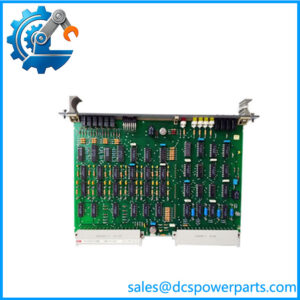
ABB IMRIO02 Remote I/O Module
The ABB Bailey IMRIO02 is a Remote I/O Module for legacy INFI 90 process-control systems. Its job is not to directly measure a 4–20 mA signal or switch a field output. Instead, it establishes the communication path between an INFI 90 Multi-Function Processor and remote I/O hardware. Bailey documentation specifies a 1 Mbit/s link and remote distances up to 3,000 m, depending on the cable and termination arrangement.
The module occupies a single MMU slot and uses configurable switches and front-panel status indicators for installation and diagnostics. In a typical architecture, one IMRIO02 works with the MFP-side equipment while another operates at the remote location, where it communicates with the local expander-bus I/O modules.

IMRIO02
Applications & Field Pitfalls — Engineer’s Perspective
The IMRIO02 was intended for plants where process I/O had to be physically separated from the main controller cabinet. Typical installations include remote process areas, distributed equipment rooms, and older INFI 90 systems with multiple remote I/O drops.
Typical Applications
- Remote INFI 90 I/O racks
Extends the I/O architecture away from the main MFP cabinet. - Distributed process areas
Useful where field termination and I/O hardware are located a significant distance from the controller. - Brownfield DCS maintenance
Commonly encountered when maintaining established Bailey INFI 90 installations rather than designing new control systems. - Redundant remote I/O architectures
The original architecture supports redundant RIO and communication hardware where the system was engineered accordingly.
Field Warnings
1. Do not treat IMRIO02 as a conventional I/O card.
The module provides the remote communication function. The actual process signal interfaces are provided by separate INFI 90 I/O modules.
2. Check the complete remote-link architecture.
A replacement IMRIO02 should be checked against the associated termination unit, cable medium, remote-link configuration, module address, and MFP arrangement. Bailey documentation lists dedicated termination hardware such as the NTRL03 and fiber-optic NTRL02 configurations.
3. Verify the module’s system position.
An IMRIO02 installed near the MFP and one installed at a remote location can have different functional roles within the RIO link. A visually identical spare is not enough; the switch configuration and network position must match the original installation.
4. Do not assume modern Ethernet protocols.
The documented IMRIO02 architecture uses the Bailey remote I/O communication scheme. Claims that the module is a standard Ethernet, Modbus, or generic remote I/O interface should be treated with caution.
Related Products
- IMMFP01 — INFI 90 Multi-Function Processor; compatible processor for the IMRIO02 architecture.
- IMMFP02 — Higher-capacity Multi-Function Processor variant used with compatible RIO installations.
- IMMFP03 — Later Multi-Function Processor compatible with the documented IMRIO02 architecture.
- NTRL03 — Remote Link Termination Module associated with IMRIO02 remote-link installations.
- NTRL02 — Fiber-optic Remote Link Termination Unit for applicable IMRIO02 configurations.
- NIRL03 — Remote Link termination hardware used within the INFI 90 remote I/O architecture.
- IEMMU01 / IEMMU02 — Module Mounting Units providing the physical and electrical mounting environment.
- IMDSI02 — INFI 90 digital input module used within the remote I/O architecture.
- IMDSO01 / IMDSO02 — INFI 90 digital output modules that can reside within the remote I/O system.
Procurement Note
For an IMRIO02 replacement, the part number alone is not sufficient for a technically safe substitution. Record the module revision, front-panel switch settings, cabinet/MMU position, MFP model, remote-link medium, termination-unit model, redundancy arrangement, and the number of remote drops.
The most important distinction is this: IMRIO02 is the communication component of the remote I/O architecture, not the field signal interface itself. A quote that identifies it simply as a generic “remote I/O card” misses the system-level function and can lead to an incorrect replacement.