Description
ABB ICSO08R1 / FPR3312101R1022
Product Introduction
Legacy CS31 installations often create a very specific maintenance problem: the control architecture may still be serviceable, while one remote I/O module becomes the component that determines whether a machine or process can remain operational. The ABB ICSO08R1 FPR3312101R1022 is an eight-channel relay digital output module for ABB Procontic CS31 remote I/O. ABB documentation identifies the module as an ICSO 08 R1 unit with electrically isolated relay outputs and a CS31 system-bus interface.
The ABB ICSO08R1 FPR3312101R1022 is specifically the 24 VDC version. Each of its eight relay outputs can switch up to 2 A, while the module requires an ECZ plug-in base with mechanical coding for the selected supply voltage. That detail matters during replacement: the module itself is not the entire mounting assembly, and the 24 VDC R1022 version should not be casually substituted with the 230 VAC R0026 version.
Key Technical Specifications
| Parameter | Specification |
|---|---|
| Product Model | ICSO08R1 |
| ABB Product ID | FPR3312101R1022 |
| Manufacturer | ABB |
| Product Family | Procontic CS31 / Advant Controller 31 |
| Product Type | Digital output module / remote I/O unit |
| Number of Outputs | 8 |
| Output Type | Relay, 1 normally-open contact per channel |
| Maximum Switching Current | 2 A per output |
| Maximum Total Output Current | 16 A across eight outputs |
| Maximum AC Switching Power | 500 VA |
| Maximum DC Switching Power | 60 W |
| Minimum Switching Load | 0.1 mA / 0.1 VDC |
| Rated Module Supply | 24 VDC |
| Maximum Module Consumption Without Output Loads | 0.2 A |
| Maximum Power Consumption Without Output Loads | 6 VA |
| Maximum Module Power Dissipation | 5 W |
| Process / Contact Voltage | Up to 250 VAC |
| System Interface | ABB CS31 system bus |
| Bus Isolation | Electrically isolated |
| Required Base | ECZ plug-in base |
| Installation | DIN rail or screw fastening |
| Diagnostic Indication | Channel LEDs and module/bus diagnostics |
| Module Weight | Approx. 250 g |
| Status | Legacy ABB hardware |
The ABB hardware manual identifies FPR3312101R1022 as the ordering number for the 24 VDC ICSO 08 R1. The same documentation identifies FPR3312101R0026 as the 230 VAC version.
Major Features and Advantages
1. Eight independent relay outputs
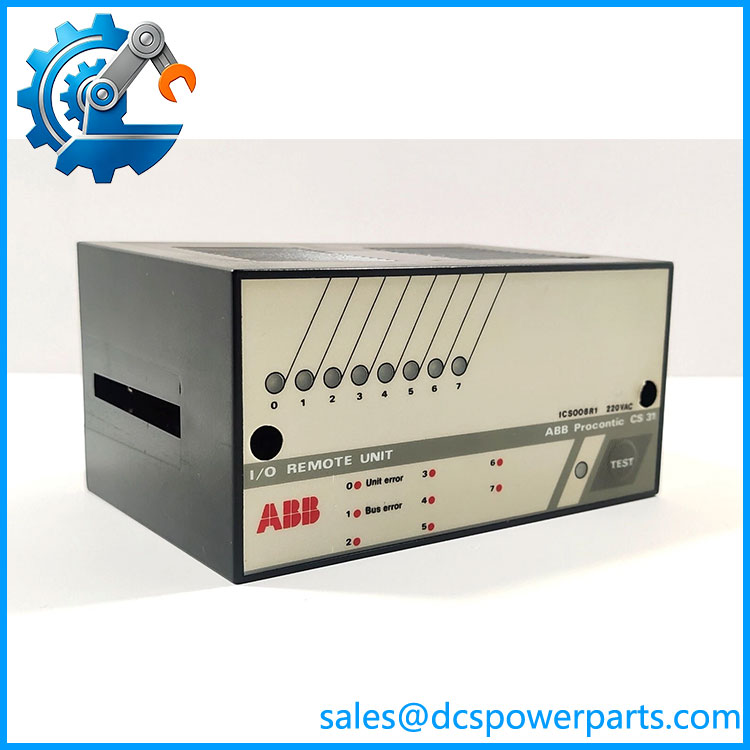
The ICSO08R1 provides eight relay output channels, with each channel using one normally-open contact. The relay contacts are electrically isolated from one another and from the rest of the module. This is useful when the CS31 controller needs to operate field devices with different electrical circuits rather than treating all outputs as one common transistor output group.
ICSO08R1 FPR3312101R1022-M
2. Designed specifically for the remote I/O architecture
This is not a generic eight-channel relay card. The module is designed to operate as a remote station on the ABB system bus. The bus interface is electrically isolated from the rest of the module, and the unit provides diagnostic information that can be evaluated by the associated basic unit or coupler.
3. 24 VDC version is clearly identified by R1022
The complete part number matters. FPR3312101R1022 corresponds to the 24 VDC version. ABB’s documentation separately lists FPR3312101R0026 for the 230 VAC version. Treating these as interchangeable because the front-panel model is the same is a procurement mistake.
4. Relay contacts can handle more than typical low-level PLC transistor loads
The documented maximum switching current is 2 A per output, with a total maximum of 16 A across all eight channels. The relay contacts are rated for applications involving higher-voltage field circuits, subject to the specified switching-power and contact limitations.
5. Local diagnostics simplify troubleshooting
Eight yellow LEDs indicate output status and can also participate in the module’s diagnostic display procedure. A red error indication and TEST button are provided on the front panel. This gives maintenance personnel a way to distinguish certain module or bus problems without immediately removing the unit from service.
Application Scenarios & Field Considerations
The ICSO08R1 is most relevant in installed ABB Procontic / Advant Controller 31 systems where relay outputs are used for field switching.
Typical applications include:
- Motor and contactor commands: relay outputs can operate suitable intermediate relays, contactors, or control circuits within the documented contact ratings.
- Valve and actuator commands: appropriate for discrete open/close or enable signals where relay isolation is required.
- Alarm and annunciator circuits: individual relay contacts can be used for status lamps, alarms, and interposing circuits.
- Legacy machine automation: particularly useful when maintaining an installed architecture where replacing the entire remote I/O structure would create unnecessary engineering and commissioning work.
A practical point from the field: the output rating alone does not tell you whether a particular load is suitable. Inductive loads require proper suppression. ABB’s documentation specifies an integrated varistor for AC inductive loads and calls for a freewheeling diode to be connected in parallel when switching DC inductive loads.
Related Products
- ABB FPR3700001R0001 / ECZ — plug-in base required for the installation.
- ABB FPR3312101R0026 — 230 VAC version; not a direct substitute for the 24 VDC R1022 version without checking the installed base and supply arrangement.
- — functional/model designation of the eight-relay digital output unit.
- ABB Procontic — controller and remote-I/O system in which the module operates.
- ABB Advant Controller 31 — broader controller family associated with this generation of hardware.
ABB documentation specifically states that the ECZ base has mechanical coding to prevent installation of a module into a base configured for a different supply voltage.
Engineer’s Guide — Field Pitfalls to Avoid
1. Do not quote the 230 VAC version by mistake
is the 24 VDC version. FPR3312101R0026 is the 230 VAC version. The front-panel model designation is similar, so purchasing by the shortened designation alone can create an avoidable mismatch.
2. Do not forget the ECZ base
The is installed on an ECZ plug-in base. The base also carries the mechanical coding associated with the selected supply voltage. If the existing base is damaged, missing, or incorrectly configured, purchasing the module alone will not necessarily solve the replacement problem.
3. Check the actual load, not just the 2 A headline rating
Two amps is the maximum documented switching current, not a blanket statement that every 2 A load is acceptable. Switching power, load type, AC/DC behavior, and inductive suppression all affect relay service life. The documentation specifies different AC and DC switching-power limits and recommends suppression for inductive loads.
4. Verify the architecture before installation
This module belongs to a legacy ABB control platform. Confirm the existing controller/basic unit, bus arrangement, station addressing, wiring, and configuration before treating the module as a simple electrical replacement.
5. Inspect the complete part number on the nameplate
For obsolete or legacy automation hardware, model numbers can be shortened in inventory databases. Before procurement, match + , supply version, revision markings, connector/base condition, and any available configuration records.
FAQ
What is ABB ?
It is an ABB Procontic digital output module providing eight relay outputs. The specific ordering number identifies the 24 VDC version.
How many outputs does the have?
The module has eight relay output channels. Each channel uses one normally-open relay contact and is electrically isolated from the other outputs.
What is the maximum current of each relay output?
The documented maximum switching current is 2 A per output. The total current across all eight outputs is specified as 16 A maximum, subject to the applicable contact and switching-power limitations.
Is a 24 VDC or 230 VAC module?
ABB identifies FPR3312101R0026 as the 230 VAC version. This distinction should be checked against the existing ECZ base before installation.
Does the module require a separate terminal or mounting base?
Yes. ABB’s documentation specifies installation on an ECZ plug-in base. The base provides the mechanical mounting arrangement and supply-voltage coding.
Is suitable for a modern PLC replacement project?
It is primarily a legacy remote I/O component, not a contemporary universal PLC output module. If the objective is to keep an existing installation running, an exact replacement can be appropriate. If the objective is a system modernization, the engineering decision should include controller architecture, field wiring, bus dependencies, software configuration, and migration requirements rather than comparing relay channel count alone.
What should procurement verify before buying ?
At minimum, verify the complete part number, 24 VDC supply version, model, ECZ base compatibility, physical condition, terminal condition, revision markings, and the installed configuration. For used or refurbished inventory, actual stock condition should be confirmed rather than inferred from a catalog description.
Procurement Takeaway
ABB is an eight-relay digital output module for the ABB Procontic remote I/O architecture, specifically the 24 VDC version. The most important purchasing distinction is between the R1022 24 VDC version and the R0026 230 VAC version. The module also depends on the ECZ plug-in base and its associated voltage coding.
For a legacy repair, match the complete ordering number and installed base rather than purchasing on the shortened “” designation alone. That small check can prevent a physically compatible-looking part from becoming an electrical mismatch during commissioning.