Description
ABB DO880 — S800 High Integrity Digital Output Module
Product Introduction
In a safety-related control cabinet, a digital output module is not simply a collection of transistor switches. The output stage has to tolerate field faults, detect wiring problems, and provide meaningful diagnostics without creating an unwanted process action. The ABB DO880 addresses this requirement as a 16-channel S800 high-integrity digital output module for 24 VDC current-sourcing applications. Each channel uses a current-limited, over-temperature-protected high-side driver, with output-state indication and isolation from the Modulebus.
The ABB DO880 supports both single and redundant configurations and provides loop supervision for configurable open- and short-load conditions. ABB specifies a maximum continuous output current of 0.5 A per channel and identifies the module as SIL3 certified. For an existing System 800xA installation, the important procurement issue is not just the DO880 part number: controller compatibility, termination-unit selection, safety configuration, module revision, and the actual installed architecture must all be checked before replacing a field module.
Key Technical Specifications
| Parameter | Specification |
|---|---|
| Product Model | DO880 |
| ABB Article Number | 3BSE028602R1 |
| Manufacturer / Brand | ABB |
| Product Family | S800 I/O |
| Product Type | High Integrity Digital Output Module |
| Number of Channels | 16 |
| Output Voltage | 24 VDC |
| Permitted DC Range | 19.2–32 VDC |
| Maximum Continuous Output Current | 0.5 A per channel |
| Signal Type | Current sourcing |
| Output Protection | Current limited / short-circuit protected |
| Over-Temperature Protection | Yes |
| Channel Grouping | 1 isolated group of 16 channels |
| Redundancy | Supported |
| High Integrity | Yes |
| SIL Certification | SIL3 according to IEC 61508 |
| HART | No |
| SOE | No |
| Intrinsic Safety | No |
| Maximum Field Cable Length | 600 m |
| Rated Insulation Voltage | 50 V |
| Dielectric Test Voltage | 500 VAC |
| Power Dissipation | 5.6 W at 16 × 0.5 A |
| +5 V Modulebus Consumption | 45 mA |
| +24 V Modulebus Consumption | Maximum 50 mA |
| External +24 V Consumption | 10 mA |
| Mechanics | S800 |
ABB specifies groupwise isolation from ground, short-circuit-proof current limiting, channel-level process-power supervision, and configurable loop supervision. The published diagnostic functions include module fault/warning information and individual channel status/error indication.
Major Features and Engineering Advantages
1. Sixteen 24 VDC output channels
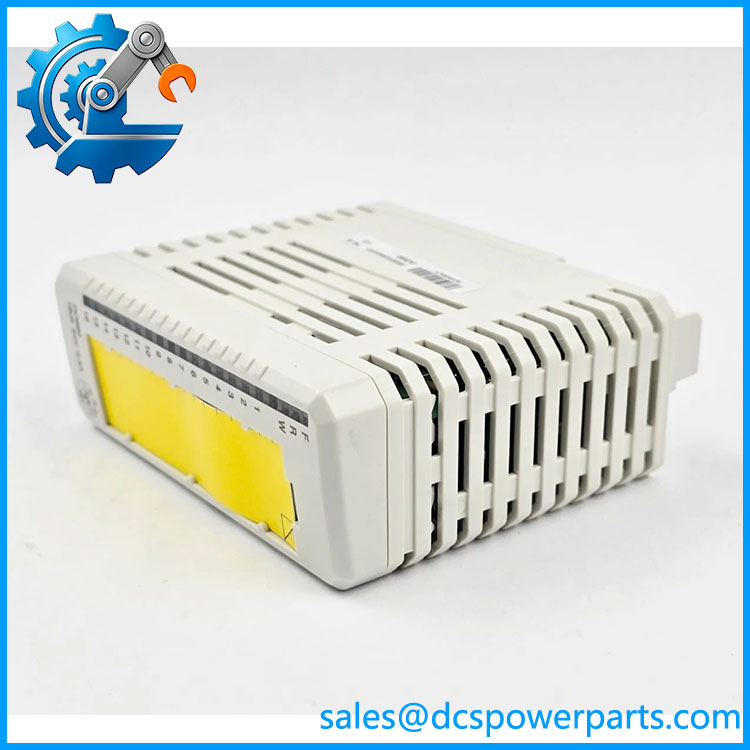
The DO880 provides 16 current-sourcing digital outputs in a single S800 I/O module. The specified maximum continuous current is 0.5 A per channel, making the module suitable for controlling typical 24 VDC discrete loads used in process automation and safety-related control applications.
DO880
2. Designed for high-integrity applications
is part of ABB’s S800 High Integrity I/O family. ABB specifies SIL3 certification according to IEC 61508 and supports single or redundant configurations. That distinction matters during system replacement: a standard DO module should not automatically be treated as an equivalent substitute simply because its channel count and voltage appear similar.
3. Output fault protection
Each output incorporates current limitation and over-temperature protection. ABB also specifies short-circuit-proof output behavior. This is important when field wiring is exposed to accidental shorts or when connected loads have significant startup or fault-current characteristics.
4. Loop supervision
The module supports supervision of open- and short-load conditions with configurable limits. ABB lists configurable loop resistance supervision from 50 Ω to 2 kΩ depending on the configuration and operating mode. This gives maintenance personnel more information than a simple ON/OFF output indication.
5. Diagnostic information at the module and channel level
Front-panel indicators provide F, R, and W status along with channel 1–16 status/error indications. ABB also specifies process-power supervision per channel and diagnostics for internal channel faults. In a plant environment, this can reduce troubleshooting time because a field-loop problem does not have to be treated as an undifferentiated controller or network fault.
6. Degraded operation for applicable configurations
ABB documents a degraded mode for normally energized channels beginning with PR:G. This is a revision-sensitive function, so procurement teams should not assume that every physical module has the same firmware or product revision behavior. Confirm the installed module revision against the applicable safety and system documentation before relying on this function.
Application Scenarios & Field Pain Points
Safety-related actuator control
can be used where 24 VDC digital outputs form part of a high-integrity control architecture. Typical loads can include solenoid-operated devices, discrete actuators, permissive circuits, and other binary field equipment, provided the electrical load falls within the documented output limits.
Redundant I/O architectures
The module supports single and redundant configurations. In a redundant installation, replacing only the failed electronic module is not enough; the installed termination arrangement, controller configuration, redundancy architecture, and safety configuration should be checked together. ABB identifies specific termination units for installations.
Process shutdown and protective functions
The diagnostic and fault-handling capabilities make relevant to applications where loss of output feedback or an unexpected output state needs to be detected. The SIL3 rating belongs to the module and its certified conditions of use; it does not mean that a complete shutdown loop automatically achieves SIL3.
Brownfield System 800xA maintenance
For older ABB installations, the practical challenge is often configuration rather than physical installation. The correct article number, controller generation, termination unit, redundancy arrangement, firmware/product revision, and safety-manual configuration all need to match the existing system.
Compatible / Related Products
The following products are relevant when evaluating an high-integrity I/O installation:
- ABB AI880A — High Integrity analog input module with 8 channels and HART support.
- ABB DI880 — 16-channel High Integrity digital input module with SOE functionality.
- ABB SS823 — 24 VDC redundant power-supply voting and overvoltage-protection device used in High Integrity 800xA architectures.
- ABB TU810V1 — Module Termination Unit supported for .
- ABB TU812V1 — MTU supported for .
- ABB TU814V1 — MTU supported for .
- ABB TU830V1 — MTU supported for .
- ABB TU833 — MTU supported for .
- ABB TU842 — MTU supported for .
- ABB TU843 — MTU supported for .
- ABB TU852 — MTU supported for .
ABB’s current hardware selector explicitly lists these MTUs as matching . Do not substitute a visually similar termination unit without checking the module’s documented compatibility.
Engineer’s Guide — Field Pitfalls to Avoid
1. Do not confuse with standard DO modules.
The family contains several 24 VDC digital output modules. Similar channel counts and output voltages do not make them safety-equivalent. ABB specifically identifies as a High Integrity/SIL3 module.
2. Verify the exact MTU before installation.
The is compatible with a defined group of termination units. The MTU is part of the field wiring interface, so replacing an existing module without confirming the terminal arrangement can create unnecessary commissioning work—or worse, incorrect field wiring.
3. Check the 0.5 A limit against the actual load.
The published 0.5 A figure is a maximum continuous output current per channel. Do not size the module from the nominal voltage alone. Check solenoid inrush, steady-state current, inductive characteristics, and the actual protection arrangement.
4. Confirm the installed product revision.
ABB documents some functionality, including degraded mode for normally energized channels, as revision-dependent. A replacement module should therefore be checked against the existing hardware and safety documentation rather than treated as revision-independent.
5. Do not equate module certification with complete-loop certification.
is certified, but the achieved safety integrity of a complete function depends on the complete architecture, configuration, diagnostics, proof-test arrangements, connected devices, and applicable safety documentation. ABB explicitly notes that High Integrity modules require configuration according to the Safety Manual.
6. Check whether the application is normally energized or normally de-energized.
The module’s documented fault behavior differs by application mode, and degraded-mode functionality has revision conditions. This should be confirmed during engineering review rather than assumed during field replacement.
FAQ
Is ABB a digital input or digital output module?
is a digital output module in the ABB I/O family. It provides 16 current-sourcing 24 VDC outputs, with a maximum continuous output current of 0.5 A per channel.
What is the ABB article number?
The ABB article number is 3BSE028602R1. When purchasing a replacement, use the complete article number and verify the physical module marking and revision rather than relying only on the abbreviated designation.
Is certified?
Yes. ABB identifies as a High Integrity module certified for according to IEC 61508. The module must still be applied and configured according to the applicable safety documentation for the intended safety function.
Can be used in a redundant I/O configuration?
Yes. ABB specifies for both single and redundant configurations. The complete redundancy arrangement—including controller, Modulebus, termination units, power architecture, configuration, and safety requirements—must be verified for the specific installation.
What is the maximum output current of each channel?
The specified maximum continuous output current is 0.5 A per channel. The outputs are current limited and protected against over-temperature and short-circuit conditions.
Is intrinsically safe?
No. ABB explicitly lists as not intrinsically safe. Do not select it simply because the application is safety-related; intrinsic-safety requirements are a separate equipment and installation consideration.
What should I verify before buying a replacement ?
At minimum, verify 3BSE028602R1, the module revision, installed controller and I/O architecture, single/redundant configuration, compatible MTU, field-load current, safety configuration, and actual inventory condition. For a used or surplus unit, physical inspection and functional testing are preferable to relying on the label alone.