Description
Product Introduction
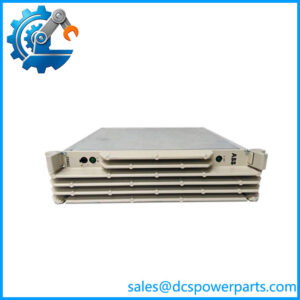
Network infrastructure in a substation has a different failure profile from an ordinary office LAN. Fiber interfaces, redundant power, managed switching, environmental requirements, and deterministic recovery behavior all become part of the engineering specification. The ABB AFS670 is a 19-inch managed industrial Ethernet switch developed for utility and power-automation environments, with modular port configurations supporting electrical and optical Ethernet connections. ABB documentation lists the AFS670 for station-bus applications in UniGear Digital systems.
The AFS670 is also important as a legacy maintenance item. ABB’s engineering documentation maps AFS670-xxx to the Hirschmann MACH1020-xxx family, while current Hitachi Energy documentation identifies AFS670/675 as legacy products. The exact AFS670 ordering code therefore matters considerably: port type, optical interface, power supply, and installed modules cannot safely be inferred from the base name alone.
Key Technical Specifications
| Parameter | Specification |
|---|---|
| Product Model | |
| Manufacturer | ABB / Hitachi Energy |
| Product Type | Managed Industrial Ethernet Switch |
| Installation | 19-inch rackmount |
| Housing | Metal |
| Maximum Port Count | Up to 24 ports in documented UniGear Digital configuration |
| Gigabit Ethernet | Up to 4 GbE ports |
| Ethernet Media | Electrical, optical, or combo depending on configuration |
| Optical Interfaces | SFP, ST, SC and other options depending on configuration |
| PoE | Available on selected configurations |
| Managed Switching | Yes |
| RSTP | Supported |
| SNTP | Supported |
| Station Bus | Supported |
| Process Bus | Not supported in the cited ABB SSC600 comparison |
| PTP | Simple PTP mode |
| PTP Hardware Timestamping | Not supported |
| Boundary Clock | Not supported |
| Transparent Clock | Not supported |
| Redundant Power | Available depending on configuration |
| Operating Environment | Industrial / utility applications |
| Legacy Status | Legacy product |
ABB’s UniGear Digital engineering guide lists as a 19-inch managed switch with up to 24 ports, RSTP and SNTP support, and station-bus capability. ABB’s SSC600 engineering documentation distinguishes from newer AFS677 hardware by noting that /675 support only PTP simple mode, without hardware timestamping, Boundary Clock, or Transparent Clock functionality.
Main Features and Engineering Considerations
19-Inch Rackmount Architecture
The is designed as a rack-mounted industrial network switch rather than a compact DIN-rail device. ABB describes a metal housing with the ports arranged on the front or rear depending on the configuration, which suits conventional substation communication cabinets.
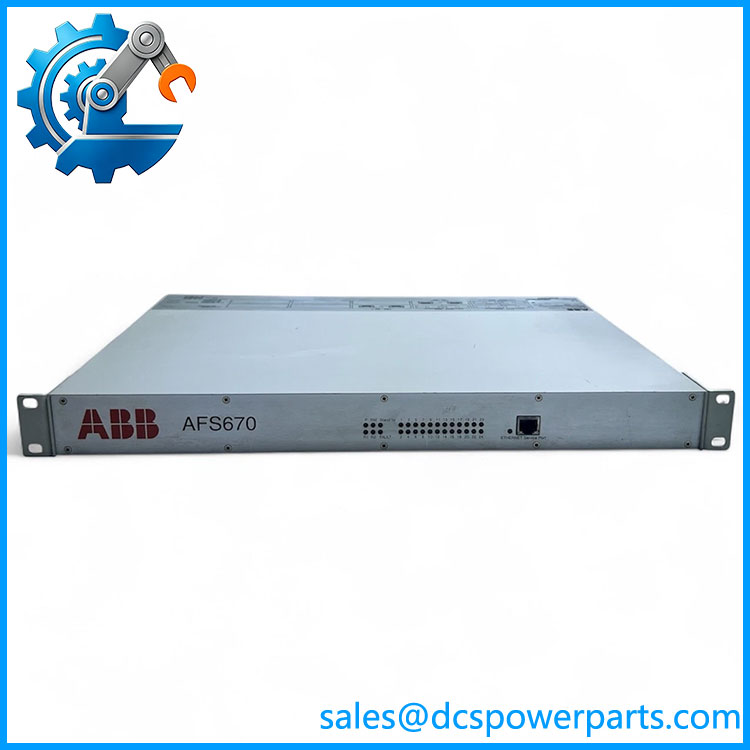
AFS670
Modular Port Configuration
This is one of the most important characteristics when purchasing an . The platform uses a modular architecture, with different modules providing electrical Ethernet, optical Ethernet, Gigabit interfaces, and other combinations. ABB documentation describes configurations reaching up to 24 ports, while the product family can include up to four Gigabit Ethernet ports.
Do not treat every as physically identical. A unit with copper RJ45 ports is not automatically interchangeable with one equipped with specific SFP, ST, or SC fiber interfaces.
Optical Ethernet for Substation Networks
The family supports optical connectivity through configurations using SFP cages and fixed optical interfaces. Optical networking can be useful for electrically noisy substation environments and for longer communication runs between cabinets or network zones. The actual fiber type, wavelength, connector, and transceiver must be checked against the complete ordering code.
Managed Ethernet Functions
is a managed switch rather than an unmanaged Ethernet repeater. ABB documentation identifies RSTP and SNTP capabilities, along with station-bus use in its UniGear Digital architecture. This allows the switch to participate in a designed industrial network topology rather than simply providing additional Ethernet sockets.
RSTP Network Recovery
RSTP support allows the to participate in Ethernet network topologies where rapid recovery from a link or path failure is required. The exact recovery behavior depends on the complete network topology and configuration; installing an RSTP-capable switch does not by itself create a redundant network.
PTP Limitation
This is an important engineering distinction. ABB identifies as supporting PTP simple mode, meaning it can derive local time from a PTP signal. It does not provide the hardware timestamping, Boundary Clock, or Transparent Clock functions found on AFS677 and certain newer AFS variants.
For an IEC 61850 process-bus application requiring high-accuracy hardware-assisted PTP, substituting an for a switch with Boundary/Transparent Clock capability would therefore require careful review.
Power Supply Options
The family was offered with different power-supply configurations. Documentation for the family identifies low-voltage DC versions as well as higher-voltage AC/DC arrangements, with redundant power configurations available. Exact input limits must be taken from the complete ordering code rather than assumed from the family name.
Application Scenarios & Field Pain Points
Substation Station-Bus Networks
The is documented as a station-bus switch for ABB UniGear Digital environments. It can provide managed Ethernet connectivity between protection, control, and supervisory equipment in a substation network.
Utility Communication Cabinets
The 19-inch form factor and configurable copper/fiber interfaces make the suitable for fixed communication cabinets where several Ethernet segments need to be consolidated into a managed switch.
Legacy ABB Network Replacement
units can appear in older ABB power-automation installations. This makes them relevant as maintenance spares even though Hitachi Energy now identifies the family as a legacy product.
Fiber-Based Industrial Networks
Configurations using SFP, ST, or SC interfaces can support fiber-connected equipment. The exact optical module and fiber specification must match the installed network; the base designation is not enough to establish optical compatibility.
Engineer’s Guide: Field Pitfalls to Avoid
1. Never purchase an by the base model alone.
The full ordering code determines the actual hardware configuration. For example, ABB/Belden-style identifiers can contain extensive port and option information.
2. Count the physical ports before approving a replacement.
“” does not mean every unit has the same port count. ABB documents configurations up to 24 ports, with different combinations of electrical, optical, and Gigabit interfaces.
3. Check the fiber interfaces carefully.
ST, SC, and SFP-based connections are not interchangeable just because both are described as fiber Ethernet.
4. Do not assume provides IEC 61850 process-bus PTP functionality.
ABB specifically identifies /675 as supporting simple PTP without hardware timestamping, Boundary Clock, or Transparent Clock functions. AFS677 provides substantially different PTP capabilities.
5. Verify the power-supply variant.
configurations can use different input-power arrangements. Check the nameplate and complete ordering code against the cabinet supply before installation.
6. Check the existing configuration before replacing a switch.
Record VLANs, RSTP parameters, SNTP/PTP settings, port assignments, link speeds, fiber transceivers, and management settings. A physically compatible replacement can still cause network problems if the configuration is not reproduced.
7. Do not confuse with AFS677.
They are related ABB managed-switch families, but AFS677 adds hardware-assisted PTP functions and process-bus capabilities documented by ABB.
8. Confirm legacy availability before specifying it for a new project.
Hitachi Energy currently marks the /675 19-inch switch as a legacy product and states that it is no longer available as a current product. For an existing installation, this makes exact spare identification particularly important.
Related Products
- ABB AFS675 — Related 19-inch managed Ethernet switch with a higher documented maximum port count.
- ABB AFS677 — Newer 19-inch managed switch family with hardware-assisted PTP and process-bus capabilities.
- ABB AFS660B — DIN-rail managed switch with a smaller port count.
- ABB AFS665B — DIN-rail managed switch family with additional port capacity.
- ABB AFS660C — Compact managed switch with HSR/PRP-related capabilities.
- ABB AFS660S — Managed switch variant supporting advanced redundancy and time-synchronization functions.
- Hirschmann MACH1020 — ABB documentation identifies the MACH1020 family as the corresponding Hirschmann platform for -xxx.
Frequently Asked Questions
What is ABB ?
The is a 19-inch managed industrial Ethernet switch intended primarily for utility and power-automation communication networks. ABB documents it for station-bus applications and configurations with electrical, optical, and Gigabit Ethernet interfaces.
Is an Ethernet switch?
Yes. It is a managed industrial Ethernet switch, not a PLC, RTU I/O module, protection relay, or network gateway.
How many ports does have?
The answer depends on the exact configuration. ABB’s UniGear Digital documentation lists up to 24 ports, while Hitachi Energy identifies configurations with up to four Gigabit Ethernet ports.
Does support fiber Ethernet?
Yes. The family supports optical configurations including SFP cages and fixed ST/SC interfaces, depending on the ordered hardware configuration.
Does support PTP?
Yes, but with an important limitation. ABB states that supports PTP simple mode. It does not provide the hardware timestamping, Boundary Clock, or Transparent Clock functionality available on and certain other ABB switch variants.
Is still a current ABB product?
Hitachi Energy currently identifies the /675 19-inch switch as a legacy product and states that it is no longer available as a current product. Existing installed systems therefore require particularly careful spare-part identification.
What is the Hirschmann equivalent of ?
ABB’s engineering documentation identifies -xxx → Hirschmann MACH1020-xxx as the corresponding product family mapping. This should be treated as a documented platform correspondence, not as proof that every individual configuration is a plug-and-play replacement.
Procurement Note
For an existing installation, specify the complete ordering code, not simply “ABB .” Before approving a replacement, verify:
- Complete type code
- Number and type of Ethernet ports
- Copper versus fiber interfaces
- SFP/transceiver specification
- Gigabit-port requirements
- Power-supply variant
- RSTP configuration
- VLAN configuration
- SNTP/PTP requirements
- Existing firmware/software configuration
- Rack and connector arrangement
The biggest procurement mistake with this family is treating as one fixed hardware configuration. It is a configurable 19-inch switch platform, and the suffix carries information that can determine whether the replacement actually matches the installed network.
For used or surplus equipment, verify the physical nameplate, port modules, optical transceivers, power modules, firmware, and management configuration. Actual inventory condition should be confirmed separately from the model identity.