Description
Key Technical Specifications
| Parameter | Value |
|---|---|
| Manufacturer | ABB |
| Model | AD02 |
| Product Family | Symphony Plus SD Series I/O |
| Product Type | Analog Drive Module |
| Total Channels | 16 |
| Analog Inputs | 4 |
| Analog Outputs | 4 |
| Digital Inputs | 4 |
| Digital Outputs | 4 |
| Analog Input Range | 4–20 mA / 1–5 VDC |
| Analog Output Range | 4–20 mA / 1–5 VDC |
| HART | Yes |
| HART Modems | 1 per module |
| HART Secondary Variables | Up to 4 per analog channel; up to 32 per module |
| HART Update Rate | 2.5 s typical; 8 s maximum |
| Digital Input Voltage | 125 VDC or 120 VAC |
| Digital Input Isolation | Optically isolated |
| Digital Output Type | Open collector |
| Digital Output Rating | 250 mA @ 24 VDC; 250 mA @ 48 VDC |
| Logic Supply | 24 VDC +12% / -10% |
| Typical Logic Current | 100 mA |
| Operating Temperature | -40 to +70 °C |
| Service Port | RS232C, mini-USB form factor |
| Compatible Base | HBS01-EPD or VBS01-EPD |
| Mounting | SD Series I/O base |
| Application | Symphony Plus process control |
ABB specifies the AD02 as having 16 independently configurable channels: four analog inputs, four analog outputs, four digital inputs, and four digital outputs.
Product Introduction
ABB AD02
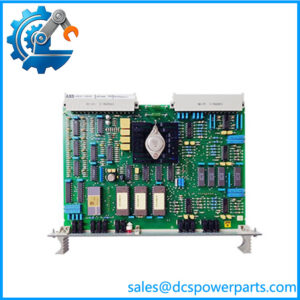
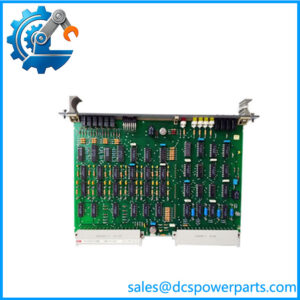
The ABB AD02 is an SD Series I/O module within the ABB Symphony Plus control platform. It combines four analog inputs, four analog outputs, four digital inputs, and four digital outputs in one module, allowing a single module to handle the signal requirements of one or more analog control loops.
The useful feature is signal density. Analog channels support 4–20 mA and 1–5 VDC, with HART available in current mode, while the digital channels provide isolated inputs and open-collector outputs. This makes AD02 particularly useful where a control loop requires mixed measurement, command, status, and discrete control signals in the same I/O location.
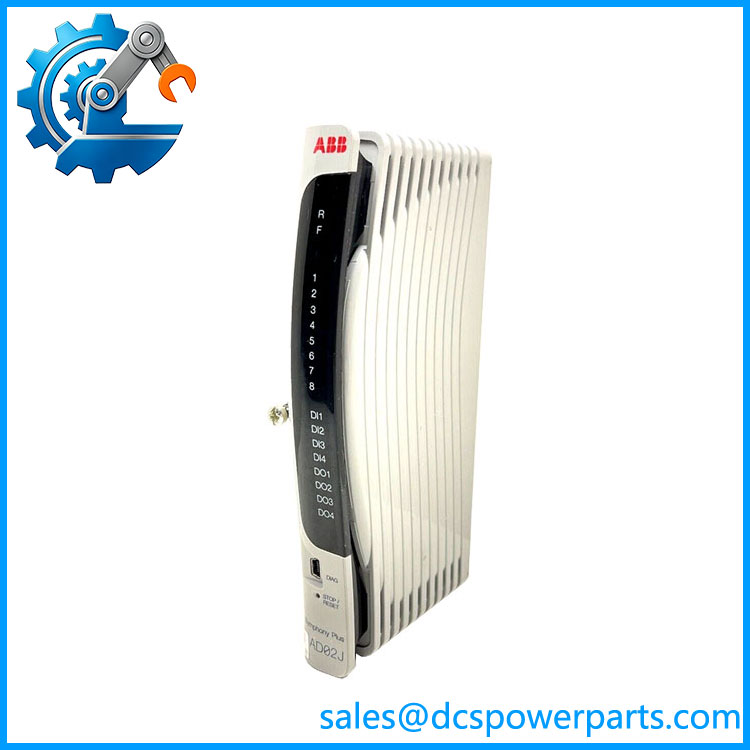
AD02
Application Scenarios & Field Pitfalls
Engineering Pain Point
A process control loop rarely consists of one signal type. A typical loop may need an analog measurement, analog control output, permissive input, and discrete actuator command. The AD02 addresses that requirement with one mixed-I/O module, but that density also means a wiring mistake can affect several different functions at the same physical location.
Typical Applications
- Power Generation — Turbine auxiliary control loops requiring analog measurement, actuator command, status inputs, and discrete outputs.
- Process Plants — Flow, pressure, temperature, and valve-control loops using mixed analog and digital signals.
- Oil & Gas — Process-control applications requiring 4–20 mA/HART instrumentation together with discrete permissives and actuator commands.
- Industrial Utilities — Pump, fan, compressor, and auxiliary equipment control where multiple signal types are concentrated in one I/O location.
Technical Pitfalls to Avoid
- Do not mistake for a standard analog input card.
It is a mixed-I/O module: 4 AI + 4 AO + 4 DI + 4 DO. Treating it as a conventional 16-channel AI module will produce the wrong wiring and configuration. - Check the base before replacement.
ABB specifies the HBS01-EPD or VBS01-EPD base for . A physically similar I/O base is not automatically compatible. - Watch the digital-input voltage.
The four digital inputs are designed for 125 VDC or 120 VAC, which is substantially different from the 24 VDC discrete inputs commonly encountered on PLC systems. - Do not exceed digital-output current.
The open-collector outputs are rated up to 250 mA at the specified voltage levels. External loads must be checked against the actual output arrangement. - HART only applies in current mode.
ABB specifies HART operation for the analog channels when configured for 4–20 mA. Do not expect HART communication when the channel is being used as a 1–5 VDC signal. - Check HART loading and configuration.
has one HART modem per module and can handle up to four secondary variables per channel. The DCS configuration must agree with the instrument’s HART setup. - Document channel assignments before removal.
Sixteen channels are divided into four different signal groups. Photograph the wiring, but also record the engineering configuration and channel function. - Check the 24 VDC logic supply.
ABB specifies 24 VDC +12%/-10% with approximately 100 mA typical logic consumption. Do not assume a generic 24 VDC supply is acceptable without checking the actual installation. - Do not confuse with AI02.
AI02 is a 16-channel analog-input module. is a mixed analog/digital module. ABB’s current documentation clearly distinguishes the two. - Plan migration carefully.
ABB’s current documentation shows an AD11e can replace AD01, , or AD11 when used with the appropriate MBA-SM01 mounting base adapter. That is a documented migration path, not evidence that AD11e is a direct plug-in replacement on the original base.
Related Products
- ABB AI02 — 16-channel analog input module for 4–20 mA or 1–5 VDC signals with HART. It is the logical choice when all required signals are analog inputs rather than the mixed-I/O arrangement of .
- ABB AO02 — 16-channel analog output module supporting 4–20 mA or 1–5 VDC with HART. It is suited to applications requiring many analog control outputs rather than ‘s mixed channel configuration.
- ABB AD11 — Related SD Series analog-drive module. It belongs to the same general mixed-I/O architecture and should be compared against when evaluating legacy system replacements.
- ABB AD11e — SDe Series replacement platform. ABB documents AD11e as a replacement for AD01, , or AD11 when installed with the appropriate MBA-SM01 adapter and original compatible base.
- ABB MBA-SM01 7PAA008655R11 — Mounting Base Adapter used to install SDe modules where legacy full-size SD Series modules such as were previously mounted. This is particularly relevant for legacy-system migration.
- ABB DO02 — 16-channel digital-output module with channel-to-channel isolation and 24–48 VDC transistor outputs. It is useful when the application needs dedicated digital outputs rather than ‘s four mixed digital-output channels.
- ABB RAO02 — Redundant 16-channel analog-output module. It provides redundancy that the standard does not provide, making it more appropriate for applications where output redundancy is required.
- ABB HBS01-EPD — Compatible base for the . It provides the physical mounting and field interface required by the SD Series module.
- ABB VBS01-EPD — Alternative compatible base for installations. Verify the existing cabinet arrangement before selecting the base.
- ABB AI12e / FI12e — SDe Series modules that can replace certain legacy SD Series analog-input modules when the appropriate mounting arrangement is used. They are relevant to SDe migration rather than direct substitution.