Description
ABB 560CMR01 R0001 | 1KGT036200R0001
Product Overview
The ABB 560CMR01 R0001 is the central communication unit for the ABB RTU560 remote terminal unit platform. Unlike an RTU560 binary input or analog input card, this module sits at the station-control level: it manages the I/O modules through the serial peripheral bus, reads process events, sends commands to output modules, and communicates with control systems or local HMI equipment. ABB documentation identifies the unit as a 32-bit CPU-based central module with two configurable serial interfaces, two 10/100BaseT Ethernet ports, a USB maintenance interface, an SPB I/O-bus connection, and a battery-buffered real-time clock.
The ABB 560CMR01 R0001 uses an ARM Cortex-A8 AM3352 processor at 800 MHz with 128 MB RAM and 8 MB boot flash. Its two serial ports can operate as RS-232C or RS-485 interfaces, with documented data rates from 200 bit/s through 38.4 kbit/s. The two Ethernet ports use RJ45 connections and IEEE 802.3 10/100BaseT signaling. A micro-USB device port is provided for diagnosis and maintenance, while the SPB I/O bus connects directly to the RTU560 backplane.
For brownfield RTU560 work, the part number deserves particular attention. ABB’s product record identifies 1KGT036200R0001 specifically as 560CMR01 R0001 and notes that protocol, function, and SD-card licenses are not included with the hardware. The same product record identifies 1KGT036200R0002 as the newer replacement product ID. That distinction matters when replacing a failed controller because a physical module exchange is not necessarily equivalent to transferring the complete software, license, cybersecurity, and configuration environment.
Product Introduction
A failed CMU can take an entire RTU station offline even when every field I/O card is still functioning. The 560CMR01 R0001 provides the processing and communications layer between those I/O modules and the supervisory/control-system network.
Its two Ethernet interfaces and two configurable serial ports make it suitable for RTU560 stations communicating with SCADA systems, IEDs, sub-RTUs, meters, or local engineering equipment. For an existing installation, though, port count alone is not enough to establish compatibility; protocol licensing and the installed RTU560 software configuration must also be verified.
Key Technical Specifications
| Parameter | Specification |
|---|---|
| Product Model | 560CMR01 R0001 |
| ABB Product ID | 1KGT036200R0001 |
| Product Family | / RTU500 |
| Product Type | Communication Unit (CMU) / Central Module |
| CPU | ARM Cortex-A8, AM3352, 800 MHz |
| CPU Architecture | 32-bit |
| RAM | 128 MB |
| Boot Flash | 8 MB |
| Serial Ports | 2 × CP1/CP2 |
| Serial Interface Type | RS-232C or RS-485 |
| Serial Connector | RJ45 |
| Serial Data Rate | 200 bit/s to 38.4 kbit/s |
| Ethernet Ports | 2 × E1/E2 |
| Ethernet Type | IEEE 802.3, 10/100BaseT |
| Ethernet Connector | RJ45 |
| USB | USB 2.0 device, micro USB Type B/AB |
| USB Speed | Up to 480 Mbit/s |
| I/O Bus | Serial Peripheral Bus (SPB) |
| RTC | Battery-buffered real-time clock |
| RTC Battery | 3 V lithium CR2032 |
| RTC Resolution | 1 s; 1 ms with time synchronization |
| RTC Free-Running Accuracy | ±50 ppm |
| SD Card | SD 2.0, Class 2, up to 4 GB |
| Backplane Connector | 48-pole Type F DIN 41612 |
| Backplane Consumption | 5 VDC, 500 mA; 24 VDC, 3 mA |
| Dimensions | 160 × 100 mm, 3U Eurocard |
| Front Panel Width | 4R / 20 mm |
| Weight | Approximately 0.14 kg |
| Mounting | rack |
| Operating Temperature | -25°C to +70°C |
| Startup Temperature | -40°C |
| Maximum Temperature | +85°C for maximum 96 hours |
| Relative Humidity | 5–95%, non-condensing |
| Security Version | Standard cybersecurity functions |
| R0002 Difference | Security chip for higher-demand cybersecurity applications |
The detailed communication-unit documentation confirms the CPU, memory, serial, Ethernet, USB, RTC, mechanical, environmental, and backplane data above.
Major Features / Practical Advantages
1. Central processing role
The 560CMR01 is not simply a communication adapter. Within an station, it provides the central processing function associated with I/O management and external communication. It manages the serial I/O bus, reads events from input modules, issues commands to outputs, and communicates with control-system and local HMI equipment.
That makes it a system-critical component. If the CMU fails, replacing individual I/O cards will not restore the station’s supervisory communication path.
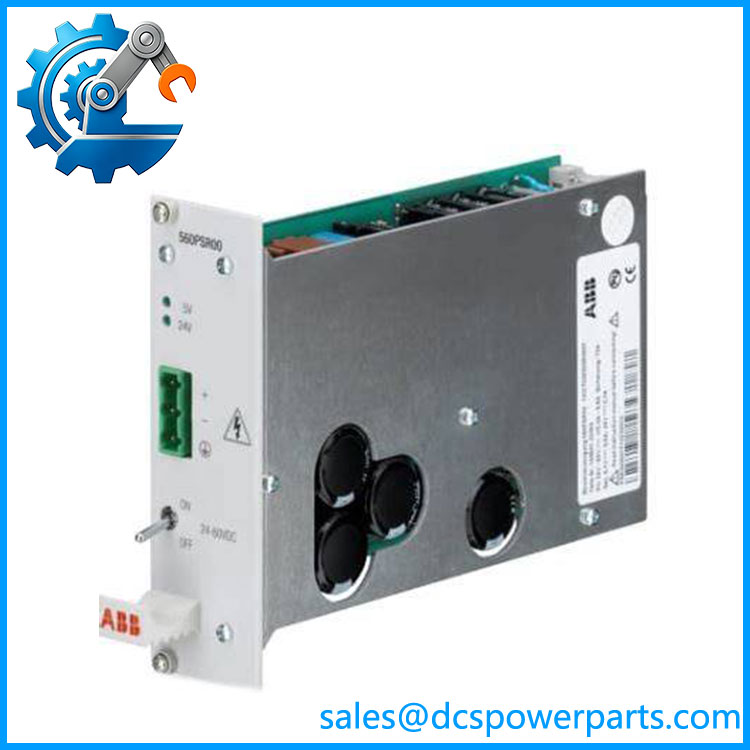
560CMR01-R0001-1KGT036200R0001
560CMR01-R0001-1KGT036200R0001
2. Dual Ethernet interfaces
Two RJ45 Ethernet ports provide 10/100BaseT connectivity under IEEE 802.3. The interfaces can be used for RTU station communication with higher-level systems and Ethernet-connected field equipment, depending on the project configuration and licensed protocol functions.
For an existing panel, document the actual network topology before replacement. The presence of two Ethernet connectors does not by itself tell you whether the installation uses redundancy, separate networks, engineering access, or another project-specific arrangement.
3. Two configurable serial interfaces
CP1 and CP2 can be configured for RS-232C or RS-485. The published data rate range is 200 bit/s to 38.4 kbit/s. RS-232C provides the documented modem/control signal set, while RS-485 is available for serial field communication.
This is useful in legacy substations and remote process installations where Ethernet and serial equipment coexist. It also means a replacement engineer should record the physical wiring and serial mode for each port before removing the original module.
4. Direct SPB I/O-bus connection
The Serial Peripheral Bus connects directly through the backplane. This is how the CMU communicates with the station’s I/O architecture. The module therefore depends on the correct rack and backplane rather than operating as an independent DIN-rail communication gateway.
The 560SFR02 and other compatible rack arrangements are therefore part of the compatibility equation.
5. Battery-buffered real-time clock
The module contains a battery-buffered RTC using a 3 V lithium CR2032 battery. Documentation specifies 1-second time resolution, with 1 ms resolution available when time synchronization is provided by the appropriate timing architecture. The free-running accuracy is specified at ±50 ppm, and the stated battery lifetime is greater than 10 years.
For an old field unit, battery condition deserves attention. A replacement module may pass a basic power-up test while its RTC battery is already near the end of its service life.
6. SD-card support
The 560CMR01 has a push-push SD-card slot supporting SD 2.0 Class 2 media, with documented capacity up to 4 GB. The ABB product record explicitly warns that SD-card and protocol/function licenses are not included with the CMU.
This is an important procurement distinction: buying the hardware does not automatically reproduce the complete software environment of the original RTU station.
7. USB maintenance interface
A micro-USB device interface is provided for diagnosis and maintenance. The documentation specifies USB 2.0 device operation at low, full, and high speed, with a maximum of 480 Mbit/s.
The port should be considered an engineering/maintenance interface rather than a general-purpose process I/O connection.
8. Industrial environmental specification
The nominal operating temperature is -25°C to +70°C, with startup specified at -40°C. The documentation permits a maximum operating temperature of +85°C for up to 96 hours. Relative humidity is specified at 5–95% without condensation.
Those limits apply to the CMU. They should not automatically be extended to every other module installed in the rack.
9. versus R0002 matters
The 560CMR01 family has two relevant hardware order variants. / 1KGT036200R0001 uses the standard cybersecurity function set, while R0002 / 1KGT036200R0002 adds a security chip intended for higher-demand cybersecurity use cases.
For a legacy replacement, do not substitute R0002 simply because it carries the same basic 560CMR01 designation. Check the installed RTU software, cybersecurity requirements, project approvals, and configuration before changing revision.
10. Replacement status requires attention
ABB’s product record identifies 1KGT036200R0002 as the replacement product for the version. The same record places the under the CMU category with availability described as “as long as available.”
That makes particularly relevant for legacy-stock procurement, but it also means the buyer should confirm exact revision and availability rather than assuming continuing production.
Related Products
- 560CMR02 — communication unit with six serial interfaces and two Ethernet ports. It provides more serial connectivity than the two-port 560CMR01 and is relevant where an existing station has a larger serial-device count.
- 560CMR02 R0002 — Later cybersecurity variant of the six-serial-port CMU family, with the security-chip architecture used for higher-demand cybersecurity applications.
- 560SFR02 — 19-inch swing-frame rack used to house CMUs, I/O modules, and power supplies. The CMR01 relies on the rack/backplane architecture rather than operating as a standalone PLC.
- 560MPR03 — mounting-panel rack alternative for installations where the 19-inch swing-frame arrangement is not used.
- 560BCU05 — bus connection unit used with applicable rack configurations and communication-unit arrangements.
- 560PSR00 — power supply for 24–60 VDC input applications; suitable for redundant power arrangements in 560MPR03/560SFR02 systems.
- 560BIR01 — 16-channel binary input module. supports 24–60 VDC process voltage; R0002 is intended for 110/125 VDC applications.
- 560BOR01 — 16-channel binary output module using relay contacts; published limits include 150 VDC maximum switching voltage and 2 A maximum breaking current at 60 VDC.
- 560AIR01 — Eight-channel analog input module for current and voltage signals, used alongside the CMU in process acquisition applications.
FAQ
What exactly does the ABB 560CMR01 do?
It is the central communication/processing unit of an station. It manages the I/O modules through the SPB interface, handles process events and output commands, and communicates with control systems, HMI systems, IEDs, sub-RTUs, and other devices through its serial and Ethernet interfaces.
Is 560CMR01 an I/O module?
No. It should not be confused with the 560BIR01 binary input, 560BOR01 binary output, or 560AIR01 analog input modules. The CMR01 is the central processing and communication module that manages those I/O resources.
Can I replace 560CMR01 with ?
Potentially, but it should not be treated as an unconditional plug-and-play substitution. ABB identifies 1KGT036200R0002 as the replacement product, while the technical documentation distinguishes by its security chip. Verify the RTU software, cybersecurity requirements, configuration, licenses, and project approvals before making the substitution.
Does 560CMR01 support firmware v3.1?
The hardware documentation does not establish a blanket “firmware v3.1” compatibility statement for this exact order code. Firmware/software compatibility must be checked against the installed application, engineering environment, protocol licenses, and target configuration. Do not approve a replacement solely because the processor and connector layout match.
Can I hot-swap the 560CMR01?
Do not assume unrestricted hot swapping. The published product documentation identifies the module’s hardware and rack architecture but does not establish a universal hot-swap procedure for every station configuration. Follow the specific maintenance procedure and site operating rules.
Are protocol licenses included with 1KGT036200R0001?
No. ABB’s product record explicitly states that licenses for protocols, functions, and the SD card are not included with the 560CMR01 hardware.
This is one of the easiest procurement details to miss. A replacement CMU can be electrically correct and still fail to reproduce the original station’s functional configuration if the required software licenses or application data are missing.
What should I check before buying a replacement 560CMR01 ?
Check the following against the existing station:
- Exact order code: 560CMR01 / 1KGT036200R0001.
- Hardware revision and nameplate: photograph the original before removal.
- versus : do not mix the two without engineering review.
- Firmware/application version: record the installed software before replacement.
- SD card: determine whether application/configuration data is stored on the existing card.
- Protocol licenses: verify the actual protocols and functions licensed at the station.
- Serial wiring: document CP1 and CP2 mode and connected equipment.
- Ethernet topology: record E1/E2 network assignments and addressing.
- RTC battery: inspect or replace the battery according to the applicable maintenance procedure.
- Backplane/rack: verify that the existing 560SFR02/560MPR03 architecture and connector condition are suitable.
Is the 560CMR01 still a current product?
ABB’s published product record lists as available “as long as available” and identifies 1KGT036200R0002 as the newer replacement product ID. That means should be treated as a legacy/availability-dependent item for procurement rather than assuming unlimited current production.
Procurement Note
The ABB 560CMR01 / 1KGT036200R0001 is a controller-level component, not merely an Ethernet communication card. Its processor, SPB interface, serial ports, Ethernet ports, RTC, SD-card capability, and software-license relationship make it central to the station’s operating configuration.
For a brownfield replacement, the most important procurement mistake to avoid is treating hardware interchangeability as functional interchangeability. Confirm the exact part number, / revision, installed software, SD-card contents, protocol licenses, serial configuration, Ethernet topology, and rack before approving the replacement.
For new surplus or previously installed stock, request clear photographs of the product label, front panel, connectors, and PCB condition. A power-on test is useful, but it does not prove that the module contains the correct application image or licensed protocol set. Those items must be checked separately.