Description
Woodward 9905-792
Product Introduction
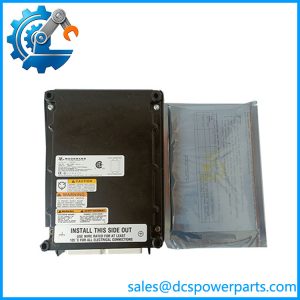
Engine speed regulation becomes a closed-loop control problem when the load changes faster than a mechanical governor can respond. The Woodward 9905-792 is a ProAct Plus digital speed control developed for engine mechanical-drive and generator-set service. Its defining configuration is the integrated 4–20 mA fuel-limit input, allowing an external signal to impose a fuel-limit command within the speed-control strategy. The original Woodward manual identifies 9905-792 as the ProAct digital speed control model covered by Manual 26334.
The 9905-792 is part of an older ProAct architecture, so replacement work needs to consider more than the controller itself. The compatible actuator, magnetic pickup, fuel-limit signal, speed reference, load-sharing arrangement, wiring, and governor settings all affect commissioning. Woodward’s current replacement documentation maps 9905-792 to 9907-1291, but that should be treated as a documented replacement path requiring application verification rather than an assumption of unrestricted drop-in interchangeability.
Key Technical Specifications
| Parameter | Specification |
|---|---|
| Product Model | 9905-792 |
| Manufacturer / Brand | Woodward |
| Product Family | ProAct Plus |
| Product Type | Digital Speed Control |
| Control Function | Engine speed governing |
| Fuel Limit Input | 4–20 mA |
| Actuator System | ProAct electric actuator |
| Actuator Rotation | 75° ProAct actuator architecture |
| Typical Application | Generator sets / mechanical-drive engines |
| ProAct II Supply | Nominal 24 VDC |
| Speed Feedback | Magnetic pickup input |
| Load Sharing | Auxiliary voltage input available for load-sensor connection |
| Replacement Part | Woodward 9907-1291 |
| Original Documentation | Manual 26334 / ProAct Plus with mA Fuel Limit Input |
| Status | Legacy / replaced part |
Woodward’s original manual states that the ProAct system is designed for engine speed control in mechanical-drive or generator-set service. It describes the electric ProAct actuator as a 75° rotary actuator intended for direct butterfly-valve drive on gas engines or linkage-driven fuel-rack control on diesel engines. The manual also specifies nominal 24 VDC operation for ProAct II controls.
Important specification caution
Several reseller pages publish additional values such as RS-485/Modbus, IP65, 2 A actuator output, -40 to +85 °C, or broad 24–48 VDC input ranges. Those claims are inconsistent with the original documentation I found and should not be treated as confirmed specifications for 9905-792.
For a replacement order, the original Woodward model number and application manual should take priority.
Application Scenarios & Pain Points
The 9905-792 is most relevant where an existing engine governor system still uses the ProAct architecture and the plant wants to maintain the installed control arrangement rather than redesign the complete speed-control loop.
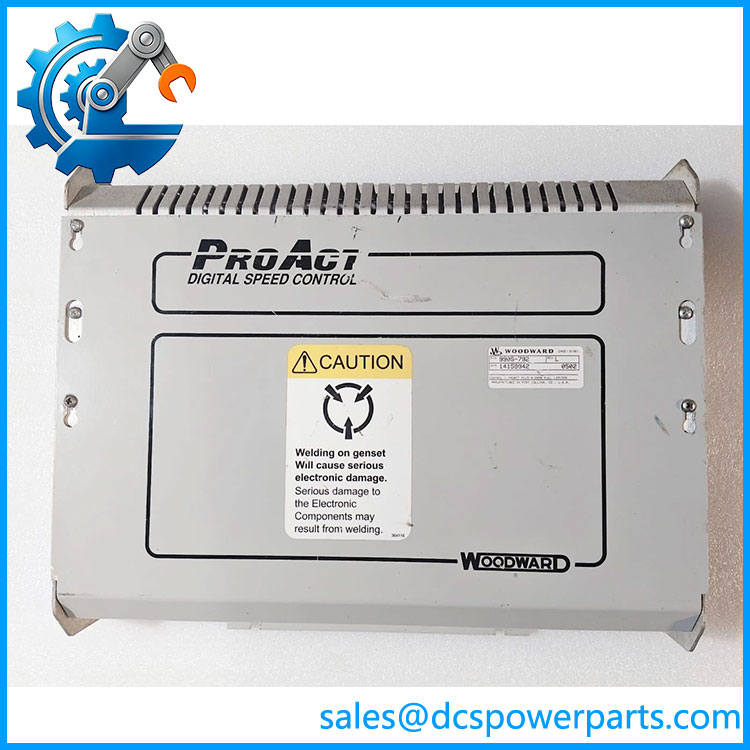
9905-792
- Generator-set engine control — Provides electronic speed governing for engine-driven generator applications.
- Mechanical-drive engines — Suitable for engines driving pumps, compressors, fans, and other rotating equipment.
- Gas-engine throttle control — The ProAct actuator architecture can directly drive a butterfly valve through its rotary output.
- Diesel fuel-rack control — With appropriate linkage, the actuator can operate the fuel rack.
- Fuel-limit coordination — The 4–20 mA input provides an external fuel-limit command within the governor system.
A common field mistake is to blame the speed controller whenever the engine hunts or fails to reach rated speed. With this architecture, the fault can just as easily originate from the magnetic pickup, actuator, linkage, fuel-limit signal, power supply, or governor tuning. Replacing the 9905-792 without checking those signals can turn a diagnostic problem into an unnecessary parts problem.
Related Products
- Woodward 9907-1291 — Current replacement identified by Woodward for 9905-792. Application and wiring compatibility should still be verified before conversion.
- Woodward 9905-462 — ProAct Model I speed-control variant; not the same fuel-limiter configuration.
- Woodward 9905-463 — ProAct Model II speed-control variant without the specific 4–20 mA fuel-limiter configuration.
- Woodward 9907-1289 — Replacement for 9905-462 in Woodward’s replacement table.
- Woodward 9907-1290 — Replacement for 9905-463.
- Woodward 8400-061 — ProAct Fuel Limit speed-control configuration.
- Woodward 8256-series ProAct 75 Driver + Actuator assemblies — Related ProAct actuator/driver hardware; selection depends on the actual control architecture.
- Woodward ProAct 75 actuators — The actuator must be matched to the controller and mechanical application rather than selected solely by physical appearance.
Engineer’s Guide: Field Pitfalls to Avoid
1. Do not confuse 9905-792 with a generic speed controller
The model has a very specific identity: ProAct Plus with 4–20 mA fuel-limit input.
If the existing system does not use this fuel-limit architecture, another ProAct model may have been installed originally. Verify the complete Woodward model number before ordering.
2. Do not assume 9907-1291 is a blind plug-in replacement
Woodward identifies 9907-1291 as the replacement for 9905-792, which is valuable information for modernization work. But replacement documentation does not eliminate the need to verify wiring, configuration, actuator compatibility, and application settings.
3. Check the magnetic pickup before replacing the controller
The speed controller depends on reliable engine-speed feedback. A weak, noisy, incorrectly gapped, or damaged magnetic pickup can look like a governor failure.
During troubleshooting, verify the pickup signal while cranking and running rather than simply checking continuity with the engine stopped.
4. Check the 4–20 mA fuel-limit signal
The fuel-limit input is one of the features that distinguishes 9905-792 from other ProAct configurations.
A failed transmitter, incorrect loop polarity, open circuit, incorrect scaling, or unstable analog signal can restrict engine output even when the governor itself is functioning normally.
5. Inspect actuator and linkage mechanically
The electronic controller can command the actuator correctly while the engine still fails to respond because of mechanical binding, incorrect linkage geometry, excessive friction, or a damaged butterfly/fuel-rack mechanism.
Always separate an electrical command problem from an actuator/mechanical response problem.
6. Confirm ProAct I versus ProAct II architecture
The original documentation distinguishes ProAct I and ProAct II configurations. ProAct II requires nominal 24 VDC, while ProAct I can operate on nominal 12 VDC. Do not apply the wrong supply assumptions simply because the two systems look similar.
7. Preserve governor settings before replacement
Before removing a working or intermittently working controller, record all relevant settings, speed references, gain/dynamics values, actuator configuration, fuel-limit scaling, and load-sharing settings.
A replacement unit with incorrect configuration can produce an apparent hardware fault during startup.
8. Treat overspeed protection separately
The 9905-792 is a speed-control component, not a substitute for an independent overspeed protection system. Do not modify or bypass independent shutdown protection during commissioning.
FAQ
What is Woodward 9905-792?
Woodward 9905-792 is a ProAct Plus Digital Speed Control with a 4–20 mA fuel-limit input. It is designed for engine speed regulation in generator-set and mechanical-drive applications.
What is the main purpose of the 4–20 mA input?
The 4–20 mA input provides an external fuel-limit command. It allows another control system or process signal to constrain the fuel command while the ProAct controller continues performing its speed-control function.
What actuator is used with the 9905-792?
The ProAct system uses a 75° electric actuator. Woodward describes the actuator as suitable for direct butterfly-valve operation on gas engines and linkage-based fuel-rack operation on diesel engines. The exact actuator selection depends on the engine and mechanical requirements.
What is the replacement for Woodward 9905-792?
Woodward’s replacement documentation identifies 9907-1291 as the new speed-control part corresponding to 9905-792. The replacement should still be checked against the actual installation before commissioning.
Is 9905-792 discontinued?
Current Woodward documentation treats 9905-792 as an old part number and lists 9907-1291 as its replacement. Secondary industrial inventory records also identify 9905-792 as discontinued.
What should be checked before replacing a 9905-792?
At minimum, verify the full model number, ProAct actuator model, supply voltage, magnetic-pickup wiring, 4–20 mA fuel-limit loop, speed-reference configuration, load-sharing connections, and governor settings. Also document the original wiring before removing the controller.
Why might a replacement 9905-792 still fail to solve an engine-speed problem?
The governor is only one element in the control loop. A poor magnetic-pickup signal, unstable DC supply, actuator fault, binding linkage, incorrect fuel-limit signal, or unsuitable dynamics settings can all create symptoms that resemble a failed controller. Troubleshooting the complete loop is more reliable than immediately replacing the speed-control unit.