Description
Product Introduction
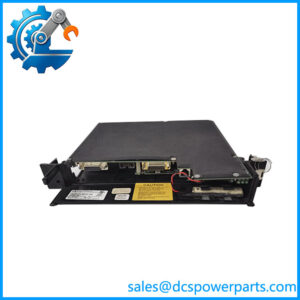
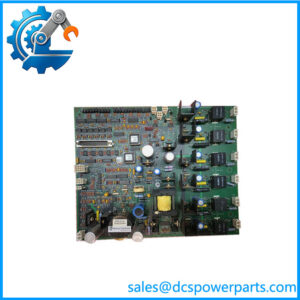
When a legacy VME control or data-acquisition system requires precise analog command signals, replacing an output card with a mismatched resolution or update method can affect calibration and system timing. The VMIC VMIVME-4116 is an eight-channel digital-to-analog converter board designed to convert processor data into bipolar analog voltage outputs.
Its 16-bit resolution, double-buffered channel data, and synchronized update options support applications that need coordinated analog outputs. Before replacing an installed card, verify the ordering suffix, output-isolation hardware, connector wiring, VME address settings, and software interface.
Key Technical Specifications
| Parameter | Specification |
|---|---|
| Model | VMIVME-4116 |
| Manufacturer / brand | VMIC; associated with GE Fanuc / Abaco Systems product lines |
| Product type | Analog output board / DAC |
| Bus architecture | VMEbus |
| Analog output channels | 8 |
| DAC resolution | 16 bits per channel |
| Output range | −10 V to +10 V |
| Output capability | ±10 V at 5 mA |
| Nominal voltage resolution | Approximately 305 μV per LSB |
| Settling time | 10 μs to within ½ LSB |
| Data buffering | Double-buffered latches |
| Update control | Software-controlled strobe or external update control; jumper-dependent |
| Digital coding | Offset binary or two’s complement |
| Output state at reset | Outputs initialized to 0 V; isolation behavior depends on the installed option |
| VME access | Short I/O access; address modifier settings are jumper-selectable |
| Board address | Selected using 12 DIP switches |
| Power requirement | +5 VDC, 2.5 A maximum |
| Board format | Double-height Eurocard, 6U |
| Approximate dimensions | 160 × 233.35 mm |
| Operating temperature | 0°C to +50°C |
| Cooling | Forced-air convection |
| Storage temperature | −20°C to +85°C |
| Isolation / built-in test | Depends on the ordering suffix |
Specifications are based on the VMIC datasheet. The output-isolation and built-in-test options are important distinctions: the base VMIVME-4116 designation alone does not identify which optional hardware is installed.
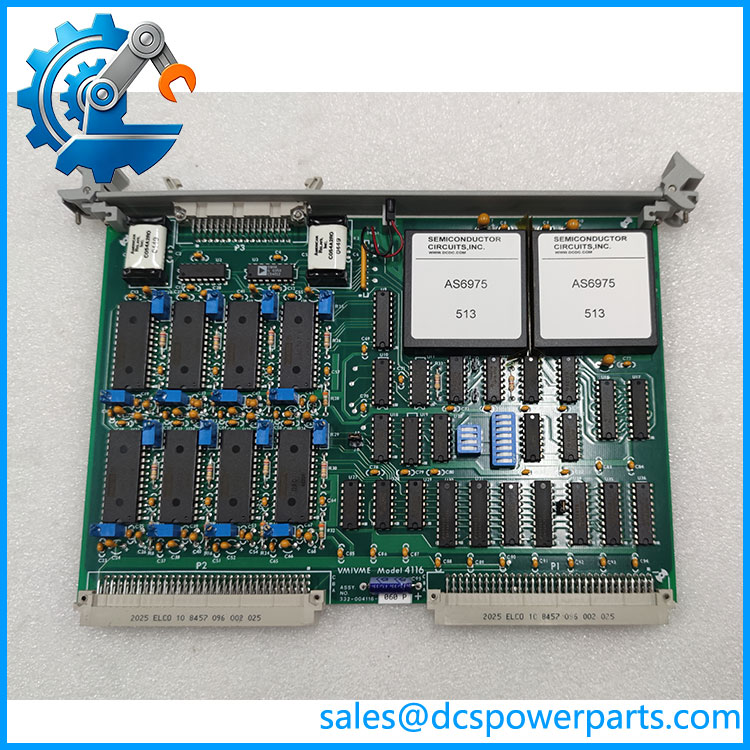
VMIVME-4116
Application Scenarios and Pain Points
In a legacy VME system, incorrect analog output scaling, timing differences between channels, or a faulty output-isolation circuit can disrupt downstream equipment even when the processor and backplane remain operational.
- Industrial control and simulation: Generate analog command or reference signals for equipment controlled through a VME-based system.
- Data acquisition and test systems: Provide programmable analog signals for measurement, calibration, and automated test sequences.
- Multi-channel output control: Use double-buffered data to prepare output values and coordinate channel updates.
- System diagnostics: Support analog loopback and built-in-test arrangements when the required AMXbus and compatible hardware are installed.
Field note: A 16-bit DAC does not guarantee 16-bit system accuracy. Actual performance depends on calibration, load impedance, grounding, noise, and the connected equipment.
Related Products and Ordering Variants
The following suffixes are documented VMIVME-4116 ordering options. They are more useful for replacement selection than assuming every board with the same base model is identical.
| Model | Configuration |
|---|---|
| VMIVME-4116-070 | 8-channel, 16-bit analog output; no built-in-test hardware and no output isolation |
| VMIVME-4116-060 | JFET output-isolation switches and built-in-test hardware |
| -050 | Output-isolation relays and built-in-test hardware |
| -040 | JFET output-isolation switches without built-in-test hardware |
| -030 | Output-isolation relays without built-in-test hardware |
These are distinct configurations, not interchangeable suffixes. Match the existing board’s complete ordering number and system requirements before sourcing a replacement.
Engineer’s Guide: Three Checks Before Replacement
- Confirm the isolation option. Check whether the installed board uses JFET switches, output-isolation relays, or no output isolation. This affects field behavior during reset and diagnostic testing.
- Record the address and update settings. Document the DIP-switch address, address-modifier jumpers, and synchronized-update configuration before removing the original card. The replacement must match the system software’s access and timing assumptions.
- Test outputs under the real load. After installation, verify all eight channels with suitable test equipment. Check output polarity, zero point, full-scale values, settling behavior, and the downstream load before returning the system to service.
Follow the equipment’s electrical safety procedures before handling the board or connected field wiring.
Frequently Asked Questions
Q1. What is the used for?
It is an eight-channel, 16-bit analog output board that converts digital data from a VMEbus processor into bipolar voltage signals.
Q2. What is its analog output range?
The documented range is −10 V to +10 V, with buffered output specified at 5 mA.
Q3. What is the resolution of the ?
It uses 16-bit DACs, with a nominal voltage step of approximately 305 μV per least significant bit across the 20 V bipolar range.
Q4. Does every include output isolation?
No. The ordering suffix identifies whether the board has JFET isolation switches, output-isolation relays, or no output isolation. Built-in-test hardware also varies by suffix.
Q5. Is an analog input board?
No. Its primary function is analog output through digital-to-analog conversion. Some catalog listings misclassify the model, so use the manufacturer’s datasheet to confirm its function.
Q6. What should I check when purchasing a used or refurbished board?
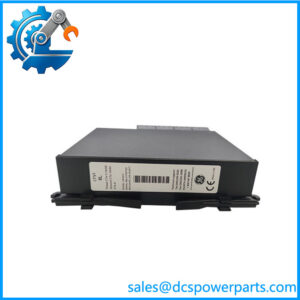
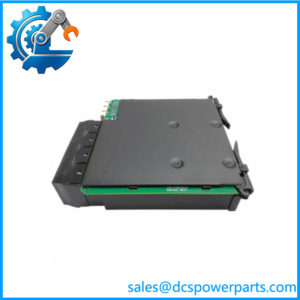
Request photographs of the complete model label, revision, connectors, and option hardware. Ask for functional test results covering all eight outputs, output range, and isolation behavior where applicable.
Q7. What information is needed to confirm compatibility?
Provide the complete board number, VME chassis and processor details, address configuration, required output-isolation option, and application software requirements.
Procurement recommendation: For , the key purchasing decision is the exact suffix and installed option hardware. Confirm those details before ordering, then validate all eight analog channels and their update behavior during commissioning.