Description
Key Technical Specifications
| Parameter | Specification |
|---|---|
| Product Model | BAI20-320 |
| Manufacturer | Aerotech, Inc. |
| Product Family | BA-Intellidrive |
| Product Type | Single-axis servo indexer / amplifier |
| Motor Compatibility | Brush and brushless servo motors |
| Input Voltage | 28–240 VAC |
| Brushless Output Voltage | 40–320 VDC |
| Peak Output Current | 20 A |
| Continuous Output Current | 10 A |
| Peak Output Power | 5,440 W |
| Continuous Output Power | 2,720 W |
| Control Processor | 16-bit 80C166 |
| Controller Clock | 20 MHz |
| Servo Update Rate | 1–4 kHz |
| Communication Interface | RS232 |
| Operating Modes | Indexer, Clock/Direction, Teach |
| Maximum Clock Input Rate | 1 MHz |
| Programmable Inputs | 3 |
| Programmable Outputs | 3 |
| Standard Input | Enable |
| Standard Output | Fault |
| PWM Switching Frequency | 20 kHz |
| Operating Temperature | 0–50°C, family specification |
| Storage Temperature | -30–85°C, family specification |
The electrical ratings are documented in Aerotech’s BA-Intellidrive manual. Some specifications are shared across the BAI10/20/30 family table rather than individually repeated for each model. Confirm the exact input configuration and any special voltage option from the unit’s label before connecting power.
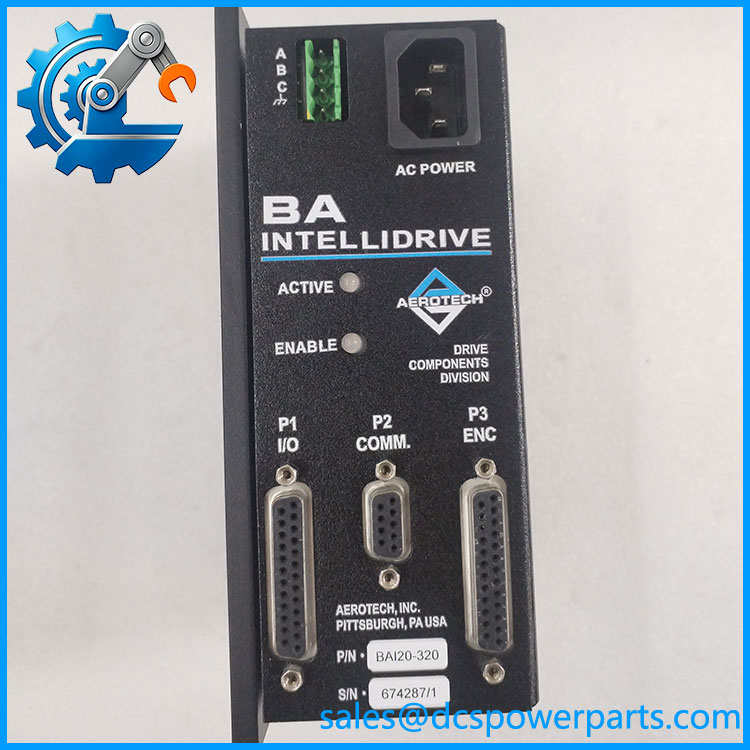
BAI20-320
Product Introduction
Aerotech BAI20-320 BA-Intellidrive Servo Drive
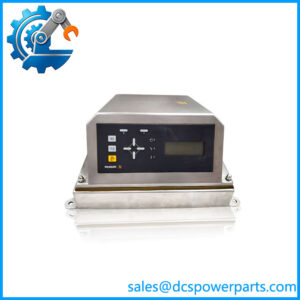
The Aerotech BAI20-320 is a single-axis BA-Intellidrive unit combining a servo amplifier and programmable motion indexer. It supports brush and brushless motor applications, with a 20 A peak and 10 A continuous output-current rating. Its integrated controller provides indexing, clock/direction, and teach operating modes for positioning applications.
RS232 communication allows a PC or PLC to issue motion commands, read status, and configure operating parameters. The integrated indexer can also execute stored motion programs, reducing dependence on a separate motion controller for suitable single-axis applications.
Application Scenarios & Field Pitfalls (Engineer’s Perspective)
A servo axis that loses position, trips during acceleration, or fails to respond to motion commands may have a drive-side problem, but the motor, encoder, limit switches, and external command source must also be investigated. The BAI20-320 integrates the amplifier and motion-control functions, so replacing it requires more than matching the current rating.
Typical application scenarios:
- Precision positioning equipment: Single-axis positioning and indexing for automated machinery.
- Industrial assembly systems: Controlled movement of mechanical stages and tooling.
- Test and inspection equipment: Repeatable positioning sequences using stored motion programs.
- Machine automation retrofits: Replacement of existing BA-Intellidrive units where the original motor and control architecture are retained.
The manual documents indexing, free-running, homing, clock/direction, and teach functions. Actual application suitability depends on motor electrical characteristics and mechanical load requirements.
Field pitfalls to check before installation:
1. Motor and voltage matching: Verify motor type, rated current, winding characteristics, and feedback arrangement. The 20 A peak rating does not mean the drive can continuously deliver 20 A; its documented continuous rating is 10 A. Check the supply configuration and any voltage option before energizing the unit.
2. Encoder and commutation configuration: Confirm encoder resolution, electrical cycles per mechanical revolution, Hall-effect feedback availability, and phase alignment. Incorrect settings can cause unstable motion, position errors, or motor startup faults. The manual provides dedicated parameters for these settings.
3. RS232 setup and stored parameters: Record the baud rate, unit address, communication mode, and motion parameters. The BAI supports local and remote RS232 operation, including ASCII command control from a PC or PLC. Incorrect remote-mode settings can prevent the host from communicating with the drive.
Incoming inspection and testing:
- Inspect motor-power and AC-input terminals for heat damage.
- Check the encoder and I/O connectors for bent pins.
- Inspect the cooling surfaces and internal components for contamination.
- Verify power and amplifier status LEDs.
- Test RS232 communication and read the stored parameter configuration.
- Conduct a controlled motor test with suitable load and safety limits before returning the axis to production.
High-voltage precautions are essential. Isolate the AC supply and allow the DC bus to discharge according to the manufacturer’s procedure before handling power connections.
Related Products
The following models belong to the Aerotech BA-Intellidrive family. They have different current capacities or configurations and are not automatically interchangeable.
- BAI10 — Lower-current BA-Intellidrive model, rated at 10 A peak and 5 A continuous output current. Suitable only when the motor and application requirements fall within its ratings.
- BAI30 — Higher-current family member, rated at 30 A peak and 15 A continuous output current. Requires verification of supply, motor, and mounting compatibility.
- BAI50 — Higher-capacity BA-Intellidrive model rated at 50 A peak and 25 A continuous output current. Its physical and electrical configuration differs from the BAI20.
- BAI20-320-S — Related Aerotech drive designation with a separately listed single-phase input and three-phase output configuration. Do not assume it is electrically identical to the BAI20-320.
Replacement recommendation: For an existing installation, match the exact model and inspect the motor feedback, AC input configuration, stored parameters, and control wiring. A BAI30 or -S should only be considered after a complete electrical and mechanical compatibility review.