Description
Stucke Elektronik SYMAP-F
Product Introduction
A feeder protection relay has to do more than trip on a high current. In a real distribution system, the relay must distinguish between phase faults, earth faults, directional fault conditions, overloads, abnormal voltage, and legitimate switching events while coordinating with upstream and downstream breakers. Stucke SYMAP-F is designed for this role as the feeder-protection variant of the SYMAP digital protection and control platform. Stucke identifies SYMAP®F for feeder protection, including feeder, shore-connection, and bus-tie applications.
The Stucke SYMAP-F platform combines protection, measurement, breaker control, programmable logic, diagnostics, event recording, and communication functions in one device. Its three-microprocessor architecture provides internal supervision, while the common SYMAP hardware platform uses plug-in CT/PT terminal connections and expandable I/O options. For a retrofit, though, the name alone is not enough: CT ratios, VT arrangement, protection functions, communication interfaces, I/O expansion, firmware, and configuration must be matched against the original installation.
Key Technical Specifications
| Parameter | Specification |
|---|---|
| Product Model | SYMAP-F |
| Manufacturer | Stucke Elektronik GmbH |
| Product Series | SYMAP® |
| Product Type | Digital multifunction feeder protection relay |
| Primary Application | Feeder, outgoing circuit, shore connection, bus tie, and switchgear protection |
| System Voltage Range | Intended for low- and medium-voltage protection applications within the SYMAP platform |
| Processor Architecture | Three microprocessors with mutual supervision |
| Phase Current Measurement | 3 × CT inputs for feeder current |
| Ground Current Measurement | 1 × CT input for ground current |
| Feeder Voltage Measurement | 3 × PT inputs |
| Busbar Voltage Measurement | Up to 2 × 3-phase PT groups within the common SYMAP architecture |
| Ground Voltage Measurement | 1 × PT input |
| Overcurrent Protection | ANSI 50/51 |
| Ground-Fault Protection | ANSI 50G/51G or related ground-current functions according to configuration |
| Directional Protection | ANSI 67 / 67G available for applicable feeder configurations |
| Voltage Protection | ANSI 27/59 |
| Frequency Protection | ANSI 81 |
| Breaker Failure | ANSI 50BF |
| Automatic Reclosing | ANSI 79 on applicable configurations |
| Distance Protection | ANSI 21 available for applicable advanced feeder configurations |
| Fault Locator | ANSI 21FL on applicable configurations |
| Event Storage | Up to 5,000 general events |
| Protection Event History | Up to 1,000 protection-function events in the documented advanced feeder configuration |
| Data Recorder | Optional; 6–72 samples, 5–60 s recording period |
| Digital I/O | SYMAP Y-series architecture provides 18 digital inputs and 18 relay outputs; exact installed hardware must be verified |
| Logic | Integrated programmable control logic |
| Communication | Configuration-dependent; SYMAP platform supports serial and network communication options |
| Installation | Switchgear/control-panel mounting |
| Terminal Interface | Rear plug-in terminals |
| Housing | Common SYMAP platform uses compact modular housings; exact housing depends on hardware series |
| Condition | Confirm actual inventory condition and configuration before purchase |
Stucke’s current SYMAP documentation identifies 17 analog CT/PT measurement inputs in the platform: three feeder-current CT inputs, one ground-current CT input, three feeder-voltage PT inputs, two three-phase busbar-voltage groups, and one ground-voltage input. The same platform provides programmable logic, event storage, diagnostics, and expandable I/O.
The advanced feeder-protection documentation specifically records protection-event information including event number, title, timestamp, pickup/trip value, setting value, trip time, and synchronized three-phase voltage/current information. It states that up to 1,000 protection-function events can be retained, while the general SYMAP event history supports up to 5,000 events.
Application Scenarios & Pain Points
Medium-Voltage Feeder Protection
For an industrial MV feeder, the relay normally has to coordinate with multiple upstream and downstream protection devices. SYMAP-F supports phase overcurrent, ground-current, directional functions, voltage supervision, and breaker-related protection so the feeder can be isolated without unnecessarily removing healthy sections of the distribution network.
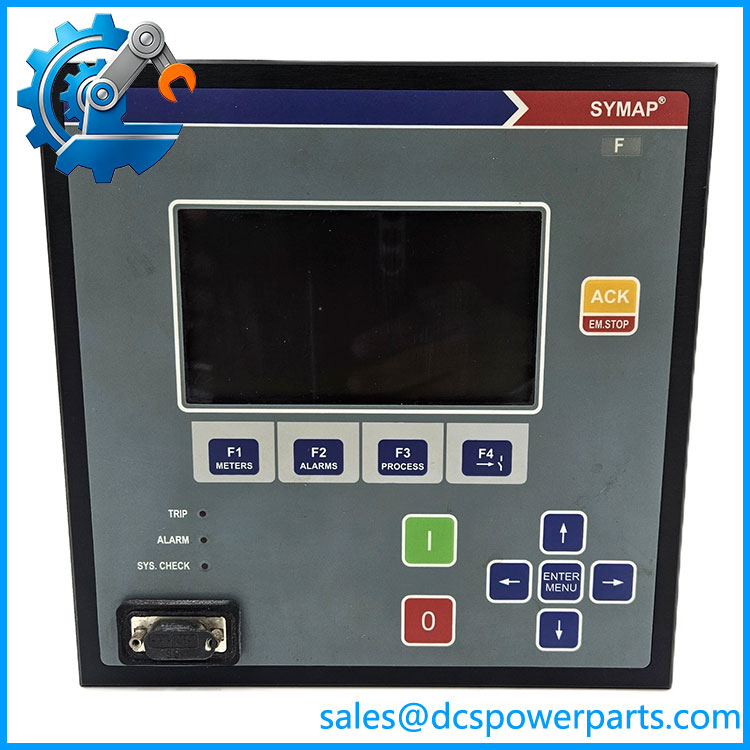
SYMAP-F
Ring and Directional Distribution Networks
Directional protection becomes important when fault current can flow from more than one direction. Stucke specifically lists directional overcurrent and directional ground-current functions for feeder applications, making SYMAP-F applicable to ring or more complicated distribution arrangements.
Shore Connections and Bus Ties
SYMAP-F is also identified by Stucke for shore connections and bus-tie applications. These installations often require more than simple feeder overcurrent protection because switching, voltage supervision, breaker control, and system coordination are part of the operating sequence.
Industrial Process Distribution
A process plant may have feeders supplying motors, transformers, MCCs, and downstream distribution boards. SYMAP-F can provide protection and switchgear control at the feeder bay while communicating measured and calculated values to a higher-level supervisory or power-management system.
Major Features and Engineering Advantages
Feeder-Oriented Protection Functions
The SYMAP-F configuration is intended specifically for feeder protection rather than motor-specific protection. Stucke lists functions including ANSI 50/51 overcurrent, 67 directional overcurrent, 50G/67G ground-current protection, 27/59 voltage protection, 50BF breaker failure, 79 automatic reclosing, and 81 frequency protection. Advanced feeder configurations can also include distance and fault-location functions.
Three-Processor Supervision
The advanced feeder-protection documentation describes three microprocessors that supervise each other through a watchdog arrangement. It also describes redundancy for important functions and an optional independently connected short-circuit protection unit that can operate even when the SYMAP-F supply voltage is lost.
Integrated Measurement Architecture
The common SYMAP platform provides dedicated CT and PT measurement connections for feeder current, ground current, feeder voltage, and busbar voltage. This architecture supports protection calculations and system supervision without requiring a collection of separate measurement relays.
Programmable Control Logic
SYMAP is not limited to protection-element processing. The platform includes programmable logic for control functions, allowing breaker management and interlocking to be implemented within the protection/control architecture. This can reduce external relay logic, but the original application logic must be preserved during a retrofit.
Event and Fault Analysis
SYMAP automatically records protection-related events with time information and relevant pickup/trip data. The optional recorder can capture analog and digital signals around a trigger event, providing useful information when investigating nuisance trips or coordination problems.
Expandable I/O
The SYMAP platform supports extension boards such as CMA 216, CMA 237, CMA 238, and CMA 215. Depending on the hardware configuration, these boards can add digital I/O, analog inputs/outputs, or high-current relay capability. They should be treated as configuration-specific hardware rather than automatically included with every SYMAP-F.
Related Products
- SYMAP-M — Motor protection variant, intended for motor cells and large auxiliary drives rather than general feeder protection.
- SYMAP-G — Generator protection variant.
- SYMAP-T — Transformer protection variant.
- SYMAP-LD — Line differential protection variant.
- SYMAP-D — Distance protection variant.
- SYMAP-ECG — Engine control combined with generator protection.
- SYMAP-BC — Protection/control architecture used for busbar and power-system applications.
- SYMAP-BCG — Power-management and protection configuration.
- SYMAP® Compact+ F3/F4 — More recent feeder protection/control options for compact switchgear applications.
These models belong to the same broader SYMAP family, but they should not be treated as direct replacements simply because they use similar housings or interfaces. Their protection algorithms, measurement requirements, firmware, I/O configuration, and application logic differ.
Engineer’s Guide — Field Pitfalls to Avoid
1. Do not specify a replacement using “SYMAP-F” alone.
This is the most important procurement warning. The actual protection configuration can include different measurement, communications, I/O, and software options. Obtain the complete order code and compare it with the original unit.
2. Check CT and PT configuration before energizing.
The SYMAP platform has multiple CT/PT measurement groups. CT ratio, secondary current, polarity, VT ratio, phase sequence, grounding method, and measurement topology must match the protection study.
3. Directional protection requires correct voltage and current references.
If ANSI 67 or 67G is used, the relay needs the correct phase relationship between voltage and current. A wiring error can produce an incorrect directional decision even when the relay itself is functioning normally.
4. Do not assume every communication option is installed.
The SYMAP family supports multiple communication technologies, but the physical communication hardware depends on the configured unit. Verify the actual ports and protocol before planning a DCS or SCADA integration.
5. Preserve the original breaker logic.
Breaker trip, close, interlock, anti-pumping, remote/local control, and permissive logic may be implemented partly inside the SYMAP configuration. Replacing the hardware without recovering these settings can produce a relay that appears healthy but does not operate correctly in the switchgear sequence.
6. Check automatic-reclose settings carefully.
If ANSI 79 is used, dead time, reclaim time, attempt count, blocking inputs, breaker status, and protection-element blocking logic need to be recovered from the existing engineering documentation.
7. Verify firmware and configuration before field installation.
Two units carrying the SYMAP-F designation may not contain identical firmware or option sets. For a live feeder, configuration compatibility matters just as much as the physical fit.
FAQ
What is the Stucke SYMAP-F used for?
SYMAP-F is the feeder-protection variant of the Stucke SYMAP digital protection and control family. It is intended for feeder, outgoing-circuit, shore-connection, bus-tie, and similar switchgear applications.
Is SYMAP-F a PLC?
No. It is primarily a digital protection and control device. It does include programmable logic and can perform breaker control, interlocking, and related automation functions, but it should not be specified as a general-purpose PLC CPU.
What protection functions does SYMAP-F provide?
The documented feeder application includes phase overcurrent, delayed overcurrent, ground overcurrent, directional overcurrent, directional ground protection, undervoltage, overvoltage, frequency protection, breaker failure, and automatic reclosing. Advanced feeder configurations can add distance protection, fault location, and other functions.
Can SYMAP-F be used in a ring network?
Yes. Directional overcurrent and directional ground-current functions are specifically relevant to ring and other networks where fault current may flow from different directions. The actual directional scheme must be engineered around the CT/PT arrangement and system grounding.
Can SYMAP-F communicate with a DCS or SCADA system?
The SYMAP platform supports integration into higher-level power-management and supervisory systems, with communication options dependent on the hardware configuration. Available platform technologies include serial communications and network/fieldbus options. The exact installed interface should be verified from the unit’s order code and hardware.
What should be checked when buying a replacement SYMAP-F?
At minimum, verify the complete order/configuration code, hardware revision, firmware, supply voltage, CT/PT configuration, protection functions, communication interfaces, I/O expansion boards, terminal arrangement, and original parameter file. For used equipment, also verify the actual physical condition and connector integrity rather than relying on a generic SYMAP-F listing.
Is SYMAP-F interchangeable with SYMAP-M?
No. They are application-specific variants. SYMAP-F is intended for feeder protection, while SYMAP-M is intended for motor protection. Their protection settings and application logic should not be transferred between them without an engineering review.