Description
Product Introduction
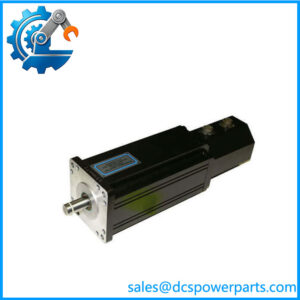
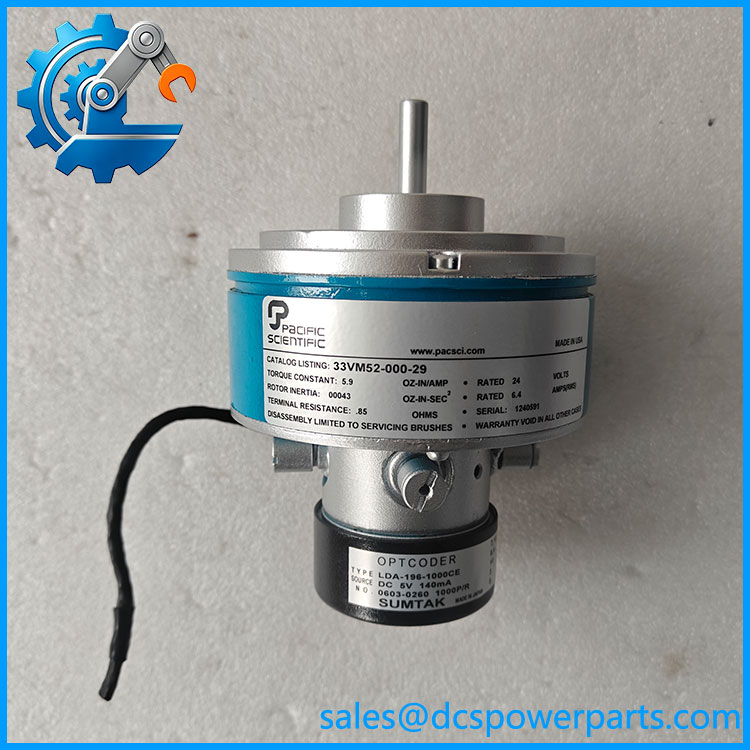
In motion-control equipment, a replacement motor must match the original drive voltage, current demand, shaft dimensions, and feedback arrangement. The Pacific Scientific 33VM52-000-29 is a low-inertia permanent-magnet DC servo motor from the VM series. Its rotor design supports rapid acceleration and deceleration in machinery that requires responsive rotary motion. The motor uses Alnico V-7 magnets and has no provision for forced-air cooling.
The Pacific Scientific 33VM52-000-29 may be considered for maintenance of existing motion-control equipment when its mechanical and electrical characteristics match the installed motor. Before ordering, verify the nameplate, shaft and mounting dimensions, rated current, and feedback hardware. Published current ratings are inconsistent, so do not size a replacement drive from a reseller listing alone.
Key Technical Specifications
| Parameter | Specification |
|---|---|
| Product Model | 33VM52-000-29 |
| Manufacturer | Pacific Scientific |
| Product Type | Low-inertia PMDC servo motor |
| Product Series | VM |
| Motor Technology | Permanent-magnet DC |
| Rated Voltage | 18–36 V DC reported |
| Nominal Operating Voltage | 24 V DC commonly reported; verify nameplate |
| Continuous Current | Conflicting published values: 3.1–5.7 A and 6.4 A |
| Magnet Material | Alnico V-7 |
| Cooling | Natural cooling; no provision for forced-air cooling |
| Analog Tachometer | None attached, according to one specification listing |
| Optical Encoder | None attached, according to one specification listing |
| Shaft Journal Diameter | Approximately 0.281–0.344 in. reported |
| Communication Protocol | Not applicable to the motor itself |
| Operating Temperature | Not verified |
| Protection Rating | Not verified |
| Installation | Mechanical mounting; confirm the original mounting and shaft arrangement |
| Lifecycle Status | Reported discontinued by secondary sources |
Specification caution: The shaft-journal dimension is not necessarily the motor’s complete output-shaft diameter. Confirm the mechanical drawing before coupling the motor to a gearbox, pulley, or load. Speed, torque, and thermal limits should also be verified against the correct motor data.
33VM52-000-29
Application Scenarios and Pain Points
- Precision positioning: Low rotor inertia can support frequent starts, stops, and direction changes when the motor is correctly matched to its drive and load.
- Legacy machine maintenance: Relevant to existing machinery designed around the Pacific Scientific VM-series motor.
- Compact motion systems: PMDC construction may suit applications where the control system provides the required current regulation and motion feedback.
- Replacement of worn motors: Useful when investigating reduced torque, excessive bearing noise, abnormal heating, or inconsistent motion in an existing assembly.
Field note: A low-inertia motor does not guarantee accurate positioning on its own. Position accuracy depends on the drive, feedback device, coupling, load mechanics, and control loop. If the original machine uses an encoder or tachometer mounted separately from the motor, document that arrangement before removing the assembly.
Related Products
These products or identifiers can help with replacement research, but they are not confirmed drop-in substitutes for the 33VM52-000-29.
| Model | Product category | Procurement note |
|---|---|---|
| 33VM52-000-14 | Related Pacific Scientific VM-series motor | Compare suffix, winding characteristics, shaft, and mounting details. |
| 33VM52-020-9 | Related motor model | A secondary catalog marks this model obsolete without a replacement; do not assume equivalence. |
| 2VM62-000-11 | Pacific Scientific motor | Different model designation; verify frame, voltage, and performance. |
| 2VM62-000-8 | Pacific Scientific motor | Related manufacturer family, but electrical and mechanical compatibility are unconfirmed. |
| 61VM82-000-6 | Pacific Scientific motor | Different VM-series designation; compare the full motor specifications before considering substitution. |
Engineer’s Guide: Three Checks Before Replacement
- Confirm electrical matching. Record the motor nameplate voltage and current, then verify the drive’s supported voltage, continuous current, peak current, and current-limiting settings. Resolve the conflicting published current values before commissioning.
- Measure the mechanical interface. Check mounting-hole locations, shaft diameter and length, keyway or coupling arrangement, and allowable load. Do not rely on the model’s frame designation alone.
- Verify feedback and cooling. Determine whether the machine uses an external encoder, tachometer, or another feedback device. Confirm that the installation provides adequate natural convection and stays within the documented thermal limits.
Frequently Asked Questions
Q1: What type of motor is the Pacific Scientific 33VM52-000-29?
It is a low-inertia permanent-magnet DC servo motor from the VM series, designed for applications requiring responsive rotary motion.
Q2: Does it operate at 24 V DC?
Secondary references commonly identify 24 V DC as the nominal voltage and report an 18–36 V DC range. Verify the actual unit’s nameplate and original specifications before applying power.
Q3: What is its rated current?
Published sources disagree. Some list 3.1–5.7 A continuous, while others list 6.4 A. Use the motor’s verified rating rather than selecting a drive based on an unconfirmed listing.
Q4: Does the motor include an encoder?
One specification reference lists no attached optical encoder or analog tachometer. Inspect the physical unit and machine wiring to determine whether feedback is integrated, separately mounted, or absent.
Q5: Can another VM-series motor replace it?
Not solely because it belongs to the same series. Compare voltage, current, torque and speed characteristics, shaft geometry, mounting, and feedback configuration.
Q6: Is the 33VM52-000-29 still manufactured?
Secondary references report it as discontinued. Confirm availability and the condition of any proposed replacement; do not assume that a similar model is an approved successor.
Q7: What should buyers request before purchasing?
Request photographs of the nameplate, shaft, mounting face, connectors, and any attached feedback components. Confirm whether the unit is new old stock, used, or refurbished, and ask for documented inspection or functional test results where available.