Description
Product Overview
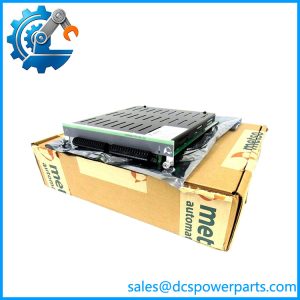
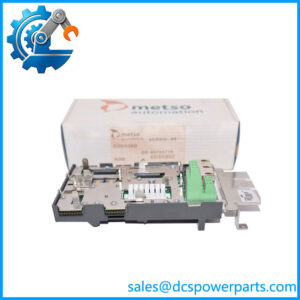
The Metso IOP324 is an analog output module associated with the MaxPAC process automation platform from Metso Automation, now part of Valmet’s industrial automation heritage. Current trade records specifically identify IOP324 as an analog output module, while a BHEL hardware-label drawing produced under technical collaboration with Valmet Automation identifies the corresponding module number as 69230I324A.
In a MaxPAC installation, the Metso IOP324 operates at the I/O layer, converting controller commands into analog signals for field equipment. Depending on the configured application, analog outputs can be used for continuous control references to valves, drives, dampers, positioners, regulators, and other process equipment. The module therefore belongs to the signal-generation side of the control loop rather than the measurement side. This distinction is important when comparing it with nearby MaxPAC designations such as IOP312, which available records identify as an isolated 4–20 mA high-level analog input module, and IOP314, identified as a three-wire RTD module.
The Metso IOP324 should be treated as a system-specific legacy I/O component rather than a generic analog output card. The MaxPAC family contains many closely numbered I/O modules, and the available Valmet/BHEL drawing confirms that IOP324 has its own hardware designation. For replacement work, the complete 69230I324A marking, installed chassis, terminal arrangement, controller configuration, and engineering database should be checked before accepting a substitute.
Technical Specifications
| Parameter | Specification |
|---|---|
| Product Model | IOP324 |
| Module Number | 69230I324A |
| Manufacturer | Metso Automation / Valmet Automation |
| Product Type | Analog output module |
| System Family | MaxPAC |
| Primary Function | Analog process output |
| Signal Direction | Controller to field device |
| System Interface | MaxPAC I/O architecture |
| Communication | MaxPAC system/backplane interface |
| Standalone Ethernet | Not verified |
| Output Signal Range | Verify from hardware documentation |
| Output Channel Count | Verify from exact module documentation |
| Output Isolation | Verify from applicable technical manual |
| Supply Voltage | Verify from system/module documentation |
| Operating Temperature | Not reliably verified |
| Protection Rating | Not reliably verified |
| Output Accuracy | Not reliably verified |
| Installation | MaxPAC I/O system |
| Hardware Identification | 69230I324A |
The 69230I324A identification is particularly useful for procurement. The BHEL/Valmet drawing lists alongside IOP312, IOP313, IOP314 and IOP329, demonstrating that these are distinct module types within the same broader hardware family.
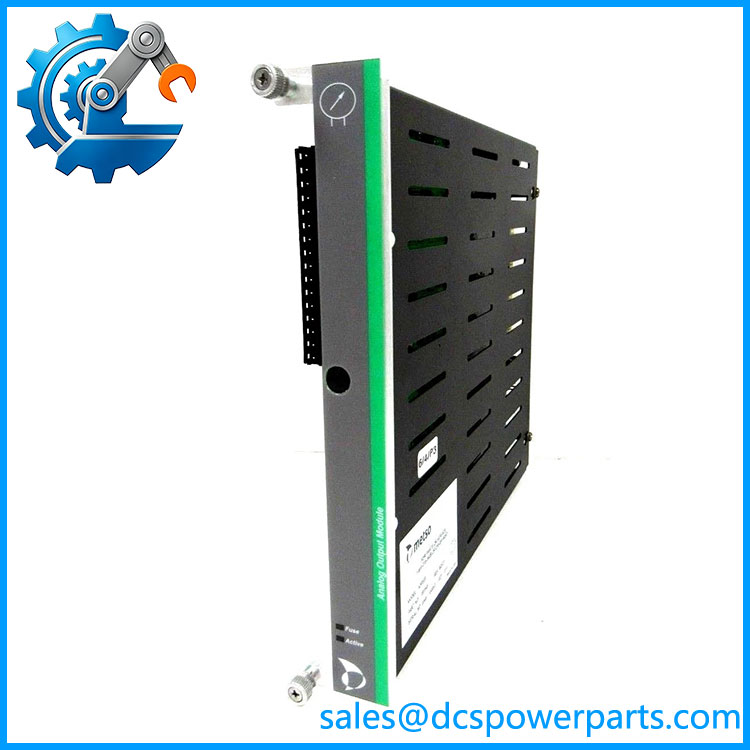
IOP320
Main Features and Engineering Considerations
Analog Output Function
The defining documented function of the is analog output. That means its role is to provide a continuous electrical command from the automation system toward a field device or downstream control interface. Trade documentation repeatedly describes specifically as an analog output module.
MaxPAC Integration
is part of the MaxPAC family rather than a stand-alone universal signal converter. Its operation depends on the associated I/O architecture, controller, chassis, termination hardware, and software configuration.
Do Not Assume the Output Standard
This is the main technical caution for procurement. I found reliable evidence identifying as an analog output module, but I did not find sufficiently strong primary documentation establishing the exact output range, number of channels, output loading specification, isolation rating, or accuracy. A supplier description that simply labels the module “analog output” is not enough to establish whether a particular installation uses 4–20 mA, 0–10 V, another range, or a specific channel configuration.
Legacy Replacement Considerations
Before replacing an installed , compare the complete board marking and revision. The BHEL drawing shows that the hardware family includes multiple IOP variants and multiple revision-specific markings, so visual similarity should not be used as proof of interchangeability.
Configuration Matters
For an operational DCS, review the configured engineering range, output fail state, scaling, control-loop behavior, and associated terminal wiring. A replacement that powers up correctly can still be unsuitable if the field output characteristics or configuration do not match the original installation.
Application Scenarios
- Continuous process-control loops
- Analog actuator commands
- Control-valve positioning
- Drive or speed-reference signals
- Damper and regulator control
- Legacy MaxPAC process automation systems
- Industrial process plants using Metso/Valmet automation hardware
- Replacement of failed MaxPAC analog output modules
Engineer’s Guide: Field Pitfalls
1. Order by the complete identification.
Use / 69230I324A, not simply “MaxPAC analog output card.”
2. Verify the output type.
Do not assume that every installation uses the same current or voltage output range. Confirm against the original system documentation or module-specific manual.
3. Check the terminal assembly.
The module and its termination hardware form part of the signal path. Record the existing terminal arrangement before removing the old card.
4. Preserve controller configuration.
Back up the MaxPAC configuration and document channel scaling, engineering units, output limits, and fail-state behavior before replacement.
5. Compare revision markings.
Photograph the front label and PCB identification. Legacy automation modules can have revision-specific hardware differences that are not obvious from the functional model name.
6. Test the complete loop.
After installation, verify the output at the module and at the field device. A wiring fault or actuator problem can otherwise be mistaken for an I/O-module failure.
Frequently Asked Questions
What is the Metso ?
The is an analog output module associated with Metso Automation’s MaxPAC process automation hardware. Trade records explicitly identify it as an analog output module.
What is the full hardware number?
The documented hardware inscription is 69230I324A, corresponding to type .
Is an analog input module?
No. Available shipment documentation identifies as an analog output module. IOP312, by comparison, is separately identified as an isolated HLAI 4–20 mA input module.
Is interchangeable with IOP312?
No interchangeability should be assumed. Their documented functions are different: is an analog output module, while IOP312 is an isolated high-level analog input module.
What output range does use?
The available sources I could verify establish the analog-output function but do not provide sufficiently reliable primary evidence for the exact output range. The output type should therefore be confirmed from the installed module documentation or original Valmet/Metso engineering records.
Is a standalone Ethernet module?
No standalone Ethernet function was established in the documentation reviewed. It should be treated as a MaxPAC I/O module whose system communication is handled through the associated automation architecture.
Procurement Note
For a replacement purchase, specify Metso/Valmet , 69230I324A and request a photograph of the actual nameplate and board revision. The analog-output identity is supported by current trade records, and the exact / 69230I324A pairing is confirmed by the BHEL/Valmet hardware-label drawing.
I would not publish an exact channel count, 4–20 mA rating, 0–10 V rating, accuracy, or temperature specification for until the original technical documentation is available. Those details are important enough that copying them from another MaxPAC I/O model could create a real replacement-compatibility problem.