Description
Product Overview
Power-supply faults can stop an industrial machine even when its controller, drive electronics, and field wiring remain functional. The KRONES BSAB3000-480T-300C is listed as an AC/DC converter intended for industrial equipment power systems. Its reported 300 VDC output distinguishes it from common 24 VDC control supplies, making voltage compatibility and the connected load especially important during maintenance and replacement.
Available parts information identifies the KRONES BSAB3000-480T-300C as an 8/10 A power supply. A related technical reference for the BSAB3000 power-supply designation describes a three-phase AC input in the 380–480 VAC range and a DC output configurable around 90/300 VDC, with a maximum output current of 10 A. These values are useful reference points, but the exact suffix and installed configuration must be checked before applying them to a specific unit. Do not assume that every BSAB3000 variant has identical input limits, output settings, or protection behavior.
For maintenance teams, the main task is to establish that the replacement matches the original electrical and mechanical configuration. Confirm the complete model code, terminal arrangement, protective-device requirements, output voltage setting, and load-current demand. If the power supply forms part of a larger machine or coordinated drive system, also review the equipment documentation before reconnecting the DC bus. A part that shares the same base model may still differ in suffix, wiring, or operating configuration.
The KRONES BSAB3000-480T-300C is reported as discontinued, so condition and test evidence deserve particular attention. Before installation, inspect the nameplate and terminals, check for damage or corrosion, and request available test records. Where the original unit has failed, investigate the upstream AC supply, fuses, cooling path, and connected load to reduce the risk of damaging the replacement at first power-up.
Product Introduction
A failed DC power stage can interrupt machine operation even when the control electronics are still serviceable. The KRONES BSAB3000-480T-300C is a legacy AC/DC power supply listed with a 300 VDC output and an 8/10 A rating. Verify the original nameplate, output configuration, and connected load before selecting a replacement.
For maintenance of KRONES production equipment, confirm the complete part number and terminal layout before installation. Because the model is reported as discontinued, request condition-specific inspection and test information rather than relying on the model label alone.
Key Technical Specifications
| Parameter | Value |
|---|---|
| Product Model | -480T-300C |
| Manufacturer / Brand | KRONES |
| Product Type | AC/DC power supply converter |
| Application | Industrial machine power systems; exact machine assignment requires confirmation |
| Output Voltage | 300 VDC, as reported in parts listings |
| Output Current | 8/10 A, as reported in parts listings; confirm exact operating rating |
| Input Voltage | Related documentation specifies 380–480 VAC, three-phase plus protective earth; verify against the exact unit |
| Input Frequency | Related documentation specifies 50/60 Hz |
| External Protection | Related documentation specifies three external 6.3 A fuses; verify the exact installation requirements |
| Output Configuration | Related documentation describes a 90/300 VDC output arrangement; verify configuration for this suffix |
| Communication Interface | Not confirmed for this exact model |
| Mounting Method | Confirm from the unit and machine documentation |
| Operating Temperature | Not confirmed for this exact model |
| Protection Rating | Not confirmed |
| Operating Accuracy / Regulation | Not confirmed for this exact model |
| Lifecycle Status | Reported discontinued |
| Condition | Must be confirmed for the individual unit |
Specification note: The detailed electrical figures above are drawn from related documentation, not independently confirmed for every -480T-300C unit. Check the nameplate and the applicable manual before energizing the equipment.
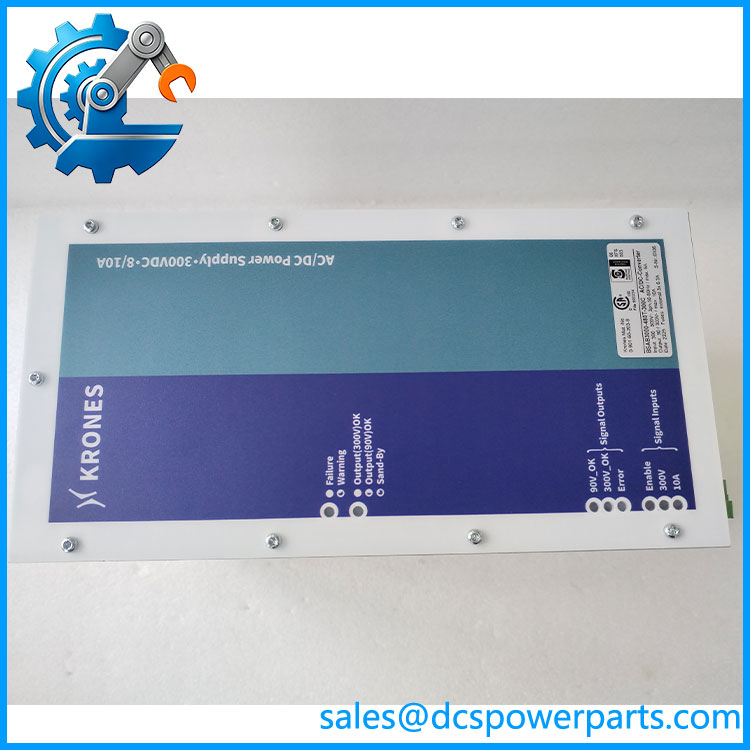
BSAB3000-480T-300C
Related Products and Components
The following items are useful for cross-checking documentation or planning a power-system repair. They are not confirmed direct reps for the .
- -1 — A closely named variant appearing in technical documentation. Compare the complete suffix and nameplate before treating it as interchangeable.
- KRONES power supply assembly — Use the equipment bill of materials and cabinet drawings to confirm the exact assembly designation.
- Three-phase AC input protection — Check the installed fuses and disconnect arrangement against the unit’s applicable manual.
- DC bus capacitors — Inspect the connected DC bus for abnormal capacitance, leakage, or short-circuit faults before reconnecting a replacement supply.
- DC bus discharge circuit — Verify the discharge path and required waiting time before servicing the power section.
- Cooling fan or cooling assembly — Check airflow and fan operation if overheating or thermal shutdown contributed to the original failure.
- Power-supply terminal and cable assembly — Compare conductor sizing, polarity, terminal layout, and protective-earth connections.
- Machine control and monitoring circuit — Confirm that any interlocks, enable signals, and fault feedback operate correctly after power restoration.
Frequently Asked Questions
he KRONES still manufactured?
Parts listings report the model as discontinued. Availability and condition therefore need to be confirmed for each unit; do not assume that a listed item is factory-new or unused.
Can I hot-swap this power supply?
Do not assume hot-swap capability. Treat the unit as a high-voltage power component. Isolate the AC supply, follow the machine’s lockout procedure, verify that the DC bus has discharged, and confirm the manufacturer’s service instructions before removal or installation.
Does this model support a 300 VDC output at 10 A?
Parts listings describe the model as a 300 VDC, 8/10 A AC/DC converter. Related documentation also describes a 300 VDC output and a 10 A rating. Confirm the exact suffix, output setting, and current limit on the installed unit before using these values for system design.
Can I replace it with another model?
Not based on the family name alone. Compare input voltage, phase requirements, output voltage, current capacity, protection, terminal arrangement, mounting, and any machine-specific configuration. A suffix difference can indicate a meaningful hardware or configuration difference.
How can I confirm that a replacement is genuine?
Check the manufacturer and complete model marking on the nameplate, serial or identification labels, connector layout, and physical construction. Request clear label photographs and available inspection or test records. These checks help establish identity and condition but do not, by themselves, prove manufacturing provenance.
Will replacing the unit erase machine settings or programs?
A power-supply replacement does not ordinarily mean that a separate controller’s program must be reloaded, but the result depends on the machine architecture. Record relevant settings and fault history before maintenance, and follow the machine documentation for backup and restart procedures. Do not assume the power supply stores or retains the machine program.
What warranty and testing should I request?
Confirm the warranty period, coverage exclusions, return terms, and whether the warranty is supplied by the original manufacturer or the component supplier. Ask for the specific tests performed, including output-voltage verification under an appropriate load when supported by the test procedure. A visual inspection alone does not establish full electrical functionality.