Description
Product introduction
Industrial control and test systems built around VMEbus hardware can be difficult to maintain when a legacy processor board fails or a replacement has a different hardware revision. The GE Fanuc V7768-322001 is associated with the V7768 single-board computer family, which provides embedded processing for systems that require a VME interface and onboard computing resources.
The V7768 platform uses an Intel processor architecture and supports VMEbus integration, Ethernet networking, serial communications, video output, and PMC expansion. It can serve in industrial control, instrumentation, data acquisition, and process-monitoring equipment. Because the full part-number suffix can represent a specific configuration, verify the processor, memory, installed options, and board revision before treating another V7768 variant as a direct replacement.
Key technical specifications
| Parameter | Available information |
|---|---|
| Product model | V7768-322001 |
| Manufacturer | GE Fanuc Intelligent Platforms; V7768 family later associated with Abaco Systems |
| Product type | VMEbus single-board computer |
| Form factor | 6U VME Eurocard |
| Processor | Intel Core 2 Duo or Celeron M, depending on configuration |
| Maximum processor speed | Up to 2.16 GHz for supported Core 2 Duo configurations |
| Memory | Up to 2 GB DDR2 SDRAM |
| System interface | VMEbus, VITA 1-1994 |
| Network interfaces | Dual Gigabit Ethernet on the documented platform |
| Serial interfaces | RS-232/RS-422 support, configuration and routing dependent |
| Expansion | PCI-X PMC site |
| Video | Front-panel SVGA |
| Operating voltage | Confirm the hardware manual and board configuration; not established for this exact suffix |
| Operating temperature | Confirm the specific hardware revision and ordering configuration |
| Installation | Compatible VME chassis; check system-controller settings and airflow requirements |
| Protection rating | Not established for the exact model |
| Operating accuracy | Not applicable as a standalone computing specification |
The processor, memory, and I/O information above describes the family, not a guaranteed bill of materials for every -322001 unit.
Major features and advantages
- VMEbus integration: Supports legacy embedded systems using the VMEbus architecture and can operate as a system controller or peripheral CPU, depending on configuration.
- Onboard computing: The Intel-based platform provides processing resources for embedded applications that need local execution rather than a separate desktop computer.
- Multiple communication options: Ethernet and serial interfaces support communication with compatible control equipment, diagnostic systems, and external devices.
- PMC expansion: The PCI-X PMC site can support compatible mezzanine hardware, subject to mechanical and electrical requirements.
- Legacy-system maintenance: A matching replacement can help preserve an existing hardware design without immediately redesigning the entire VME-based system.
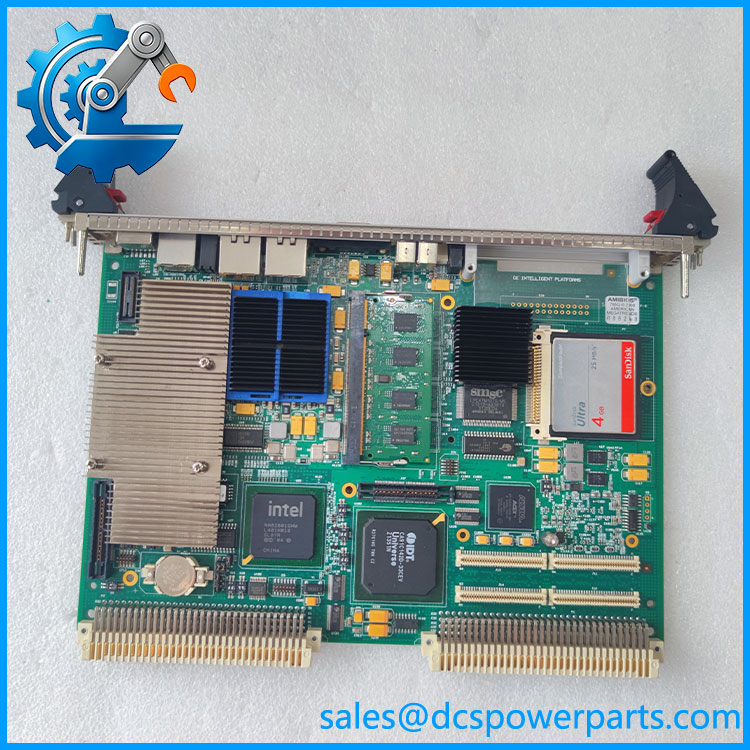
V7768-322001
Application scenarios and common pain points
Typical -family applications include industrial control, process monitoring, instrumentation, automated testing, and data acquisition.
Common maintenance concerns include:
- Boot failure: Check memory seating, BIOS configuration, storage media, and the board’s status indicators.
- Network or serial communication loss: Confirm the interface type, cabling, connector routing, and software configuration.
- VME chassis integration: Verify slot compatibility, system-controller settings, rear transition connections, and cooling airflow.
- Replacement mismatch: Similar family names do not guarantee identical processor, memory, firmware, or expansion configuration.
Related models and hardware
| Model | Relationship |
|---|---|
| -322000 | Related part-number variant; verify configuration differences |
| Base model designation for the VME single-board computer family | |
| V7769 | Related platform with a different physical configuration and mezzanine-board arrangement |
| ACC-0623 | Mezzanine board associated with the V7769 configuration |
| ACC-0602/03RC | Rear transition module referenced for -family systems |
These are related family or platform references, not confirmed drop-in substitutes for -322001.
Engineer’s guide before ordering
- Match the complete part number. Compare -322001 with the label on the installed board, including any assembly number and revision.
- Check the system configuration. Confirm processor type, installed RAM, PMC hardware, rear I/O requirements, BIOS settings, and VME system-controller role.
- Verify condition and testing. For used or refurbished units, request photographs of the actual board label and connectors, confirmation of boot testing, and details of any replaced components.
Important: Do not order based on the family name alone. Confirm that the proposed unit matches the original board’s hardware and software requirements.
Frequently asked questions
What is the GE Fanuc -322001?
It is a part number associated with the GE Fanuc VMEbus single-board computer family. The exact configuration should be confirmed against the physical label.
Is a Mark VIe I/O pack?
The stronger documentation identifies the family as a VME single-board computer, not a Mark VIe I/O pack. Treat descriptions that classify it as a discrete I/O module cautiously.
What processor does it use?
The family supports Intel Core 2 Duo or Celeron M processors, depending on configuration. The exact processor installed on aicular unit must be verified.
Can -322eplace ?
Not without checking the assembly details. The related part numbers may differ in configuration or revision, so confirm compatibility with the equipment manufacturer or system integrator.
What voltage does the board require?
Do not infer a supply voltage from the model number alone. Confirm the applicable hardware manual, chassis requirements, and board documentation before powering it.
Can a used unit be installed directly?
Possibly, if its hardware, BIOS settings, memory, installed options, and software environment match the original. Test it in a controlled maintenance process before returning the host system to service.
What should buyers confirm about availability and lead time?
Ask for the exact part number and assembly revision, actual stock condition, functional-test scope, warranty terms, and estimated dispatch time. Availability and lead time need to be confirmed at quotation.