Description
GE IS200TBAIH1BBB Analog Input Terminal Board
Product Overview
The GE IS200TBAIH1BBB is a TBAI-H1B Analog Input/Output Terminal Board used within the GE Mark VI turbine control platform. Its job is not to perform the primary control computation. Instead, it provides the field-side termination and signal interface between transmitters/analog devices and the Mark VI analog I/O electronics. GE’s hardware documentation describes the TBAI as supporting 10 analog inputs and 2 analog outputs, with the inputs accommodating two-wire, three-wire, four-wire, or externally powered transmitters.
For the original Mark VI architecture, the TBAI works with the VAIC analog input board. A simplex arrangement can use one processor connection, while a TMR configuration uses three connections so the field signals are distributed to the R, S, and T control channels. The board also provides a 24 VDC source for transducers and incorporates signal filtering/noise suppression. The analog input circuits can be configured for current or voltage operation through board jumpers, while the two output circuits support configurable current ranges.
The IS200TBAIH1BBB should therefore be treated as a system-specific termination assembly rather than a generic analog I/O card. The complete part number matters because the H1B hardware revision belongs to an earlier Mark VI configuration. GE documentation explicitly distinguishes TBAIH1B from later TBAIH1C and TBAIS1C revisions and does not identify H1B as a general-purpose Mark VIe or Mark VIeS replacement. For a plant modernization or DCS system upgrade, the installed VAIC/PAIC hardware, terminal-board revision, connector arrangement, and I/O architecture should all be checked before substitution.
Product Introduction
Ten analog inputs and two analog outputs make the TBAI more than a simple termination strip. It provides the field interface, configurable input conditioning, transmitter excitation, and routing required by the Mark VI analog I/O architecture. In TMR installations, the same field signal is distributed to the three control channels rather than being processed through a single board path.
For legacy replacement, the revision is critical. GE identifies TBAIH1B as an earlier board revision associated with VAIC-H1C and earlier configurations, while TBAIH1C is associated with later VAIC-H1D configurations. GE documentation also identifies TBAIH2C as the replacement path for earlier H1A/H1B applications in the applicable architecture.
Key Technical Specifications
| Parameter | Value |
|---|---|
| Product Model | IS200TBAIH1BBB |
| Functional Designation | TBAI-H1B |
| Manufacturer | General Electric |
| Product Family | Mark VI Speedtronic |
| Product Type | Analog Input/Output Terminal Board |
| Analog Inputs | 10 |
| Analog Outputs | 2 |
| Input Device Types | 2-wire, 3-wire, 4-wire, externally powered transmitters |
| Input Signal Types | Current or voltage, depending on channel configuration |
| Input Voltage Options | ±5 VDC / ±10 VDC on applicable channels |
| Input Current Options | 4–20 mA and other documented current configurations |
| Analog Output 1 | 4–20 mA or 0–200 mA, jumper configurable |
| Analog Output 2 | 4–20 mA |
| Transmitter Supply | 24 VDC source provided by the terminal board |
| Processor Interface | Three DC-37 connectors |
| Simplex Operation | Supported |
| TMR Operation | Supported |
| Mark VI Processor | VAIC |
| Field Wiring | Two barrier-type terminal blocks |
| Input/Output Filtering | Noise suppression for surge/high-frequency noise |
| Hardware Revision | H1B |
| Lifecycle Position | Earlier/legacy Mark VI revision |
GE’s hardware guide specifies the TBAI functional capacity and compatibility architecture. Exact electrical limits can vary by channel configuration and connected VAIC/Mark VI hardware, so unsupported blanket values should not be applied to every H1B installation.
Major Features / Practical Advantages
10 analog input channels
The TBAI provides ten analog input circuits for process transmitters. The documented interface accommodates two-wire, three-wire, four-wire, and externally powered transmitters. This makes the board suitable for the mixed transmitter arrangements commonly encountered in turbine control cabinets.
The important point for maintenance engineers is that the board is not simply a passive terminal block. Input conditioning, jumper-selected signal configuration, transmitter power, filtering, and processor routing are all part of the TBAI assembly.
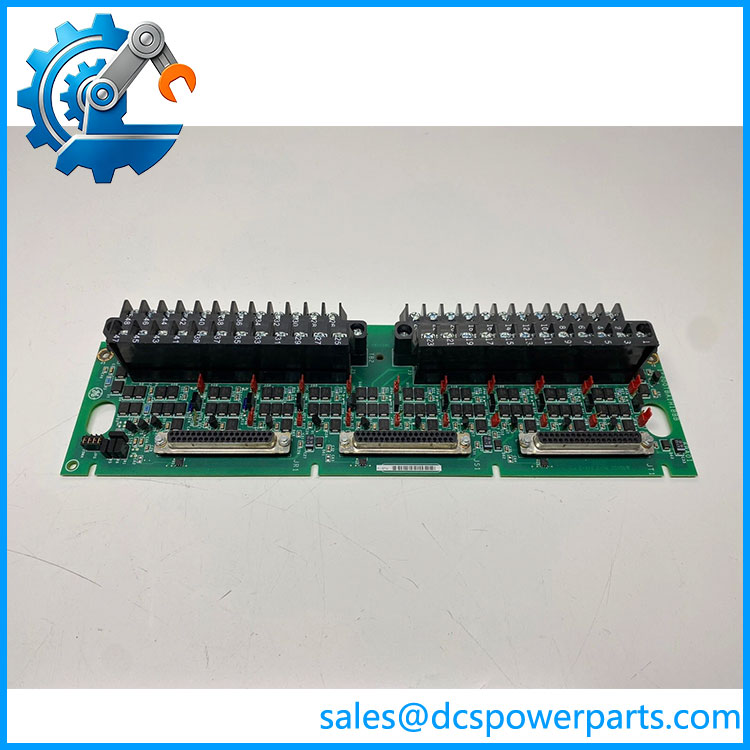
IS200TBAIH1BBB
Two analog output channels
Two analog output circuits are also available. GE documentation states that one output is 4–20 mA, while the other can be configured for either 4–20 mA or 0–200 mA using the appropriate jumper arrangement. This gives the TBAI both input and output capability within the same terminal-board assembly.
The output range should be checked against the actual jumper configuration before commissioning a replacement. Do not assume that every board is wired for the same output range.
24 VDC transmitter supply
The TBAI provides a 24 VDC source for field transmitters/transducers. GE documentation specifies current-limited transmitter power, allowing transmitters to be powered directly from the control system or independently powered when the field architecture requires it.
This is useful during troubleshooting because a failed transmitter loop can involve the terminal-board supply, field wiring, transmitter, or input circuitry. Replacing the board without checking the loop power can simply move the fault from one spare to another.
Simplex and TMR configurations
Three DC-37 processor connectors are provided. Simplex operation uses one processor connection, while TMR operation uses all three. In TMR service, the input signals are fanned to the R, S, and T control channels.
That architecture is one reason the board should not be compared directly with an ordinary PLC analog-input card. The terminal board participates in the physical signal distribution required by the Mark VI redundant turbine-control system.
Noise suppression
The TBAI incorporates noise-suppression circuitry intended to protect the analog signal path from surge and high-frequency interference. GE documentation also describes input common-mode rejection performance associated with the TBAI/VAIC arrangement.
For turbine cabinets, this is practical rather than cosmetic. Field wiring frequently runs near excitation, solenoid, motor, and other electrically noisy circuits.
Jumper-configurable inputs
The input circuits use hardware jumpers to determine current/voltage configuration and applicable loop connections. The output configuration also uses a jumper to select the applicable current range.
A replacement board should therefore be documented against the removed board before installation. Simply transferring wires terminal-for-terminal without recording jumper positions can create a configuration fault even when the replacement board is electrically correct.
Legacy Mark VI compatibility
The H1B revision has a specific place in the Mark VI product family. GE’s hardware guide lists TBAIH1B with the earlier VAIC configuration and distinguishes it from TBAIH1C, TBAIH2C, and the safety-rated TBAIS1C.
This matters during procurement. IS200TBAIH1BBB should not automatically be quoted as a universal replacement for every GE TBAI board. The complete installed system configuration must be matched.
Related Products
- IS200VAICH1C — Mark VI VAIC analog I/O processor associated with earlier TBAI-H1B installations. The TBAI provides the field termination and signal interface for this processor architecture.
- IS200TBAIH1C — Later TBAI hardware revision associated with VAIC-H1D and later applicable configurations. It should not be assumed to have identical interchangeability with H1B without checking the system revision.
- IS200TBAIH2C — TBAI revision documented by GE as the replacement path for earlier TBAIH1A/H1B configurations in the applicable Mark VI architecture.
- IS200TBAIS1C — Safety-certified TBAI revision for Mark VIeS applications. It is a different safety-system hardware configuration, not a casual substitute for H1B.
- IS220PAICH1A — Mark VIe PAIC analog I/O pack used with compatible TBAI terminal-board configurations. It represents a different I/O generation from the original VAIC arrangement.
- IS220PAICH1B — Later Mark VIe analog I/O pack with specified TBAI compatibility. Confirm the exact terminal-board revision before substitution.
- IS200TBTCH1C — Mark VI thermocouple input terminal board for thermocouple/mV signals; it is not an equivalent replacement for the analog TBAI.
- IS200TBCIH1B — Mark VI contact-input terminal board for discrete field contacts, serving a fundamentally different signal type from the TBAI.
FAQ
Can I replace IS200TBAIH1BBB with an IS200TBAIH1C?
Do not treat it as an automatic drop-in replacement. GE’s documentation distinguishes the revisions by their compatible VAIC generations: TBAIH1B is associated with VAICH1C and earlier, while TBAIH1C is associated with VAICH1D and later. The controller, I/O processor, terminal-board revision, and system configuration should be checked together.
What does the TBAI board actually do?
It provides the field termination and analog signal interface for the Mark VI control system. It handles analog inputs, analog outputs, transmitter power, signal conditioning, and routing to the VAIC processors. It is not the main turbine controller.
How many analog channels does have?
The TBAI functional design provides 10 analog inputs and 2 analog outputs. The inputs can accommodate several transmitter arrangements, while the output circuits have configurable current ranges.
Can I hot-swap the ?
Do not assume live removal is permissible merely because the board is a terminal assembly. The Mark VI architecture and plant maintenance procedure determine the appropriate replacement method. De-energization, isolation, turbine operating state, and the associated VAIC connections should be considered before removal.
Does this board support 4–20 mA?
Yes. The TBAI architecture supports 4–20 mA analog input configurations and 4–20 mA analog output operation. One output circuit can also be configured for 0–200 mA where supported by the applicable Mark VI configuration.
Does support ±10 V inputs?
The TBAI documentation includes ±5 VDC and ±10 VDC analog input configurations. The actual channel configuration depends on the installed jumper arrangement, so the replacement board should be matched to the configuration of the removed board.
Does it work with Mark VIe?
The original H1B revision should not be assumed to be a Mark VIe-compatible terminal board. GE’s compatibility table identifies TBAIH1B with the earlier Mark VI VAIC architecture and identifies later TBAI revisions for Mark VIe.
Does it support TMR?
Yes. The TBAI architecture supports both simplex and TMR applications. In TMR service, three processor connections are used and the analog inputs are distributed to the R, S, and T control channels.
Does the board itself contain the turbine control logic?
No. The TBAI is a terminal/interface board. The associated Mark VI analog I/O processor performs the primary electronic I/O processing. In the original Mark VI configuration, the TBAI works with the VAIC processor.
Does this support firmware v3.1?
The part number does not establish a firmware revision. Firmware compatibility belongs to the associated controller/I/O processor architecture and system configuration, not simply the TBAI-H1B terminal-board number.
Procurement Note
When sourcing , quote the complete part number, including the trailing revision characters. The exact suffix matters because GE Mark VI terminal boards exist in multiple hardware revisions with different processor compatibility.
For an installed H1B board, first identify the associated VAIC revision, the simplex/TMR architecture, field signal types, jumper configuration, and whether either analog output is configured for 4–20 mA or 0–200 mA. Photographing the existing board before removal is worthwhile; the jumper positions can be more important than the label when commissioning the replacement.
GE’s own documentation places TBAIH1B in the earlier Mark VI compatibility group and identifies TBAIH2C as the replacement path for earlier TBAIH1A/H1B configurations in the applicable architecture. Later TBAIH1C hardware is associated with VAICH1D and later systems, while TBAIS1C is the safety-certified revision for Mark VIeS. These should be treated as engineering compatibility decisions, not interchangeable suffixes.
For surplus procurement, verify the actual PCB identification, revision markings, connector condition, terminal blocks, jumper positions, and evidence of corrosion or heat damage. A visually clean TBAI board is not proof that every analog channel has been electrically tested.
Bottom line: the is a GE Mark VI TBAI-H1B analog input/output terminal board with 10 analog inputs and 2 analog outputs, intended for the earlier VAIC-based architecture. It is a legacy turbine-control interface board, and complete system compatibility should be established before using it as a replacement for a later TBAI revision.